These four practices bring together the channel map, accurately located acupoints, simple movement, and tuning forks. Each begins with the situation in front of you—not with a universal symptom chart.
The cursor is still blinking, but the last paragraph has been read three times. On a train, the words on a phone begin to swim and the stomach turns. At bedtime, the room is quiet while the mind continues answering messages that no one has sent. After a long afternoon in a chair, the first few steps feel heavier than they should.
The first response in each of these scenes belongs to the scene itself. Bring the mouse closer and let the eyes leave the screen. Put the phone down in a moving vehicle and look toward the horizon. Lower the light before bed. After a long stretch in a chair, stand up and let the calves work again. These changes are part of the practice, not preparations to hurry through: they reduce the demand the body is still answering. Acupressure and sound can then address the tension or unsettled feeling that remains with greater precision.
Four ordinary moments
Change the situation before adding a tool
The first response belongs to the scene itself. Acupressure and sound can work with what remains.

01At the desk
Bring the mouse closer.
Let the eyes leave the screen and the arms hang.

02On the move
Put the phone down.
Give vision a stable distant reference.
03Before sleep
Lower the light.
End the stream of new information.

04After sitting
Stand and move.
Let the calves and ankles work again.
Each routine also carries one small detail from its beginning to its end. Before working with screen tension, turn the head once in each direction; afterward, repeat the same movement. During travel, notice whether the nausea is building, holding steady, or easing, then check again after pressing PC 6. Following a long period of sitting, pay attention to the first few steps and compare them with the steps taken at the end. This modest before-and-after comparison makes the result easier to interpret. It shows what changed, what did not, and whether there is any reason to add another point or another sound.
1. When the Screen Has Pulled the Body Forward
Screen fatigue is rarely caused by “sitting” in the abstract. A distant mouse draws the working elbow from the ribs. A high monitor tilts the chin upward; a low laptop invites the head forward. The desk edge presses into the forearm while the hand repeats hundreds of small movements. By late afternoon, one shoulder may sit higher and turning toward the non-mouse side may reveal a clear stopping point.

No acupoint corrects a badly placed screen. OSHA’s guidance begins with the workstation itself: bring frequently used objects into easy reach, support the feet and back, vary posture, and interrupt long blocks of computer work. Set down the mouse, move the chair back, and let the arms hang.
Turn the head right and left without tipping it backward. Notice the shorter side and where the resistance appears—high in the neck, across the shoulder, or between the shoulder blades. Look across the room for twenty seconds, roll the shoulders up, back, and down three times, open the hands, then walk to the far side of the room and return.
Now use TE 5 · Waiguan · 外关 · Outer Pass. Place the forearm palm-down. Find the dorsal wrist crease, measure 2 B-cun toward the elbow, and settle between the radius and ulna rather than on either bone. Waiguan, “Outer Pass,” lies on the outer, back-facing forearm. The traditional Triple Energizer route travels from the ring finger along the outer arm and shoulder to the side of the neck, ear, and temple. That route explains why TE 5 belongs here.
Routine 1 · Screen work
Desk first, TE 5 second
Correct the reach and interrupt the fixed posture before narrowing attention to one forearm point.
Bring the mouse beside the keyboard, let the eyes leave the screen, support the feet, then turn the head, roll the shoulders, and walk across the room.
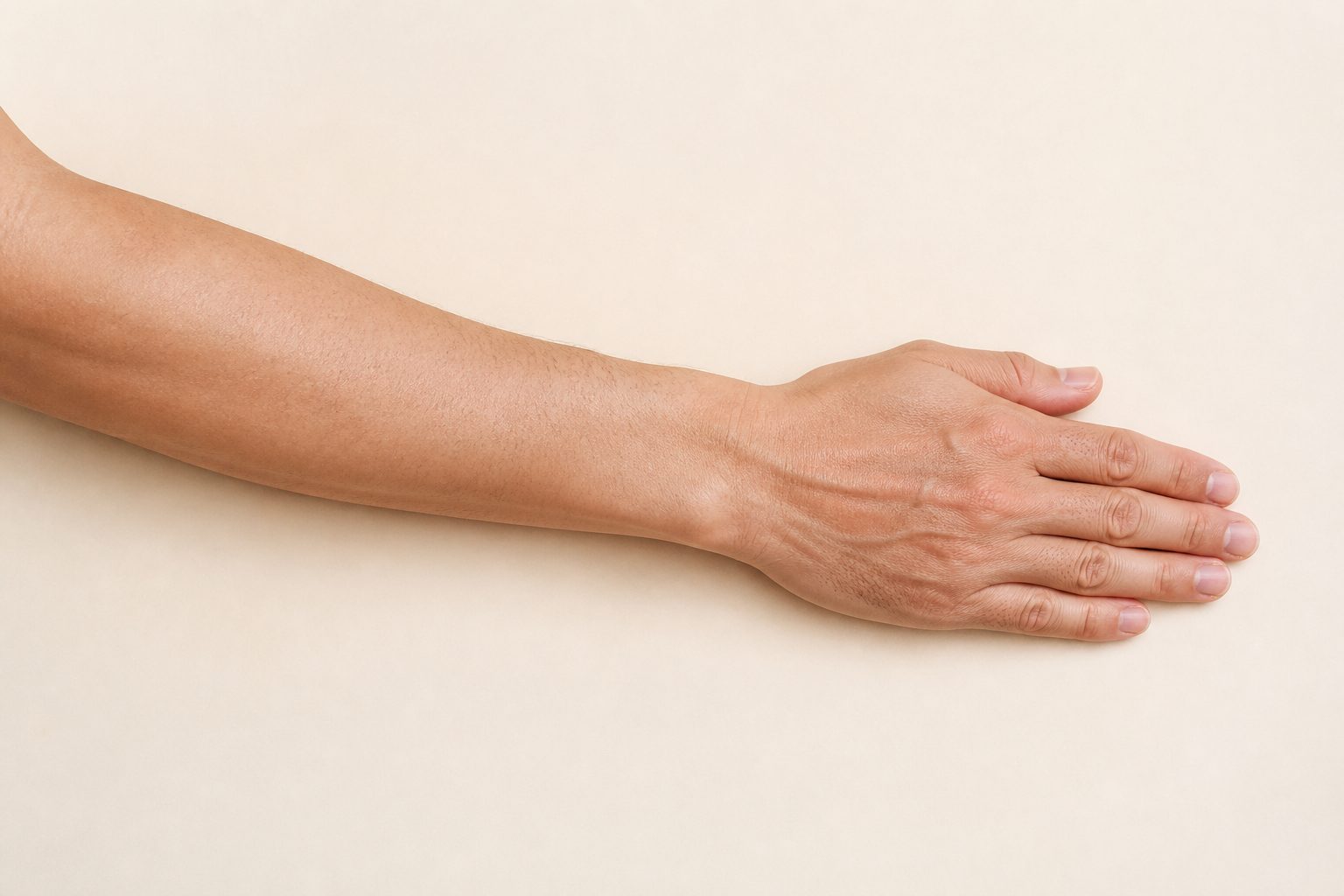 TE 5 · Waiguanbetween radius and ulna 2 B-cun
Outer Pass · 外关
On the posterior forearm, midway between radius and ulna, 2 B-cun proximal to the dorsal wrist crease. Press first; weighted contact is optional.
Point marker follows the WHO standard surface location. The lifestyle photograph does not mark an acupoint.
Press with a finger pad for several easy breaths. If the point is clear and the skin is healthy, activate a weighted fork on the hockey-puck activator and place the flat stem end at TE 5 for one decay on each side. Keep contact on the forearm.
An unweighted fork may finish the pause. Hold it well away from the ear, sound it gently, and let the tone disappear without trying to match the breath to it. Turn the head again and check the shorter side. If the desk is still pulling the body forward, change that before repeating the fork.
2. When Travel or a Meal Leaves the Middle Unsettled
Travel nausea and after-meal discomfort can feel similar, but they begin differently. In a moving vehicle, the inner ear registers acceleration while eyes fixed on a page report apparent stillness. The CDC therefore recommends reducing the conflict: stop reading, face forward, limit unnecessary head movement, and look toward a stable horizon when possible.

After a meal, sit upright rather than folding over a phone, loosen a tight waistband, and choose a slow walk over vigorous movement. In either situation, first note whether the unsettled feeling is mild, moderate, or increasing.
The first point is PC 6 · Neiguan · 内关 · Inner Pass. Turn the palm upward, find the wrist crease, measure 2 B-cun toward the elbow, and locate the space between the palmaris longus and flexor carpi radialis tendons. Flex the wrist briefly to reveal them, then relax. Neiguan, “Inner Pass,” faces Waiguan across the forearm; its traditional route links the inner arm with the chest and upper middle. Hospitals teach P-6 self-acupressure for nausea, and studies cover postoperative and treatment-related settings. Results vary; motion-sickness evidence remains mixed.
Support the forearm and press firmly enough to feel the tendon interval, never hard enough to send tingling into the hand. For travel, PC 6 alone is a complete first round.
For after-meal heaviness, add ST 36 · Zusanli · 足三里 · Leg Three Miles if its location is familiar. From the depression beside the patellar ligament, travel 3 B-cun downward and one finger-width lateral to the tibial crest, onto tibialis anterior. Pulling the toes upward reveals the muscle; relax before pressing. ST 36 is a major Stomach-channel point traditionally associated with digestion, nourishment, and endurance—associations remembered in its old name, “Leg Three Miles.”
Routine 2 · An unsettled middle
Similar sensations, different beginnings
Travel nausea first asks for a stable visual reference. After-meal heaviness asks for space, upright posture, and unhurried movement.
In a moving vehicle
Reduce visual–vestibular conflict first.
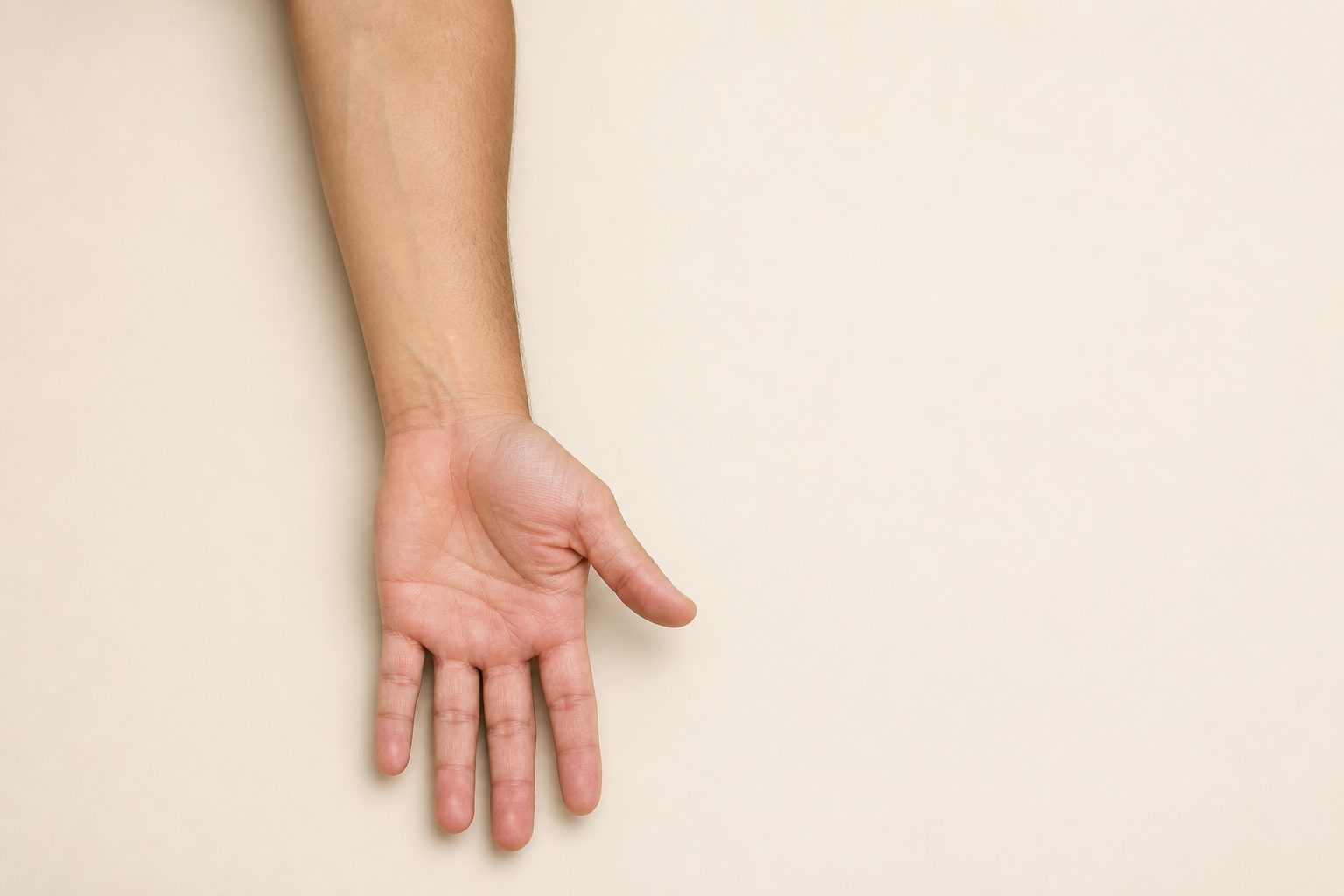 PC 6 · Neiguanbetween the two tendons 2 B-cun
After a meal
Reduce compression and allow gentle movement.
PC 6 · Neiguanbetween the two tendons 2 B-cun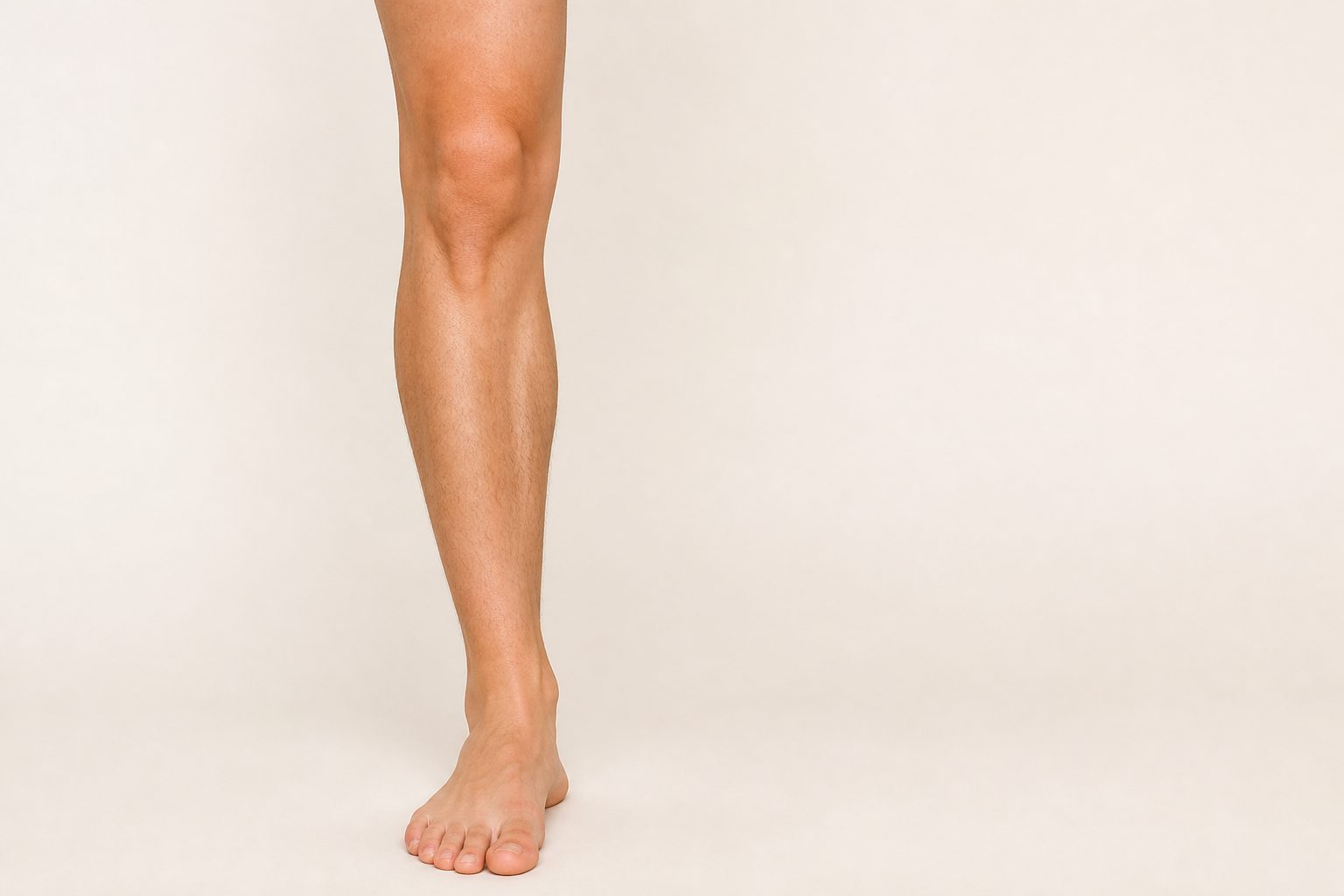 ST 36 · Zusanlion tibialis anterior 3 B-cun
Point markers follow WHO standard surface locations. Lifestyle photographs do not mark acupoints.
Choose PC 6 or ST 36 for the fork rather than moving quickly between both. Apply a weighted 128 Hz fork for one decay on each side. When tactile vibration feels unwelcome—as it sometimes does during nausea—leave the fork off the body and use one quiet unweighted tone, or omit sound altogether.
Check whether the feeling is easing, unchanged, or building. Repeated vomiting, dehydration, faintness, chest pain, severe or persistent abdominal pain, or recurring unexplained nausea requires appropriate care, not a longer sound session.
3. Making an Evening Boundary the Body Can Recognize
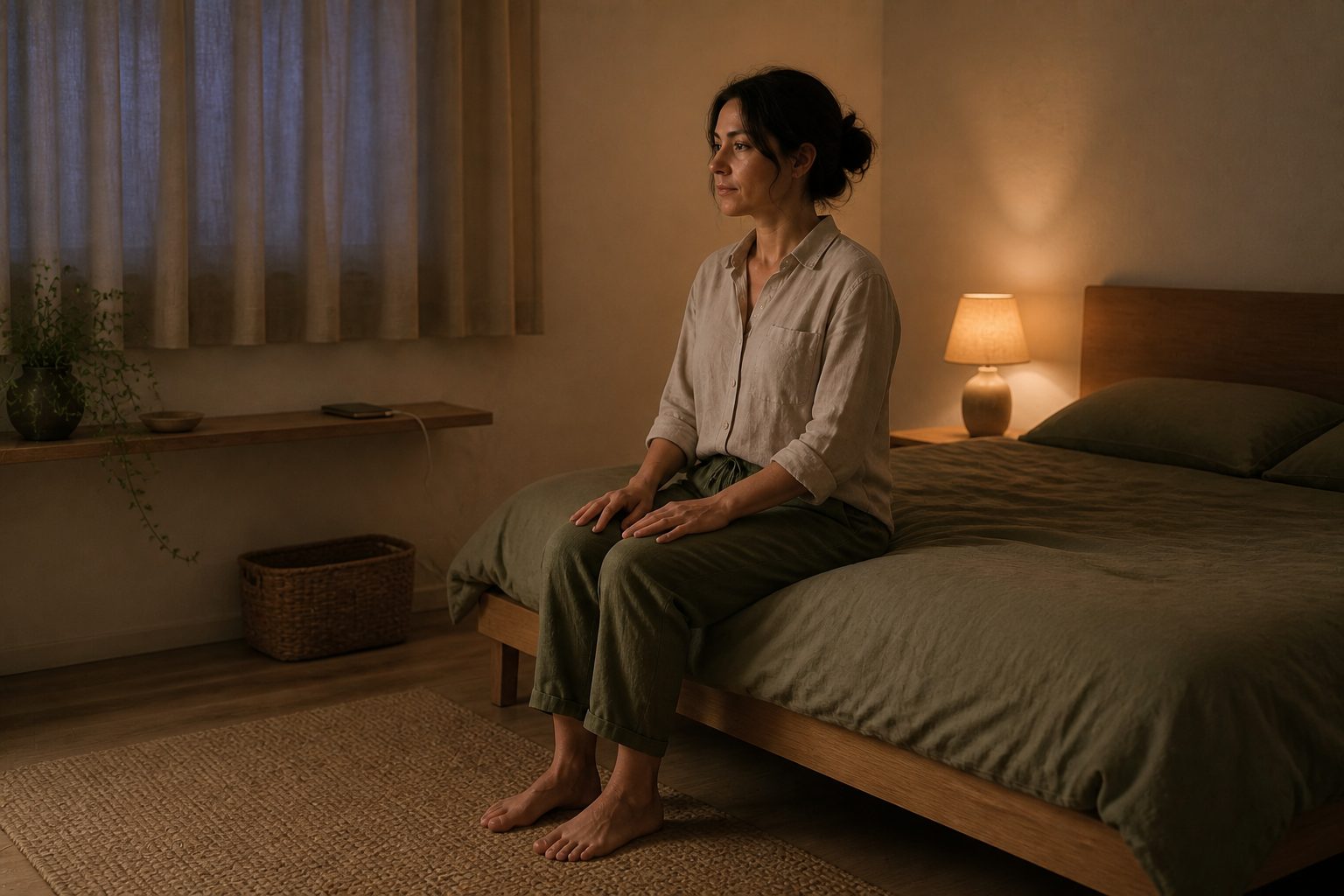
Sleep begins as the evening loses light, activity, and novelty. Electric lighting can extend an indoor twilight long past sunset. In one field study, ordinary home lighting was bright enough to produce substantial predicted melatonin suppression in many participants, though individual sensitivity varied widely. A bright bathroom, an overhead kitchen light, and a phone close to the face all shape the setting in which a bedtime practice must work.
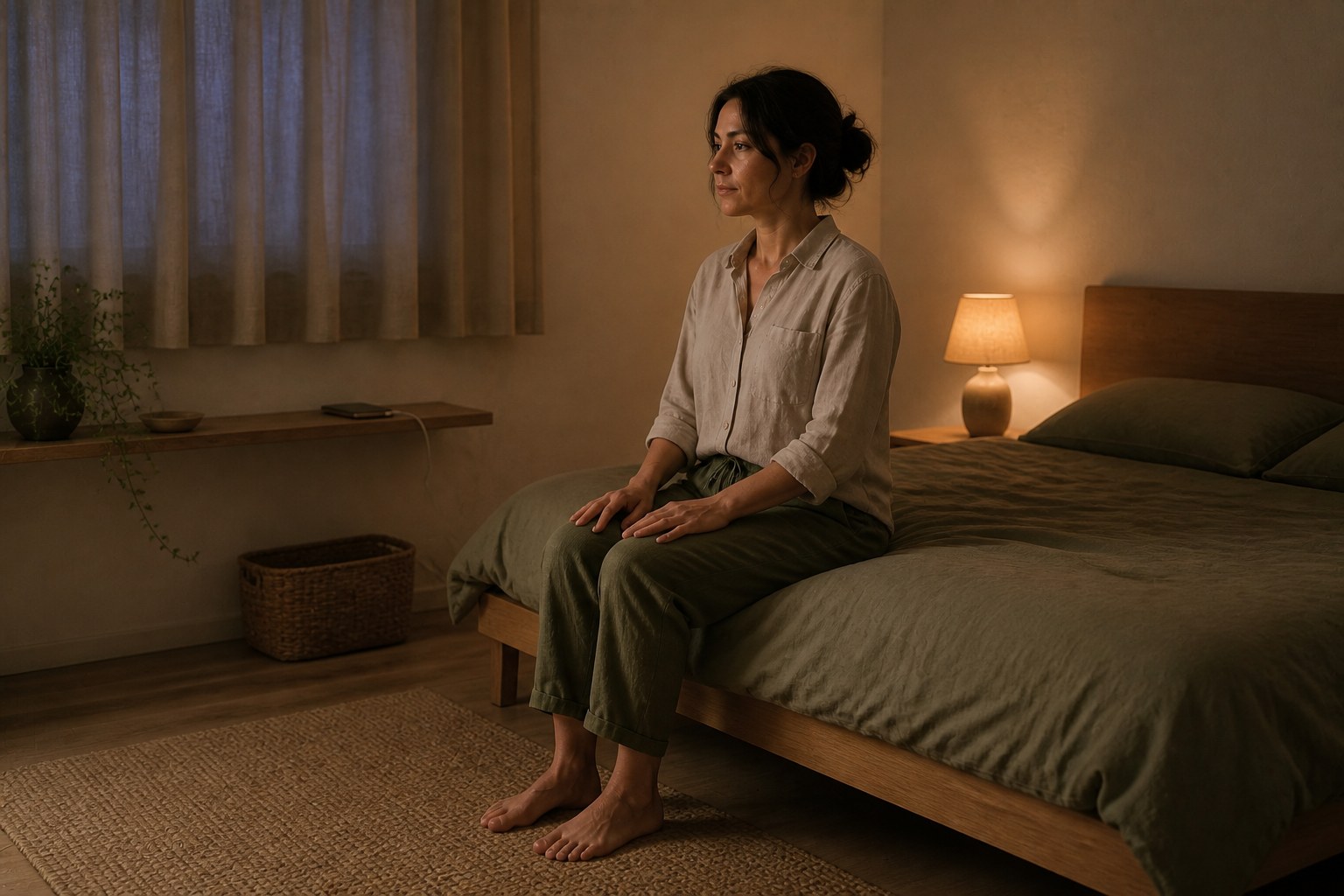
Turn off the brightest overhead light, put the phone on charge beyond arm’s reach, and finish the last small task—fill the water glass, close the curtains—so the next minutes do not keep reopening the day.
Sit on the bed with both feet supported. Unclench the jaw, circle the wrists, spread the toes, and let the exhalation leave without counting it. Notice the height of the shoulders or whether the soles feel warm, cool, or barely noticed.
HT 7 · Shenmen · 神门 · Spirit Gate lies at the little-finger end of the palmar wrist crease, beside the flexor carpi ulnaris tendon near the pisiform. Chinese medicine associates it with shen, the Heart’s language for mental and emotional presence. KI 1 · Yongquan · 涌泉 · Gushing Spring lies in the sole’s depression when the toes curl, one-third of the way from the base of the second and third toes toward the heel. Traditional practice uses it to draw excess activity downward and restore a sense of ground.
Routine 3 · An evening boundary
Lower the light before adding sound
A quiet point practice has to work inside the room that surrounds it. Change that room first.
Turn off the brightest overhead light, place the phone beyond easy reach, support both feet, and finish the last small task.
HT 7 · Shenmenon the crease, radial to FCU HT 7 · Shenmen
Wrist landmark: on the palmar crease, radial to the flexor carpi ulnaris tendon near the pisiform.
Use comfortable thumb pressure or optional weighted contact.
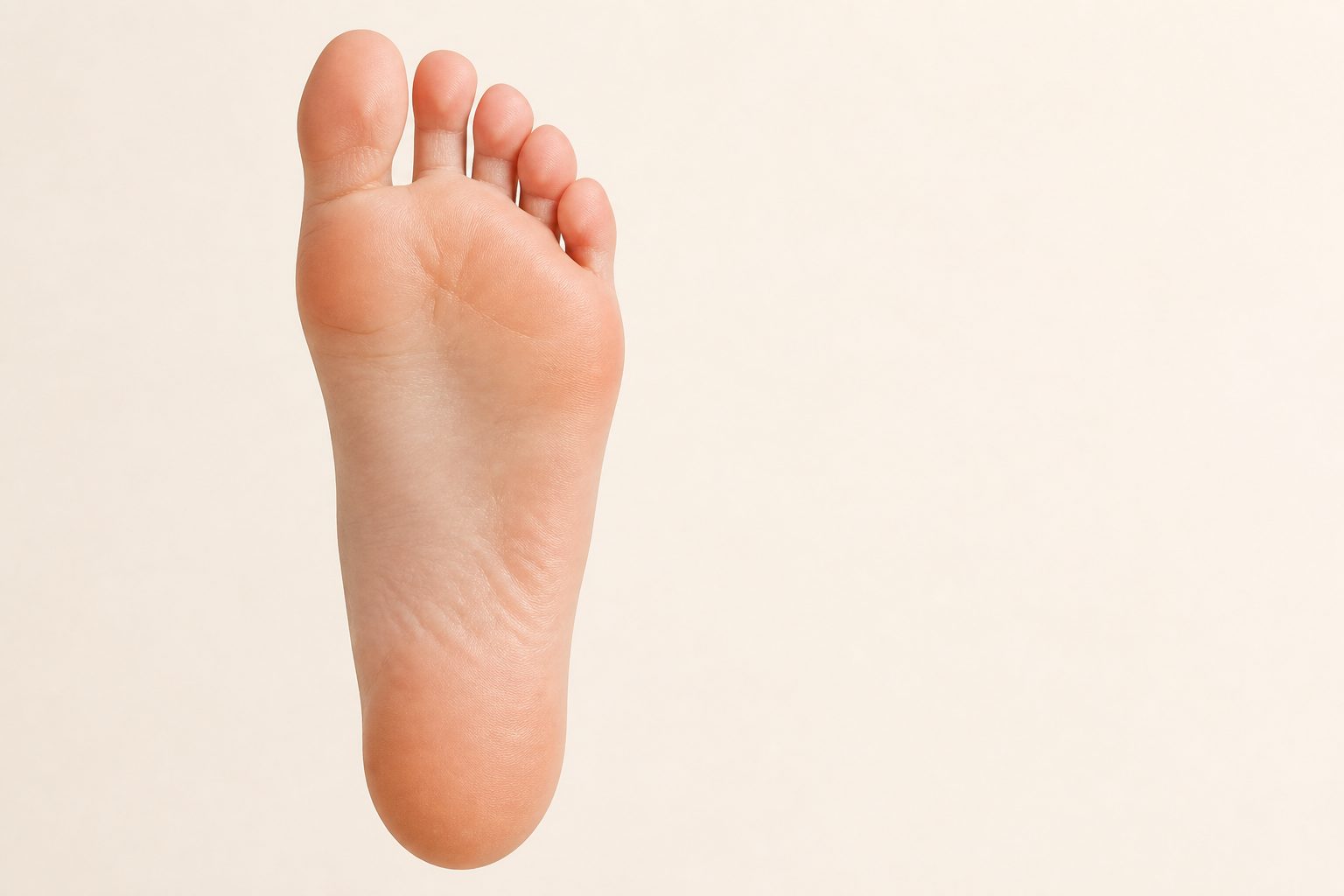 KI 1 · Yongquanfront one-third / back two-thirds
 KI 1 · Yongquan
Sole landmark: the deepest depression when the toes curl, near the front one-third / back two-thirds junction.
Use thumb or soft-ball pressure; sound is optional.
Point markers follow WHO standard surface locations. The lifestyle photograph does not mark an acupoint.
Press HT 7 with the opposite thumb, or roll the sole over a soft ball and pause at KI 1. Thirty seconds is enough. Sleep studies have generally used repeated acupressure sessions over days or weeks, often including HT 7. Familiarity comes through repetition, not force.
Choose one point for weighted contact: KI 1 with the foot securely supported, or HT 7 with the forearm resting and wrist neutral. Use one decay on each side. Put the weighted fork down, sound one unweighted fork, and listen until ordinary room sound takes its place.
Check the same sign again. If the hands have slowed or the shoulders have dropped, end there. The routine has a deliberate boundary: the light lowers, new input stops, the hands or feet receive attention, and one tone finishes.
4. Giving the Legs Their Work Back After Sitting
After hours in a chair, standing alone may not change much. The hips and knees have remained flexed, and the calf muscles—part of the pump that moves blood and fluid from the lower legs—have barely contracted. After eight hours of uninterrupted sitting, researchers measured more lower-leg extracellular water, larger calf and ankle circumference, and poorer blood-flow measures in the foot. In another trial, two minutes of walking every thirty minutes preserved blood flow better than uninterrupted sitting or simply standing.

Movement is the main intervention. With a stable chair nearby, rise onto the balls of the feet six times, sit down and stand up three times without dropping into the seat, then walk for two minutes if space allows. Notice the arm swing, ankle bend, and sensation beneath the soles.
Return to ST 36. After walking, tibialis anterior is easier to identify. Confirm the kneecap, patellar-ligament depression, 3 B-cun distance, tibial crest, and muscle in that order; then press while the leg relaxes. Find KI 1 by curling and releasing the toes. One point lies on the lower leg’s descending Stomach channel; the other opens the Kidney channel at the sole. Sound-healing practitioners may call this grounding or moving stagnation. Here the words refer to visible events: calves contracted, ankles moved, feet met the floor, and weight began to travel through the legs.
Routine 4 · After sitting
Movement leads this routine
Standing still is not the same as asking the calves, ankles, and feet to work again.
Keep a stable chair nearby. Raise both heels slowly, use comfortable sit-to-stands, then walk if space allows.
ST 36 · Zusanlion tibialis anterior 3 B-cunST 36 · Zusanli
3 B-cun below ST 35, on tibialis anterior.
KI 1 · Yongquanfront one-third / back two-thirds KI 1 · Yongquan
Use the curl-toe depression, not the centre of
the sole.
One short round
The numbers are a starting guide, not a target. Stop for pain, dizziness, worsening numbness, or spreading discomfort.
Point markers follow WHO standard surface locations. The lifestyle photograph does not mark an acupoint.
Apply a weighted fork to ST 36 for one decay on each side; use thumb or ball pressure at KI 1. Finish with the same first six steps. Are they more even, the ankles freer, the soles more present? Movement has already supplied the most important part of this routine.
Giving Each Fork One Job
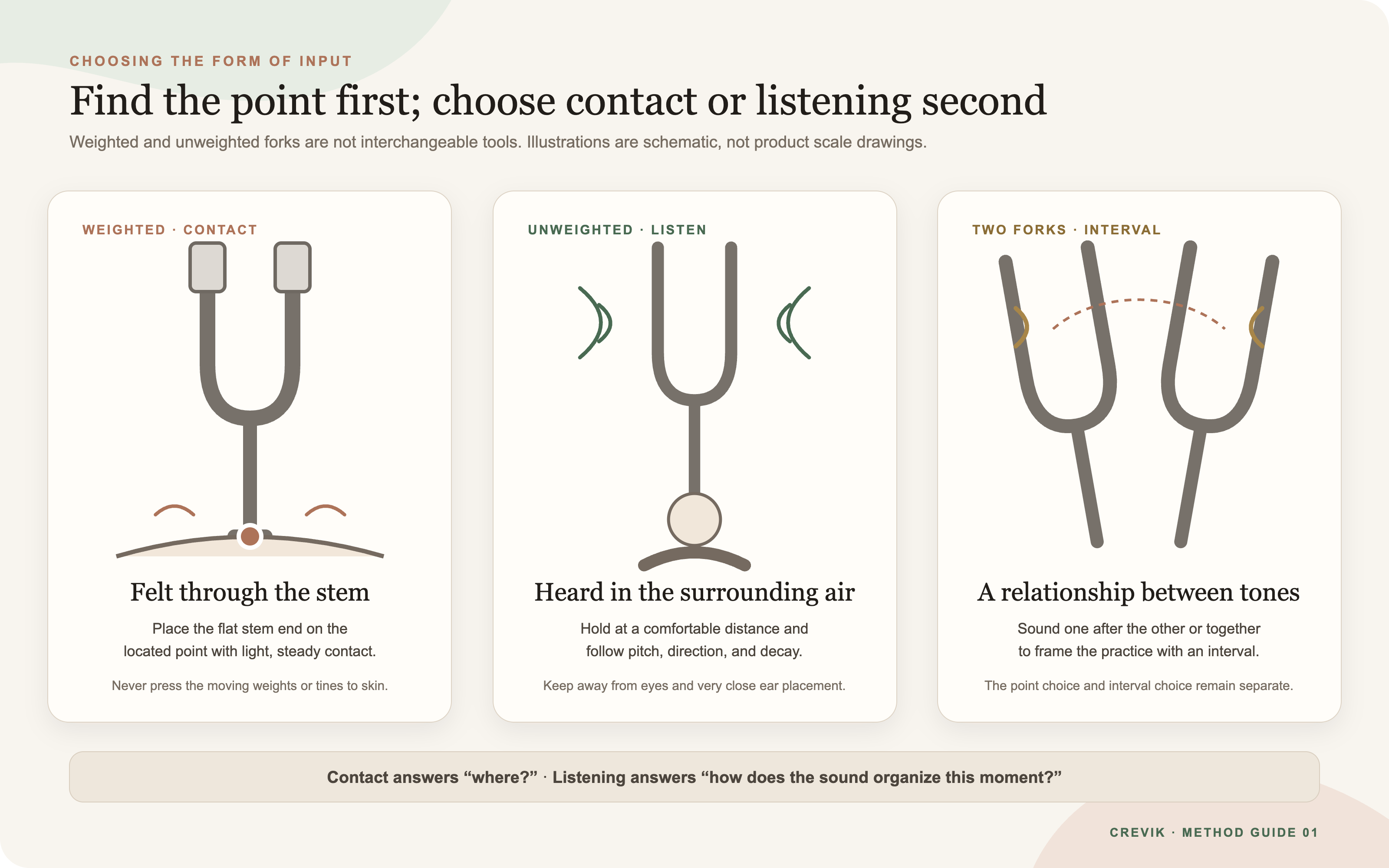
A short routine becomes muddled when every available fork is used. Separate contact from listening.
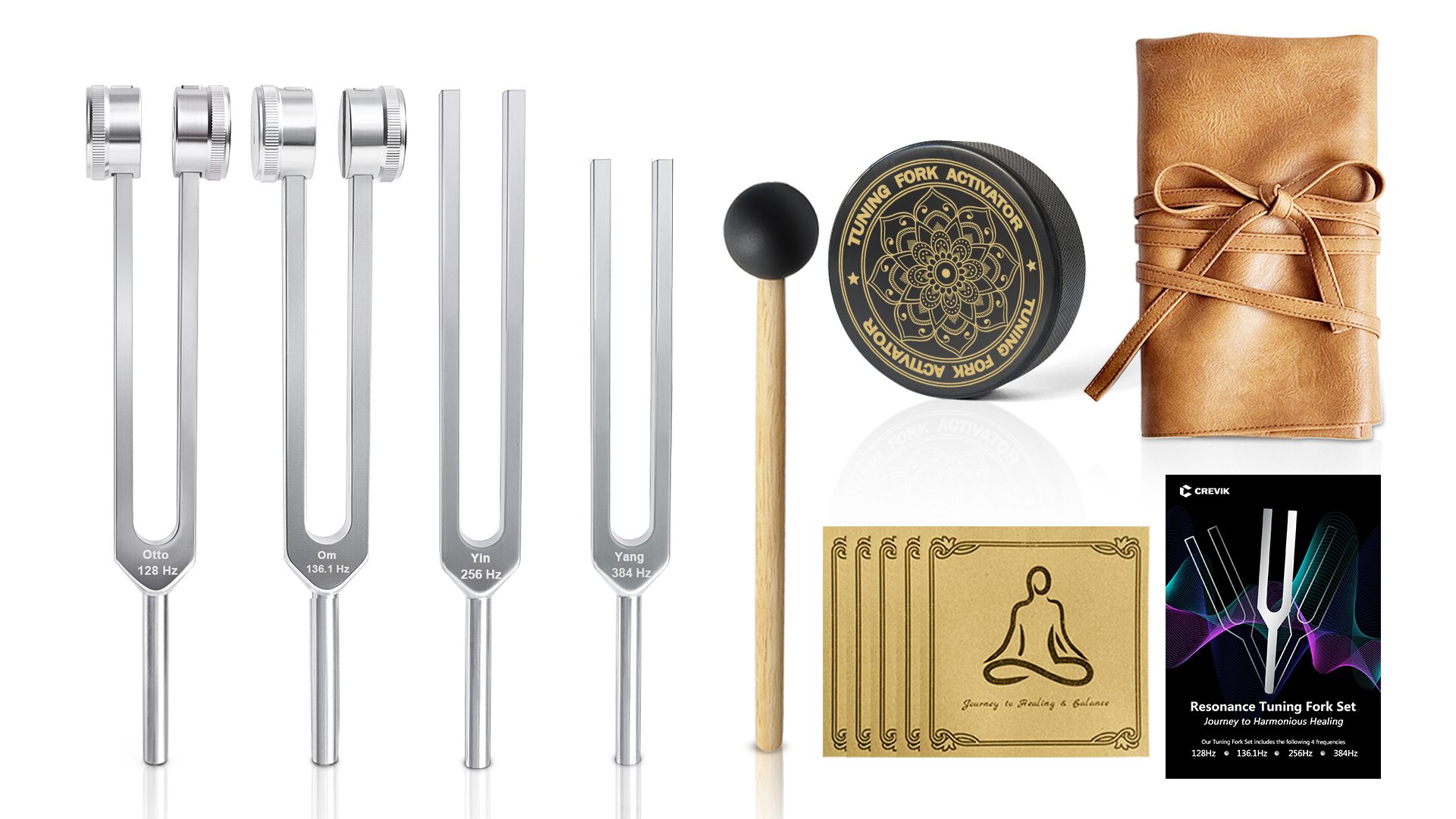
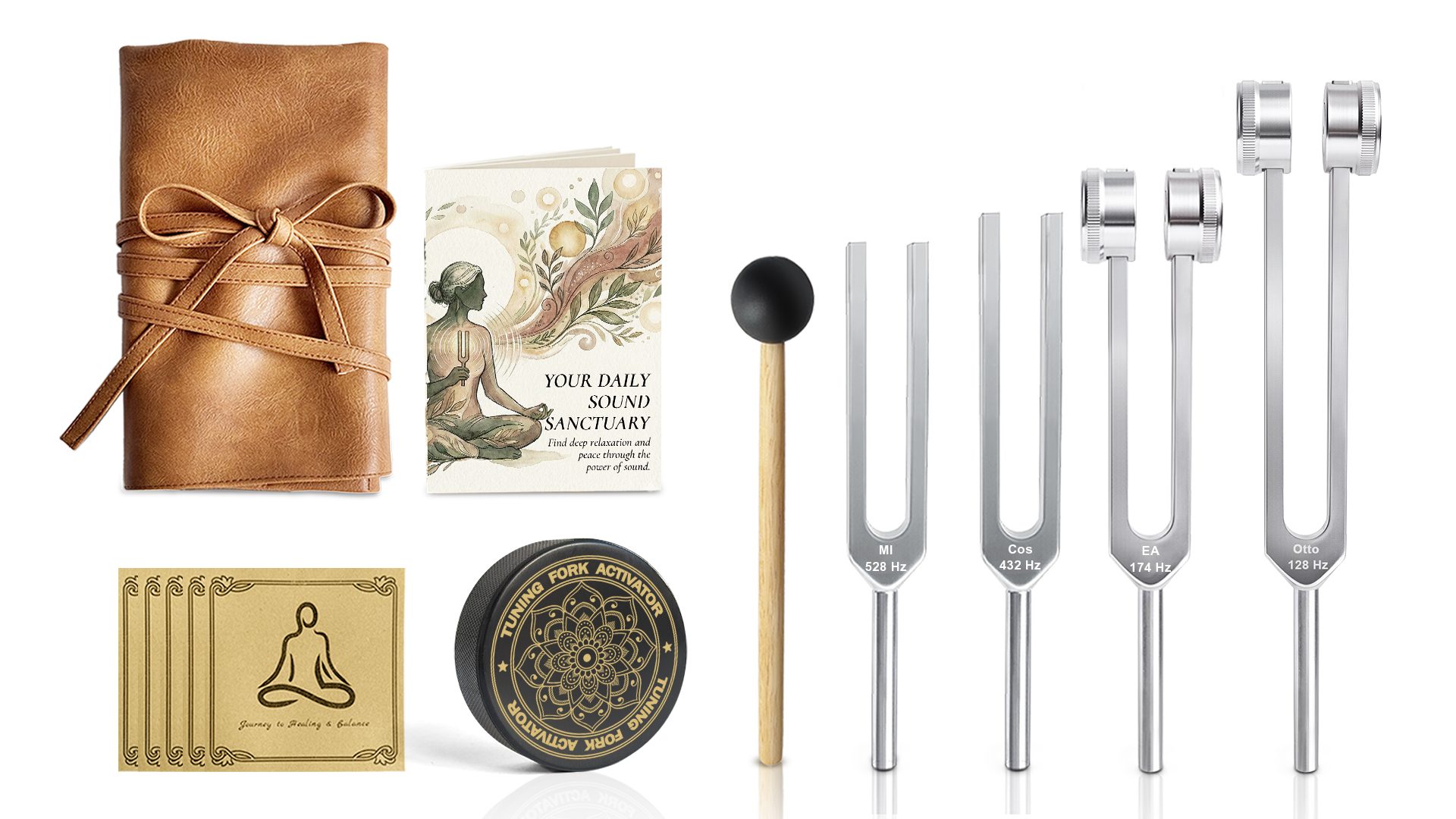
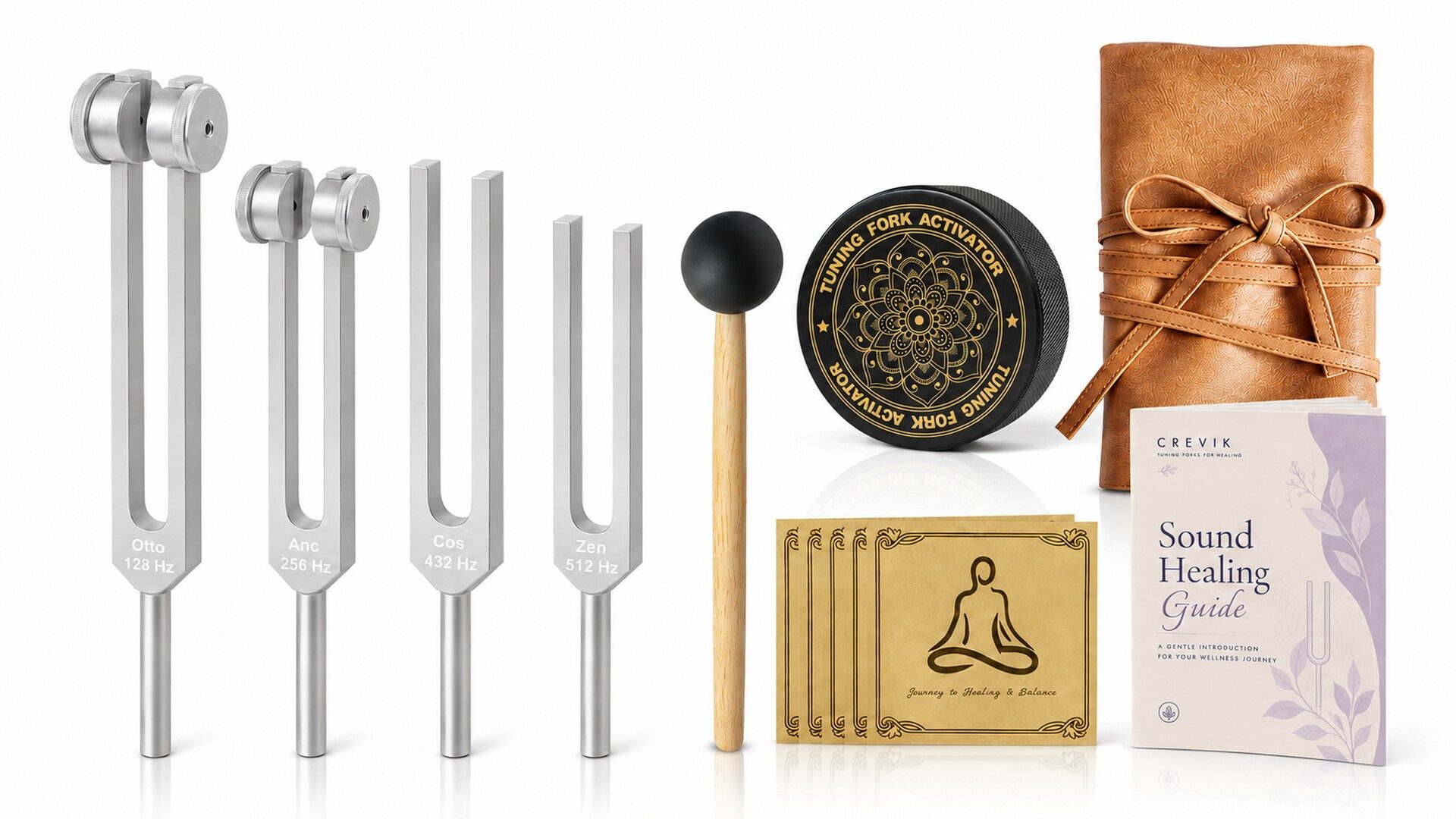
The weighted 128 Hz fork appears in the Alignment, Resonance, and Harmony Sets, making it a consistent contact fork while learning the points. Place its flat stem end on one well-located point, use light steady contact, and wait through one decay. No fixed meridian or symptom correspondence is required.
Explore the other weighted fork—Alignment 256 Hz, Resonance 136.1 Hz, or Harmony 174 Hz—on another day. Keep the method unchanged and compare tactile quality and decay.
Unweighted forks serve audible work: Alignment pairs 432 and 512 Hz, Resonance 256 and 384 Hz, and Harmony 432 and 528 Hz. Use one tone or interval to open or close the practice. It stays away from the ear, and its tines do not touch the body.
Practice safely. Do not apply pressure or contact vibration to broken or irritated skin, an active rash or infection, severe swelling, a numb area, or a site affected by a recent blood clot or injury. Activate the fork on a resilient activator, never on the body or a joint. Keep weighted contact away from the eyes and the front or side of the neck, and stop if pressure or vibration causes sharp pain, dizziness, worsening numbness, or spreading discomfort. During pregnancy, seek qualified guidance before using acupressure protocols; commonly cautioned points include LI 4, SP 6, GB 21, BL 60, and points of the lower abdomen and sacrum. Implanted devices, tumors, recent surgery, and complex medical conditions call for individual advice rather than a generic routine.
The Method Behind the Four Routines
Begin with the room, journey, meal, or work habit shaping the body. Correct what can be corrected there. Move before trying to “move qi” with a tool. Locate one point from actual landmarks, confirm it with comfortable pressure, then decide whether the moment calls for tactile vibration, an audible tone, or neither.
Repeat the first question. Head rotation, the unsettled feeling, shoulder height, foot temperature, or the first six steps cannot diagnose a condition; they can show whether this particular sequence was useful today. A five-minute practice gains depth from knowing why a route was chosen, where the point lies, what movement contributes, and when to stop.
This is the final guide in our four-part introduction to meridians, acupoints, and tuning forks. Begin with the meridian map, continue through the twelve-channel clock, and review how to locate acupoints before applying vibration.
References and Further Reading
- World Health Organization: WHO Standard Acupuncture Point Locations in the Western Pacific Region
- World Health Organization: Standard Acupuncture Nomenclature
- OSHA: Computer Workstations—Work Process and Recognition
- OSHA: Computer Workstations—Desks and Work-Surface Arrangement
- CDC Yellow Book: Motion Sickness
- Memorial Sloan Kettering: Acupressure for Nausea and Vomiting
- Cochrane Review: P6 Stimulation for Preventing Postoperative Nausea and Vomiting
- U.S. Department of Veterans Affairs: Acupressure for Sleep
- Waits et al.: Acupressure and Sleep Quality—Systematic Review and Meta-analysis
- Cain et al.: Evening Home Lighting, the Circadian System, and Sleep
- Morishima et al.: Prolonged Sitting, Lower-Limb Fluid, and Blood Flow
- Peddie et al.: Prolonged Sitting, Standing, and Activity Breaks
- Acutonics: Use and Application of Tuning Forks
- Wakefield and MichelAngelo: Vibrational Acupuncture