A tight band at the base of the skull, pressure at the temples, and heaviness across the face may all be described as a headache. In casual conversation, the location can seem like a secondary detail. In Chinese medicine, it is often the beginning of the inquiry.
The back of the head and neck is crossed by different channel pathways from the side of the head. The cheek, jaw, and area beside the nose belong to still other routes. A practitioner also asks whether the sensation stays in one place or travels, what makes it better or worse, and whether it appears alongside nausea, eye strain, jaw tension, poor sleep, or changes in appetite. The purpose is not to assign every headache to a single line on a chart. It is to understand the symptom as part of a pattern with a location and a direction.
This is the first useful idea to carry into the study of meridians: the map is relational. It connects the surface of the body with movement, sensation, internal functions, and distant treatment sites. An acupoint only makes sense inside those relationships.
The Map Came Before the Point List
The earliest surviving Chinese channel texts do not contain the system seen on a modern acupuncture chart. Two silk manuscripts excavated from Mawangdui Tomb 3, sealed in 168 BCE, describe eleven mai—vessels or pathways—with names, courses, and associated disorders. They discuss moxibustion, but not the familiar twelve-channel circuit with hundreds of numbered points.
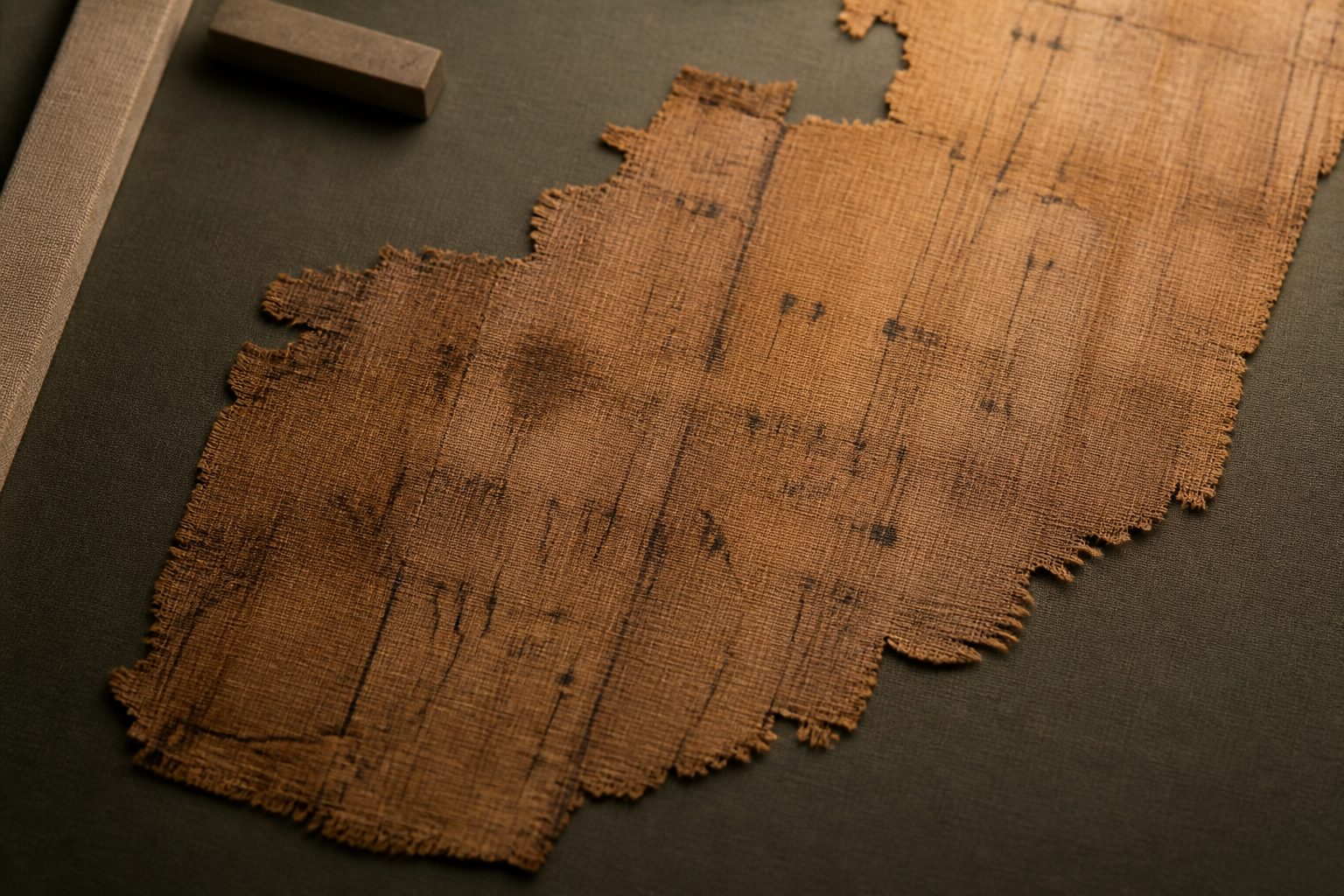
They show a medical map in development: bodily paths were being organized before the system acquired its later number, sequence, and point structure. Research on the Mawangdui vessel texts and early moxibustion cautions against the story that one physician discovered the meridians exactly as they are taught today.
The developed framework appears in the Huangdi Neijing, or Yellow Emperor’s Inner Classic. Despite its title, it was not written by the legendary Yellow Emperor or composed by one author at one moment. Its materials accumulated over a long period and continued to be edited by later scholars.
Much of the work takes the form of conversations. Huangdi asks questions; physicians and advisers—most famously Qibo—answer them. The dialogue moves among climate, diet, emotion, pulse diagnosis, anatomy, channels, and needling. A principle may be stated, qualified, or contradicted elsewhere, so isolated quotations can sound more final than the collection actually is.
The received work is mainly divided into the Suwen (Basic Questions) and the Lingshu (Spiritual Pivot). Roughly speaking, the Suwen develops the larger theoretical world of yin–yang, seasonal change, zang–fu functions, diagnosis, and health cultivation. The Lingshu gives sustained attention to channels, blood and qi, needling, and treatment. Its Jingmai chapter sets out the continuous sequence of twelve primary channels still taught today.
The Neijing did not finish the map. Later physicians interpreted its routes and debated point locations. In the eleventh century, the Northern Song court sponsored illustrated standards and life-size bronze acupuncture figures for teaching and examination. In the twentieth century, international meetings addressed the need for practitioners using different languages to identify the same point.
The result was modern nomenclature for the twelve primary channels, the Governing and Conception vessels, and the 361 classical points on those fourteen routes. The World Health Organization’s standard did not create the points; it created a shared index across languages and medical traditions.
A map assembled over time
Four historical layers
The evidence shows a developing medical language rather than one completed chart appearing at a single moment.
Eleven named mai, described through routes, disorders, and moxibustion.
The twelve primary channels form a continuous circuit and a richer treatment system.
Illustrated standards and bronze figures make point location teachable and examinable.
International standards align names, codes, and surface locations across languages.
What a Channel Map Describes
The term jingluo combines two levels of a network. Jing refers to the main longitudinal routes; luo to connecting branches. “Meridian” remains common in English and appears in WHO names, while many practitioners prefer “channel.” Both refer to the same Chinese medical framework.
A channel diagram contains at least three kinds of information.
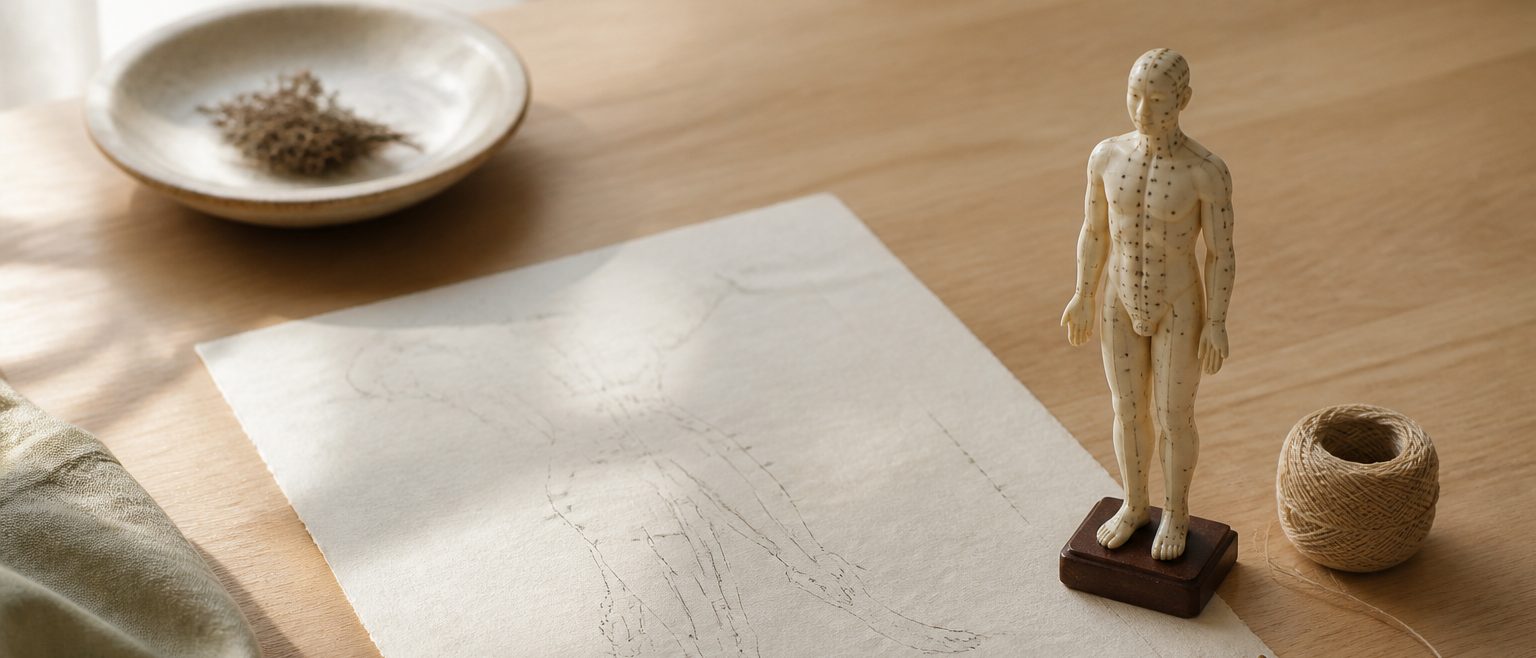
First, it shows a surface route. The Lung channel reaches the thumb side of the arm; the Gallbladder crosses the side of the head and body; the Bladder travels over the head and down the back. These routes help describe where a sensation appears and spreads.
Second, it records functional relationships. A capitalized Chinese-medicine Lung, Spleen, Liver, or Kidney is not identical to the anatomical organ sharing its English name. The Lung includes respiration as well as traditional relationships with the skin, voice, fluids, and movement of qi; the Spleen includes digestive transformation and nourishment.
Third, it supports treatment at a distance. A hand point may be selected for the face; an ankle point may be used when its channel passes through the back or head. Relating one region to another is central to the model.
One map · three kinds of information
What a channel diagram is carrying
The visible line is only one part of the model.

Surface route
A practical summary of where a channel travels across the body.
Functional relationships
Capitalized organ names gather functions beyond the anatomical organ.
Treatment relationships
A point can be selected for a distant region connected through the channel framework.
Concept guide only: it does not replace an anatomical route or point-location chart.
Channel routes overlap nerves, vessels, muscles, fascia, and connective-tissue planes in many places, and researchers study several of these as possible mechanisms of acupoint stimulation. No single structure reproduces the complete traditional map. A meridian is a historical clinical model that uses anatomy without reducing to one anatomical tube.
Note: the system is larger than twelve channels. The twelve primary channels are the main teaching circuit, not the whole network. Chinese medicine also describes connecting vessels, channel sinews, divergent channels, cutaneous regions, and the eight extraordinary vessels. The Governing Vessel and Conception Vessel have their own point sequences; the other extraordinary vessels work through points located on the primary channels. We will return to these layers after the twelve-channel circuit is clear.
Five Terms That Make the Map Easier to Read
Qi is often translated as “energy,” but the English word is narrower than its uses in Chinese medicine. Qi can describe breath, warmth, movement, protection, nourishment, or functional capacity. It is more useful to ask whether qi is ascending, descending, circulating, gathering, or becoming constrained than to picture an invisible fluid.
Blood, or xue, includes actual blood but also belongs to a wider language of circulation, nourishment, menstruation, sleep, and mental steadiness. Classical discussions frequently pair blood with qi: nourishment must also be moved.
Zang–fu names the paired internal systems associated with the primary channels. Zang systems are described as storing and regulating; fu systems as receiving, transforming, and transmitting. Their familiar organ translations are useful labels, not exact physiological equivalents.
Yin and yang describe relationships rather than substances: inner and outer, rest and activity, coolness and warmth, storage and movement. The twelve primary channels comprise six yin and six yang routes arranged in pairs.
Acupoints, or shuxue, are specific sites where a channel can be assessed or stimulated. Some lie near a symptom; others are distant points on its route, meeting points, or members of categories such as source, connecting, back-shu, and front-mu. A traditional point name aids memory but is not a complete statement of function.
Reading One Modern Point Name
Consider PC 6 (Neiguan, 内关, “Inner Pass”).
PC is the WHO code for the Pericardium Meridian, or Hand Jueyin Pericardium channel. The number 6 identifies the sixth point in its standard sequence. Neiguan is the pinyin name, and “Inner Pass” a common English translation. These are four identifiers for one point.
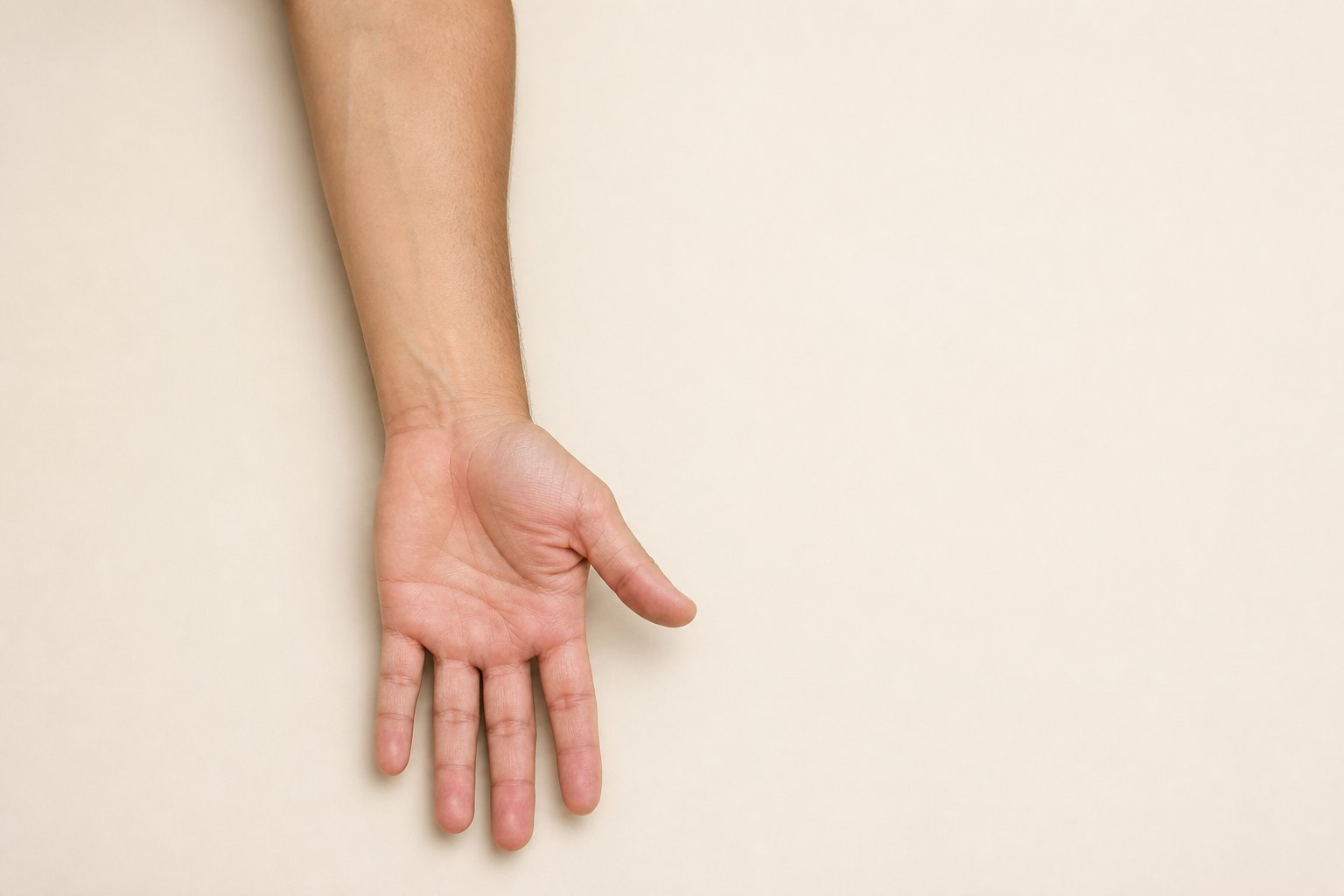
PC 6 is located on the inner forearm, 2 B-cun above the palmar wrist crease, between the tendons of palmaris longus and flexor carpi radialis. A B-cun is a proportional body unit, not a fixed centimeter or English inch. For home acupressure, three fingers of the opposite hand provide an approximation; formal location uses anatomical landmarks and proportional measurement.
PC 6 · Neiguan · Inner Pass
Locate from the wrist, then confirm the interval
Begin with a fixed crease, measure proximally, and use the tendon interval to check the location.
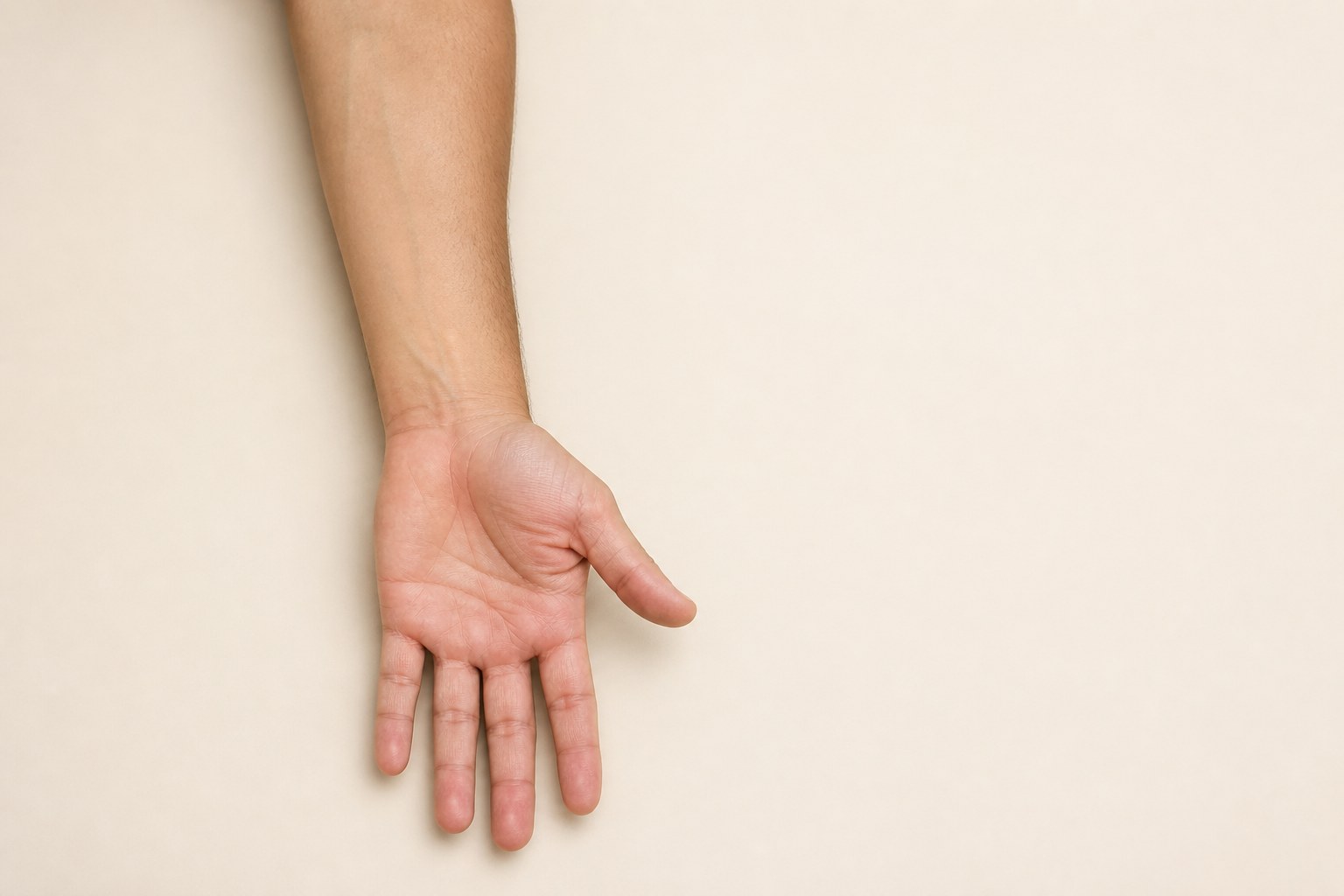 PC 6 · Neiguan between the two central tendons 2 B-cun
Use the main crease where the palm meets the forearm.
For home acupressure, three finger breadths give an approximation—not a universal ruler.
PC 6 lies between palmaris longus and flexor carpi radialis. Some people do not have a palpable palmaris longus.
Traditional point theory relates PC 6 to the Pericardium channel, the chest, and the regulation of the middle of the body. It is also one of the best-known acupressure points in Western patient education for nausea. Memorial Sloan Kettering’s PC 6 self-acupressure guide uses the wrist crease, three-finger measure, and the space between the two forearm tendons to help patients locate it.
A First Practice: Location Before Frequency
This practice teaches one point accurately. It works with the fingers alone; add a weighted fork only after locating the point comfortably.
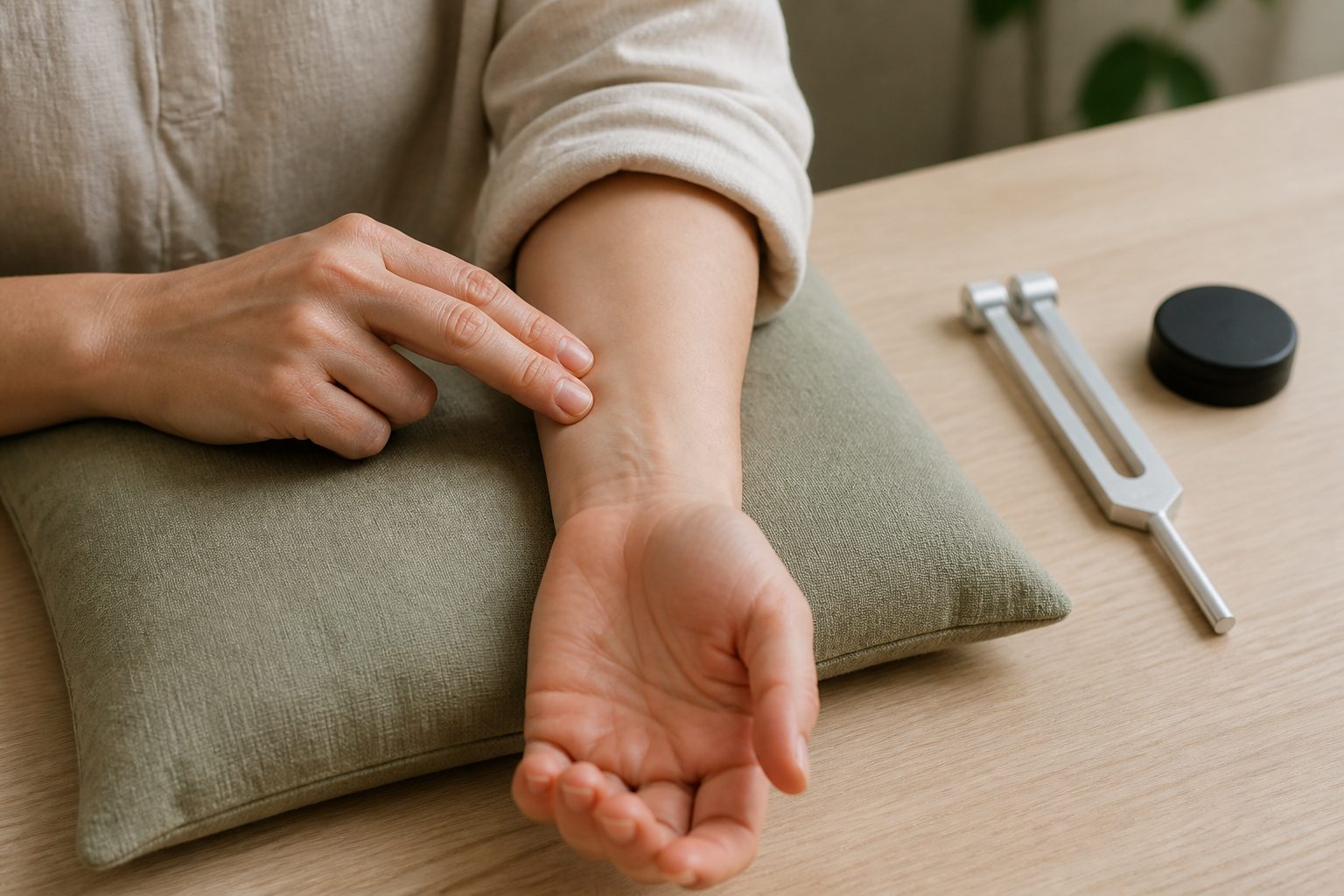
Establish a baseline. Sit with your forearms supported and your palms facing upward. Notice whether your hands feel warm or cool, how freely the wrist bends, and whether your breathing reaches the lower ribs without effort.
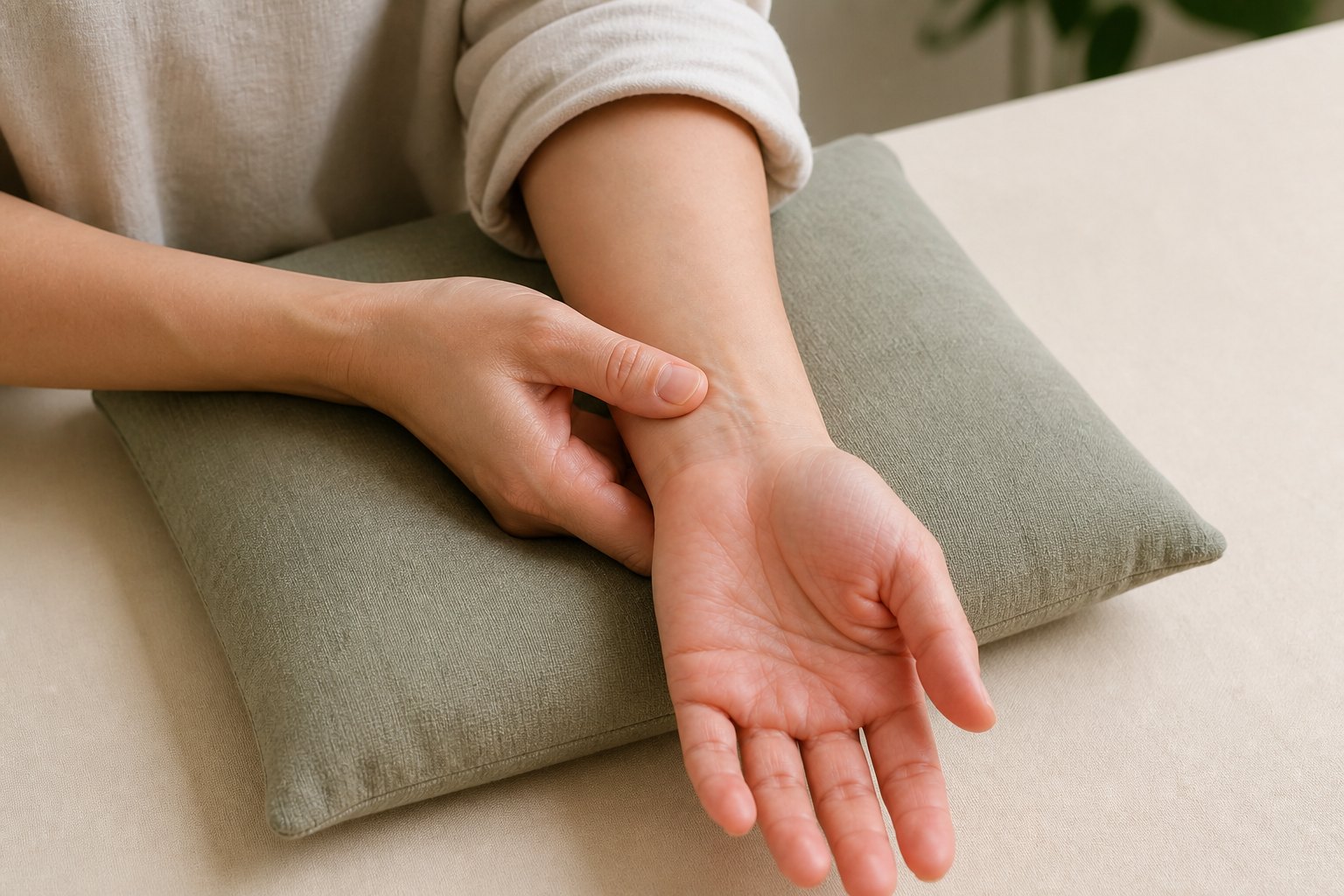
Find the landmark. Locate the main wrist crease on the palm side. Lay the first three fingers of your opposite hand across the forearm, with the ring finger nearest the crease. Just beyond the index finger, feel near the center of the forearm for the space between two tendons. Flexing the wrist slightly can make them easier to see; relax the hand again before pressing. Some people have only one clearly visible central tendon, so use the wrist crease and central forearm line together rather than digging for a structure you cannot feel.
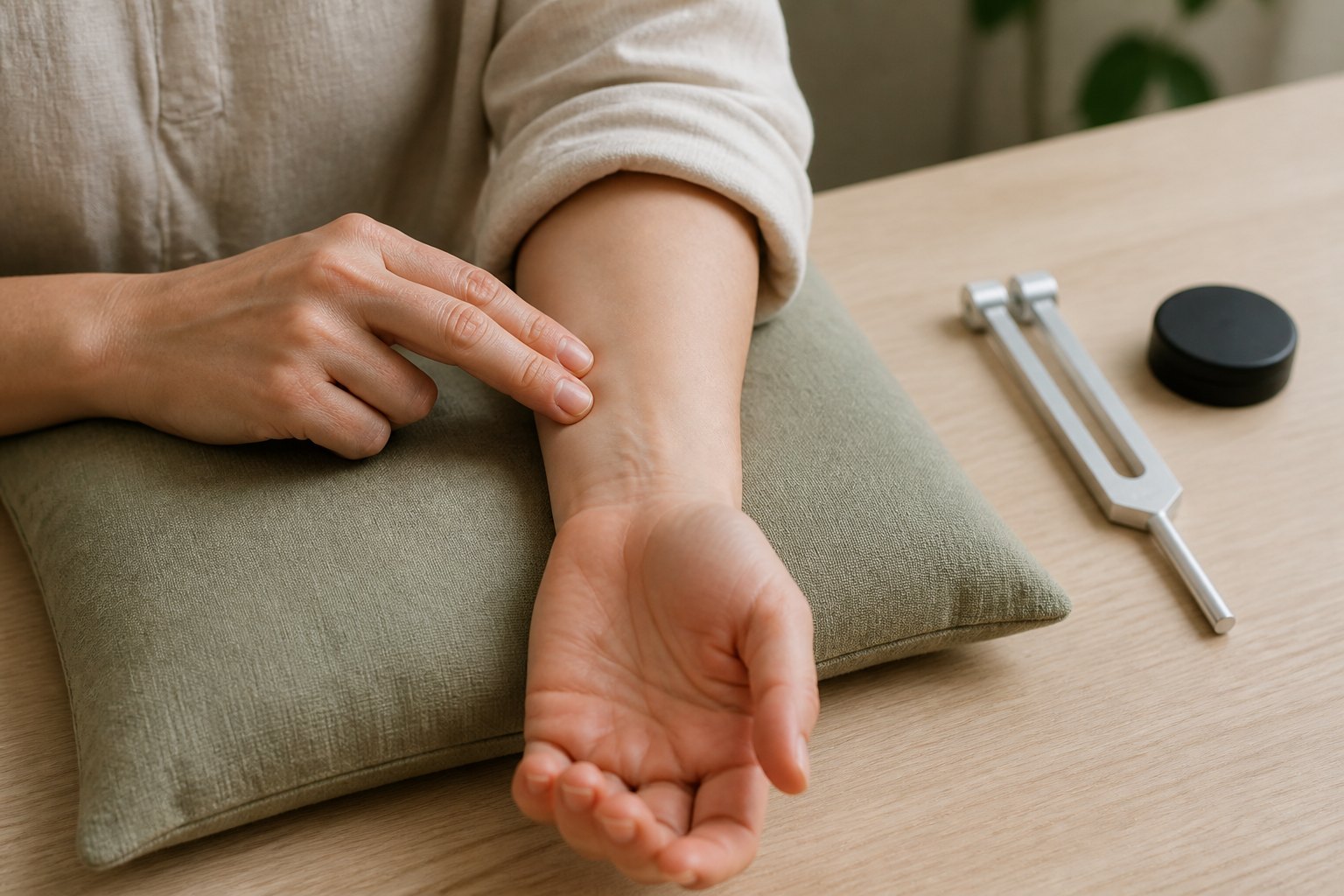
Use pressure first. Rest your thumb or fingertip on the area and apply firm but comfortable pressure for several slow breaths. A mild ache or tenderness can occur, but sharp pain means the pressure is too strong. Repeat on the other arm and compare the two sides.
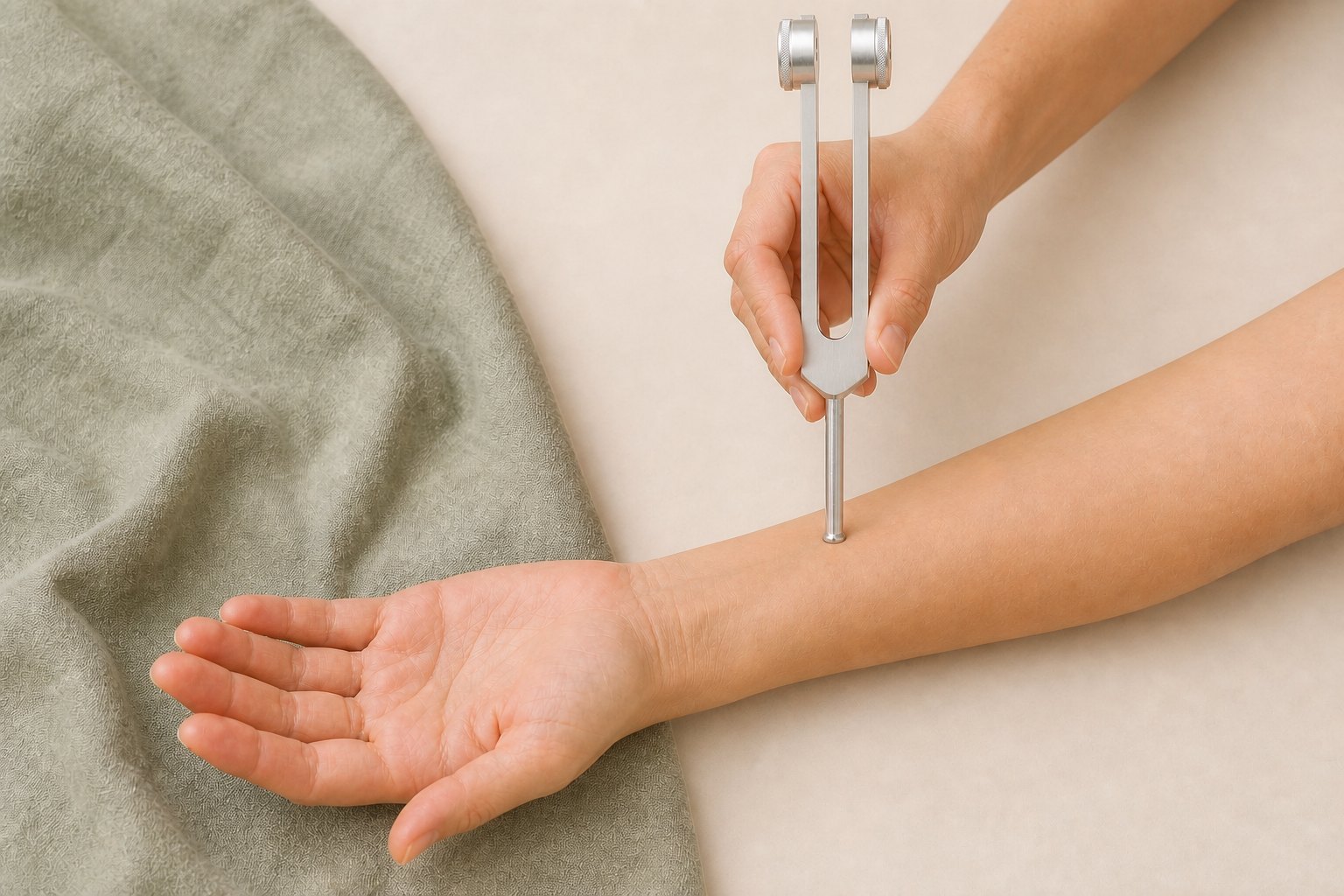
Add contact vibration. Activate a weighted fork on a suitable resilient activator. Hold the fork by its stem and place the flat end of the stem gently on PC 6. Let the vibration fade without increasing pressure. One or two applications on each side are enough for a first session. A 128 Hz weighted fork—the contact frequency shared by CREVIK’s current sets—is a straightforward choice because its vibration is easy to feel. Do not apply it over broken, irritated, swollen, or infected skin.
Check again. Move the wrists, take one unforced breath, and compare with the baseline. The forearm may feel clearer, the breath may slow, one side may differ from the other, or nothing obvious may change. No particular sensation is required.
The sequence matters more than the promise attached to a frequency. You located a standard point, confirmed it through anatomy and touch, applied one form of stimulation, and observed the result. That is already the basic structure of practical acupoint work.
A first acupoint sound practice
Location before frequency
Learn the point with landmarks and touch before introducing contact vibration.
 01
01Notice first
Forearms supported · palms upward
 02
02Use landmarks
Wrist crease · 2 B-cun · tendon interval
 03
03Pressure first
Comfortable fingertip or thumb contact
 04
04Vibration optional
Weighted fork · light flat contact
 05
05Compare again
Wrist movement · breath · side-to-side feel
What You Can Take With You
You can now explain why a meridian is more than a printed line: it describes surface routes, functional relationships, and connections between distant regions.
You can recognize its historical layers: early vessel texts, the twelve-channel framework of the Huangdi Neijing, later interpretation, and modern WHO codes.
You can also read one of those codes and do something with it. PC 6 means the sixth standard point of the Pericardium channel; Neiguan is its Chinese name; its location can be checked against the wrist crease and forearm tendons; and it can be approached through pressure or the controlled contact vibration of a weighted tuning fork.
The next article follows the twelve primary channels as one continuous circuit, using the twenty-four-hour channel clock to connect their traditional sequence with the ordinary rhythms of waking, eating, working, and resting.