A single tuning fork gives you time to get to know a sound. There is the beginning of the note, the steady ringing, and the gradual softening as it fades.
Add a second tone, and there is something else to follow. Your attention may move between the lower and higher notes. At moments, you might hear them as one combined sound; then one becomes distinct again.
This is a lovely place to begin listening to musical intervals. A few short examples can make the idea familiar before you have much occasion to think about the numbers.
One Tone, Then Another
An interval is the distance between two pitches. You can hear it when one note follows another, as in a melody, or when both sound together.
Listening in these two ways brings out different details. One note after another makes the movement in pitch easy to follow. Together, the notes give you time to notice how they blend, remain distinct, or create a gently changing sound.
The frequencies below are measured in hertz, or Hz: the number of vibration cycles each second. A 256 Hz tone completes 256 cycles per second. A higher frequency gives a higher pitch.
Start at a low, comfortable volume. These softly fading, synthesized examples are made for listening as you read. Each of the first two plays a lower note, a higher note, and then both together.
An Octave: A Familiar Sound, Higher Up
Listen first to 256 Hz, followed by 512 Hz. The second note is clearly higher. Listen for whether it also has something familiar about it.
Listen: When the two notes sound together, try following the lower one, then the higher one.
The distance between these notes is an octave. The higher frequency is twice the lower one, giving a ratio of 2:1. During a single vibration cycle of the lower tone, the higher tone completes two.
You may recognise this relationship from singing. Two people can sing the same tune comfortably in different registers, with one voice an octave above the other. The melody remains easy to recognise, even though the voices occupy different heights.
In familiar musical notation, notes an octave apart share a letter name: one C and the next C, for example. The notes are different in pitch, but closely related enough to belong to the same named family.
Try the recording once more. As the two tones fade, notice whether you keep hearing both or begin to follow just one. A small shift of attention can change what stands out.
A Fifth: Listening to Two Distinct Voices
Keep the lower tone at 256 Hz. This time, let the upper tone be 384 Hz.
Listen: Compare this pair with the octave. How easily can you hear the two notes separately?
These notes form a perfect fifth, tuned here to the ratio 3:2. In the time the lower tone completes two cycles, the higher completes three.
Compared with the octave, the upper note sits closer to the lower one. You may find the two voices easier to keep apart, while still hearing a comfortable blend when they ring together. Let your ear move between the separate notes and the whole sound for a few seconds.
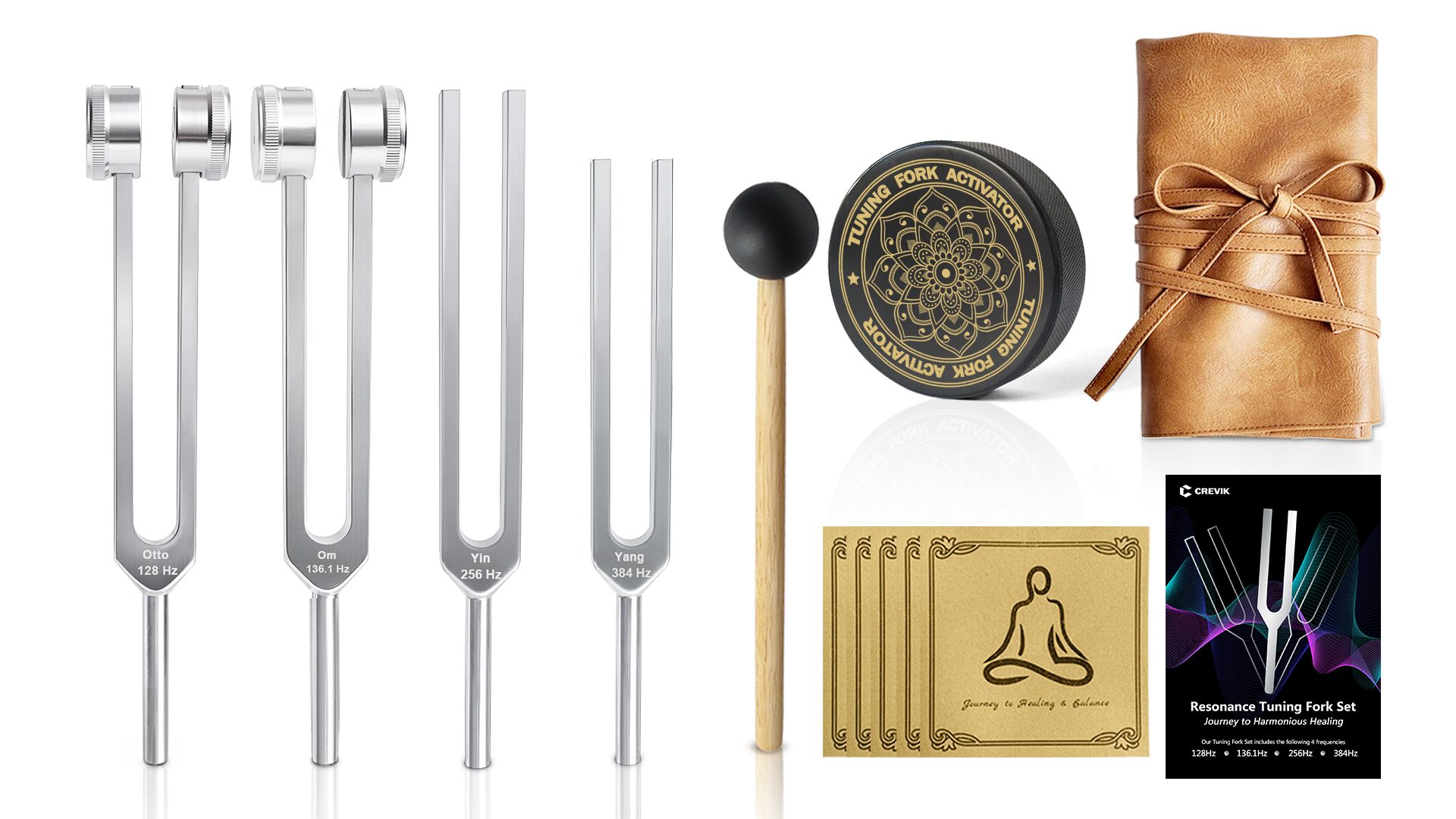
The 256 Hz and 384 Hz unweighted forks in the CREVIK Resonance Set form this same relationship. If you have the set, this is a pair you can return to after listening to the recording.
The character of an interval also comes from the instrument playing it. A piano, a voice, and a tuning fork each bring a different colour to the same pair of pitches. Many instruments carry a collection of higher components, called overtones, alongside the main note. Those components help shape how two notes sound together. Research into timbre and consonance shows how changing that colour can change which combinations listeners enjoy.
With these simple tones, there is room to hear the pitches clearly and discover which details hold your attention.
The Same Relationship, a Different Starting Note
Now listen to two fifths. The first is the pair you have just heard: 256 and 384 Hz. After a short pause, both notes move higher, to 320 and 480 Hz.
Listen: The second pair is higher. Does the spacing between the notes still feel familiar?
Both pairs have the same 3:2 ratio. In the second pair, each frequency has been raised by a quarter: 256 becomes 320, and 384 becomes 480.
There is a useful detail here. The first pair differs by 128 Hz; the second differs by 160 Hz. The numerical gap grows as the whole interval moves higher, yet the musical relationship remains a fifth.
This is how a tune can move to a higher starting note and still sound like the same tune. The pitches change together, preserving the relationships that give the melody its shape.
If you would like to explore how these ratios become a scale, our article on Pythagorean tuning and Scientific Pitch follows that path further.
When Two Notes Are Almost the Same
For the last example, bring the pitches much closer: 256 and 258 Hz.
Heard separately, they may sound almost identical. Listen to what happens when they play together.
Listen: After the two separate notes, notice the gentle rise and fall in loudness when they join.
That regular swelling and softening is called beating. The two vibrations move in and out of step. As their sound waves reinforce one another, the sound grows stronger; as they oppose one another, it becomes softer.
For two close frequencies, the number of beats each second equals their difference. Here, 258 minus 256 gives two, so you hear two pulses per second.
Musicians use this effect while tuning. When two notes are nearly in unison, a small adjustment changes the speed of the beating. As their frequencies approach one another, the pulses slow down.
It is a surprisingly clear way to hear a very small difference. The separate pitches may be difficult to tell apart, but together they make the difference audible as a rhythm.
Trying It with Your Own Forks
If you have two unweighted tuning forks, take a moment to hear each one by itself. Hold the stem, keep the tines free, and activate each fork gently with a suitable rubber activator. Leave a comfortable space between the forks and your ears.
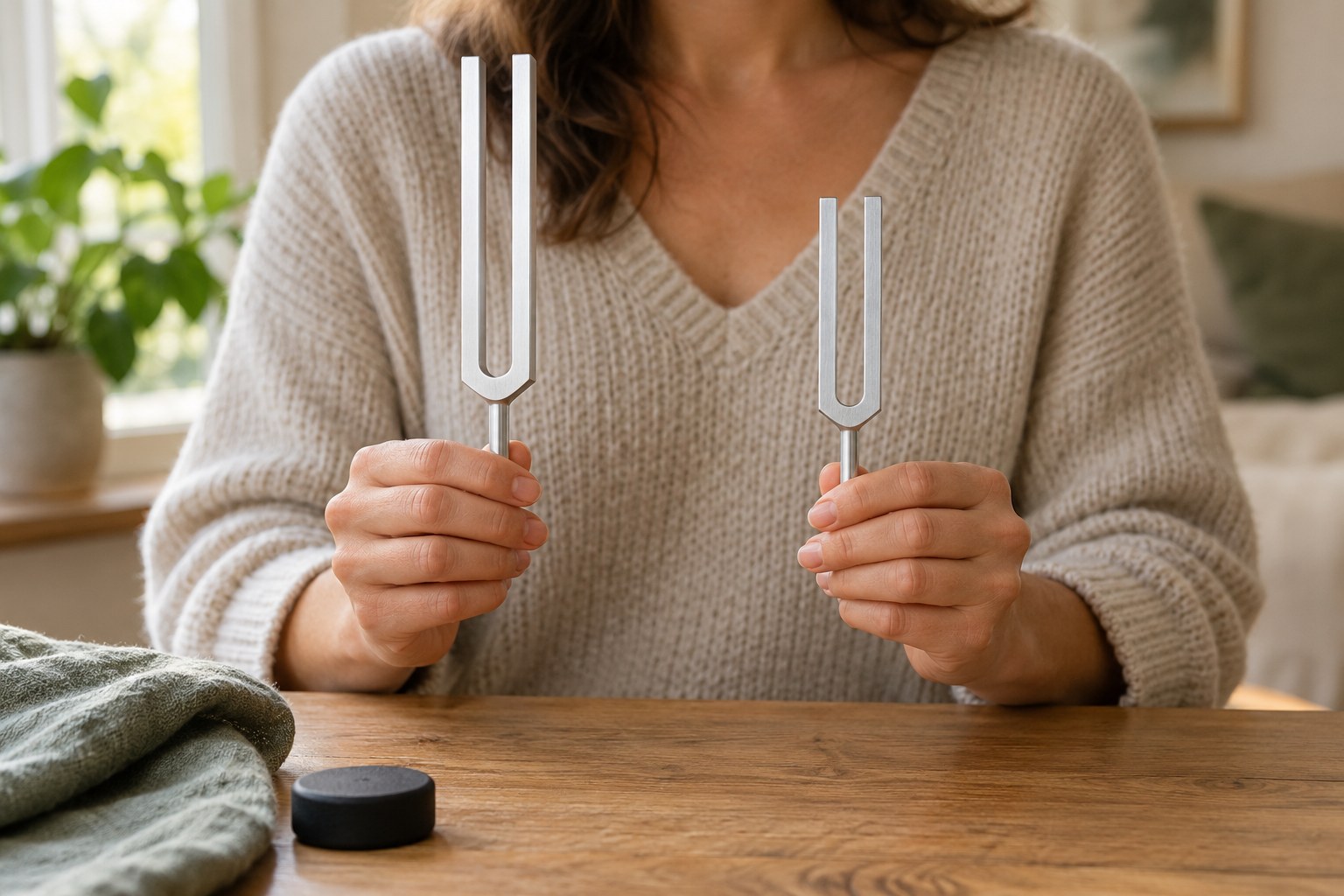
Then let the sounds overlap. Hold them apart so the tines have room to vibrate without touching. With the Resonance Set, the 256 and 384 Hz forks give you the fifth from the second recording.
Listen for the moment the second note joins. Does your attention move toward it? Can you return to the first note while both are still sounding?
Real forks will soften at their own rates, and your hand position can make one easier to hear than the other. Allow a little time to find a position where both are clear. A gentle activation is enough; let the remaining sound guide your attention as it fades.
You might enjoy the octave most, or find yourself replaying the small pulse of the close tones. On another listen, a detail you missed may become the most interesting part.
Return to whichever pair made you curious. Hear each note again, then let them meet.