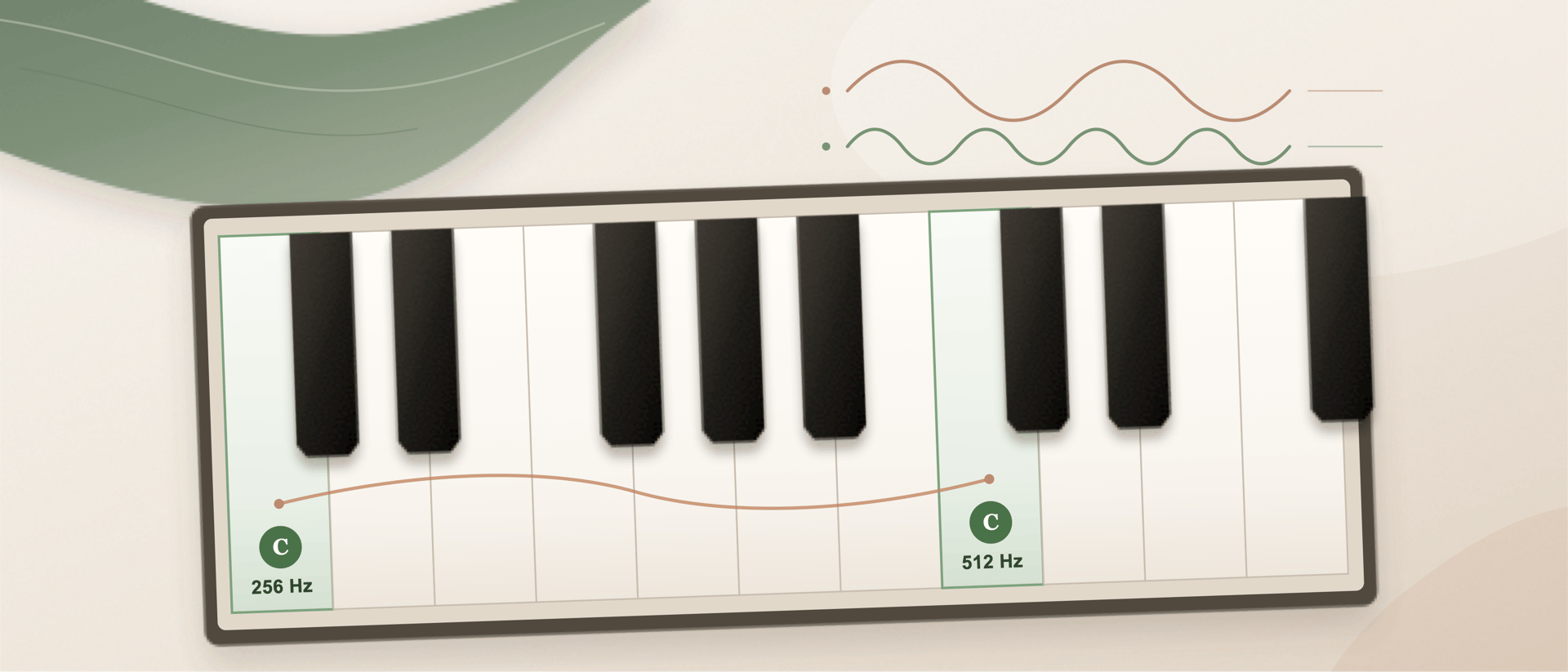
On a piano, middle C and the next C to its right are clearly different in height: the second sounds much higher. Yet both keys have the same note name. If a melody is moved from one register to the other, with every note shifted by the same amount, it remains recognizably the same melody. Music theory calls the distance between those two Cs an octave.
The relationship can be stated precisely in frequency. A tone at 256 Hz completes 256 vibration cycles per second; a tone at 512 Hz completes twice as many. Doubling a frequency raises its pitch by one octave, while halving it lowers the pitch by one octave. The two tones are not identical—one is plainly higher—but they belong to the same pitch class, which is why both are named C.
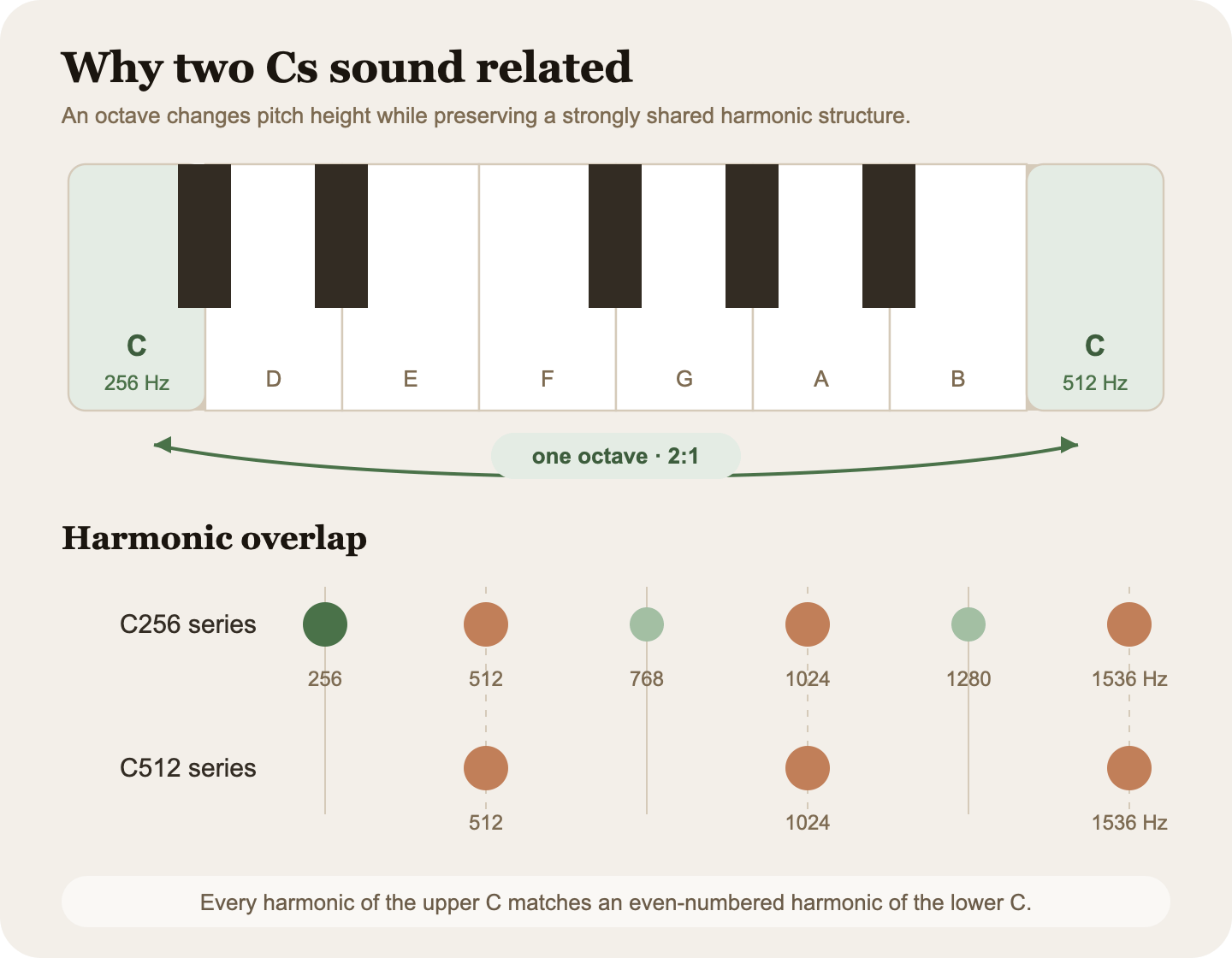
Part of the explanation lies in the way musical sounds are built. When a piano hammer strikes a string whose fundamental pitch is 256 Hz, the string does not vibrate only as a whole. It also vibrates in smaller sections, producing a series of upper frequencies called harmonics. In an idealized example, those harmonics occur at whole-number multiples of the fundamental: 512, 768, 1024 Hz, and so on.
A C at 512 Hz begins its harmonic series at 512 Hz, followed by 1024, 1536, 2048 Hz, and so on. Every harmonic in the upper C’s series coincides with an even-numbered harmonic of the lower C. The two sounds therefore share a large part of their frequency structure. This overlap is one reason the ear groups octave-related pitches together even while easily distinguishing which one is higher.
From the Octave to the Perfect Fifth
The octave’s frequency ratio is 2:1, the simplest possible relationship between two different pitches. The next important ratio is 3:2, heard as the interval from C to G. Western music theory calls this interval the perfect fifth.
On a modern piano, the C–G interval is adjusted very slightly to fit equal temperament. In pure tuning, if C is 256 Hz, G is exactly 384 Hz:
The harmonic series again shows why the combination tends to sound stable. The third harmonic of C256 is 768 Hz. The second harmonic of G384 is also 768 Hz. Their upper frequencies continue to coincide at regular points above that. The overlap is not as complete as it is between two Cs an octave apart, but it occurs early enough in the harmonic series to give the interval a strong sense of fusion.
The perfect fourth, from C to F, follows the ratio 4:3. With C at 256 Hz, a pure F is approximately 341.33 Hz. The fourth harmonic of the lower C and the third harmonic of the upper F meet at 1024 Hz. The fourth and fifth are closely related: moving up a perfect fifth and then a perfect fourth completes an octave, because (3/2) × (4/3) = 2.
In this terminology, “perfect” is a historical classification, not a claim that the interval is flawless or therapeutically superior. The octave, fifth, and fourth received the name because Western theory treated them differently from intervals that appear in major and minor forms.
Octaves, fifths, and fourths are commonly described as consonant intervals. Consonance does not mean that other intervals are unpleasant or musically inferior; dissonance is essential to movement, tension, and resolution. It means that these particular combinations tend to fuse readily and produce relatively little roughness when played with harmonically rich sounds such as voices, strings, and many acoustic instruments.
Their small whole-number ratios help explain that quality. When two fundamentals stand in a relationship such as 2:1 or 3:2, their vibration cycles realign after a small number of repetitions, and many of their harmonics fall on the same frequencies. More complex ratios generally produce fewer early matches and more closely spaced components that can create beating or roughness.
A note on consonance: Harmonic overlap is a useful first explanation, not a complete theory of musical perception. Timbre, register, loudness, musical context, listening experience, and culture also affect whether an interval sounds settled or tense. The explanation applies most directly to harmonically rich sounds. Tuning forks produce comparatively pure tones, so their perceived relationships also depend on how the auditory system processes the fundamentals themselves.
This gives us two separate questions. An interval such as an octave or perfect fifth describes the relationship between two tones. It does not specify the absolute frequency of either tone. A pure fifth remains 3:2 whether it begins at 100 Hz, 256 Hz, or any other starting point.
Pythagorean tuning addresses the first question. It constructs a scale from the 3:2 perfect fifth and uses the 2:1 octave to bring the resulting notes into the same register. Scientific Pitch, developed many centuries later, addresses the second by choosing a fixed frequency for a reference note. Understanding that difference is the key to seeing how a system associated with ancient Greece eventually became connected with middle C at 256 Hz.
Building a Scale from the Perfect Fifth
Pythagorean tuning is traditionally associated with Pythagoras and the school that formed around his teachings in ancient Greece. Its lasting contribution to music was a practical rule: begin with one tone, generate new tones through the ratio 3:2, and use octave shifts to keep them within a usable range.
Start on C, without assigning it a frequency. A perfect fifth above C gives G. Another perfect fifth above G gives D, although this D initially falls beyond the octave from C to the next C. Moving it down one octave—dividing its frequency by 2—places it back inside the scale. Repeating the operation from D gives A.
The first part of the chain can therefore be written as:
The notes are not being selected in the order they appear on a keyboard. Each one is generated from the preceding note by a pure fifth. Measured against the original C, their ratios are C 1:1, G 3:2, D 9:8, and A 27:16. Continuing the same process produces the remaining notes of a Pythagorean scale.
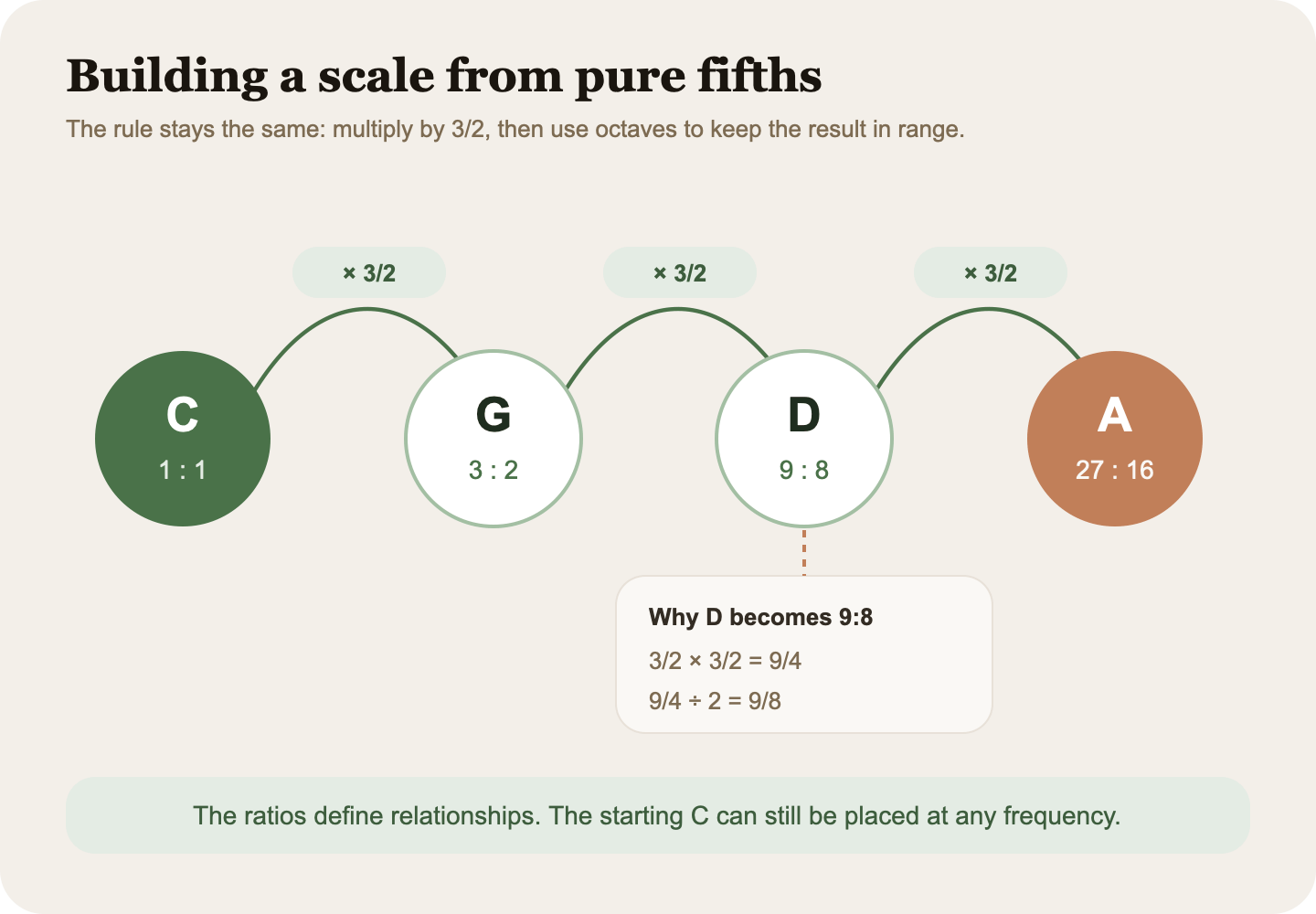
This method determines the internal proportions of the scale, but the first C remains movable. Give that C one frequency and the whole scale follows; give it another and the same pattern reappears at a different height. Ancient musicians could tune intervals by ear, string length, or other instruments without knowing how many cycles per second a tone completed. The modern unit hertz did not yet exist.
For much of European musical history, that flexibility was normal. A written C identified a position within a musical system, but its sounding height could vary between cities, churches, courts, and ensembles. As musicians and instruments began to travel more widely, variation in absolute pitch became a practical problem. A tuning system could tell everyone how to build a fifth, yet still leave two orchestras with different starting notes.
Scientific Pitch: Giving C a Fixed Frequency
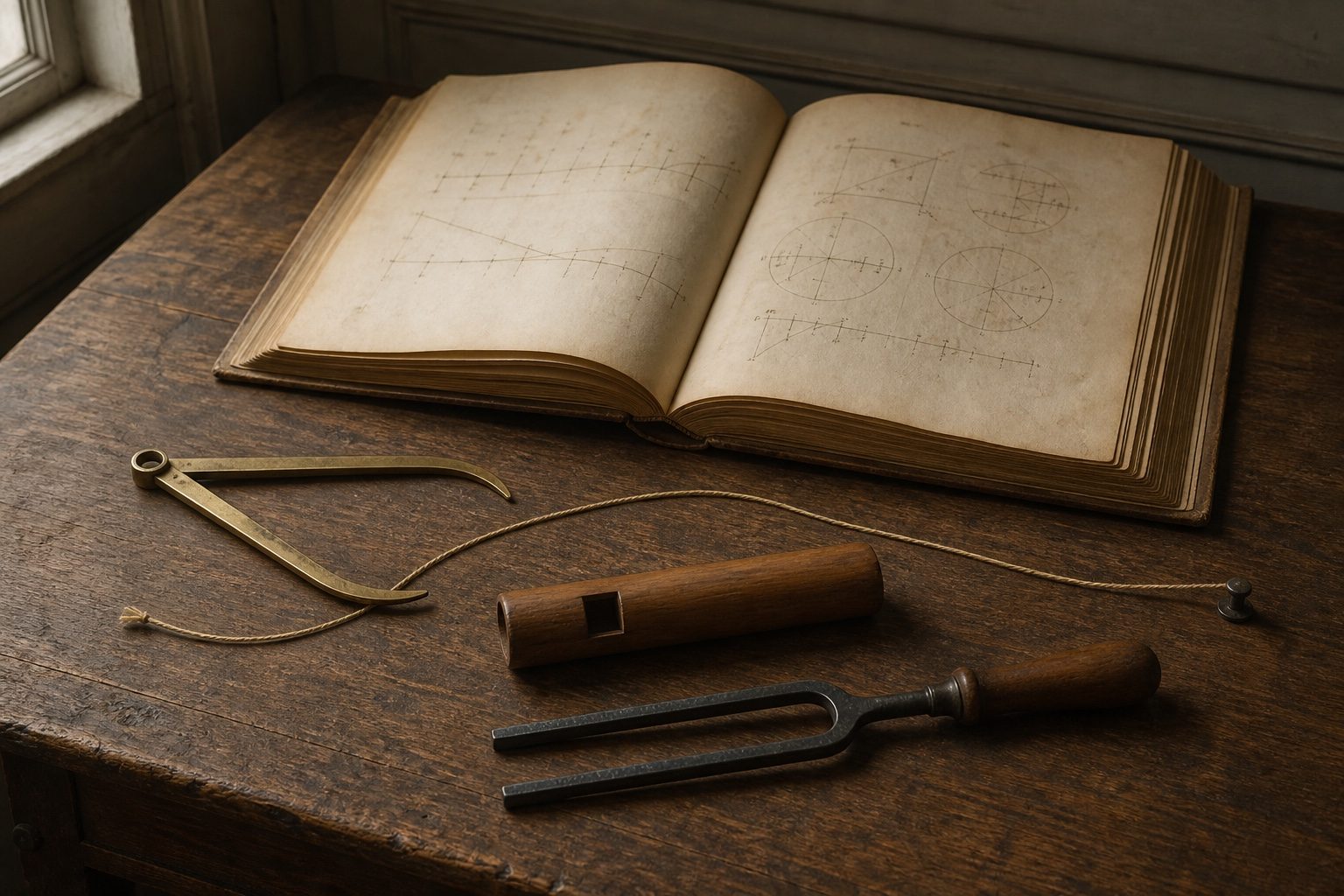
At the beginning of the eighteenth century, French acoustician Joseph Sauveur was working on a way to describe pitch independently of a particular organ, pipe, or local tuning practice. In 1701 he proposed a son fixe, or fixed sound, based provisionally on 100 vibrations per second. The significance of the idea was the reference itself: a pitch could be specified by a repeatable number.
Sauveur revised the proposal in 1713. Because octaves progress by doubling, he selected 256 vibrations per second for a C in the middle register. The number is 2⁸, so its entire C family can be reached by doubling or halving without producing fractions:
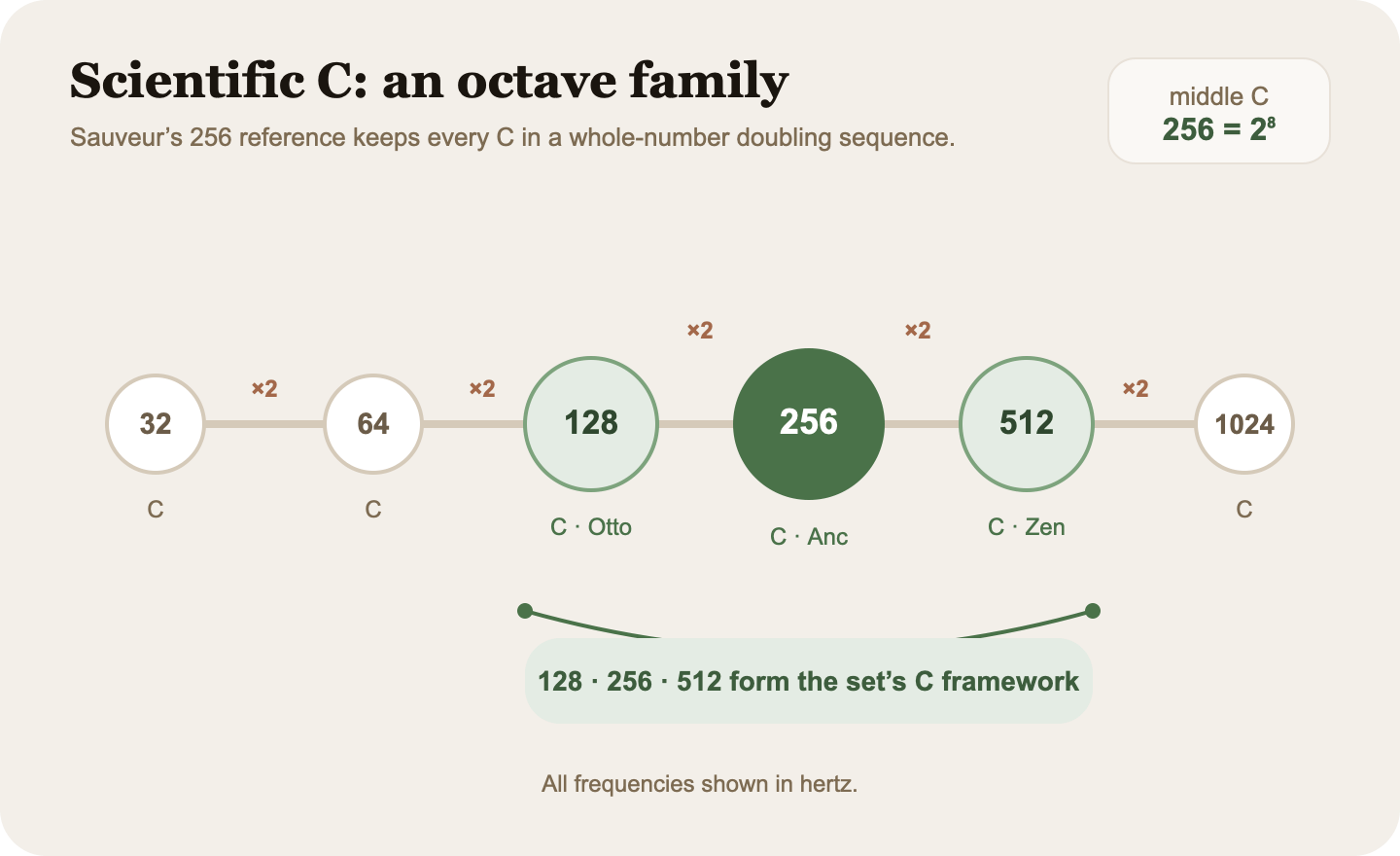
This convention later became known as Scientific Pitch, Philosophical Pitch, or Sauveur Pitch. Its appeal is easy to see on the page. C128, C256, and C512 are exact octaves, and each is a whole number. For acoustical calculations and teaching demonstrations, the sequence is unusually convenient.
The name Scientific Pitch can be misleading if it is taken to mean that C256 is the only natural or scientifically valid C. It is a chosen reference, just as A440 is a chosen reference in most modern concert music. What distinguishes C256 is the numerical clarity of its octave series. The convention makes one of music’s simplest audible relationships equally simple to calculate.
Why is A432 sometimes called “Verdi pitch”? Giuseppe Verdi took part in nineteenth-century efforts to curb orchestral pitch inflation and establish a lower, consistent performance standard, partly in response to the demands placed on singers. He supported the French standard of A435 and was also associated with a preference for the slightly lower A432. The modern label “Verdi tuning” makes this connection sound more exact than the historical record allows. Verdi did not originate Scientific Pitch, which grew from Sauveur’s work more than a century earlier. For a fuller account, see this study of the history and modern reception of 432 Hz.
How C256 Leads to A432
Scientific Pitch supplies the starting point; Pythagorean tuning supplies the route. Once C is fixed at 256 Hz, the three fifths described above can be calculated directly.
The first fifth produces G:
A fifth above G produces 576 Hz. That tone lies above the C256–C512 octave, so it is lowered by one octave to obtain D:
A fifth above D then produces A:
The complete relationship between the starting C and this A is 27:16. In this setting, A432 is not an isolated frequency added to the scale because of its modern popularity. It is the result of moving from C through three consecutive Pythagorean fifths: C to G, G to D, and D to A.
The C octave family continues on either side of the starting tone. Halving C256 gives C128; doubling it gives C512. Four frequencies that may first look like separate numbers can therefore be read as a short musical path:
The first two tones form a 1:2 octave. The final three outline C–A–C: a Pythagorean major sixth from 256 to 432, followed by a Pythagorean minor third from 432 to 512. Across the complete span, 128, 256, and 512 preserve the same note identity through two octaves, while 432 creates movement inside the upper octave.
The tuning system matters here. C256 and A432 form an exact pair only under the Pythagorean construction used in this article. If A432 is used as the reference for modern twelve-tone equal temperament, middle C is approximately 256.87 Hz. In five-limit just intonation, an A tuned as a pure 5:3 major sixth above C256 is approximately 426.67 Hz. These figures answer different tuning questions; none is a universal replacement for the others.
From Ratios to Sound-Healing Practice
On paper, a frequency ratio is exact and silent. A tuning fork turns it into an event with a beginning, a period of resonance, and a gradual decay. With two or more forks, the interval becomes something that can be followed in time: one tone settles, the next enters, and the ear registers both the change in pitch and the relationship that holds the sequence together.
This is one reason relationships matter in sound-healing practice. A frequency label tells us how quickly one fork vibrates. It does not describe how the session is paced, where vibration is felt, which tone comes next, or how the listener responds. Practitioner and tuning-fork educator John Beaulieu puts the musical principle plainly: “What is most important is the relationship / intervals between the tones.” Jonathan Goldman makes a related point when he argues against searching for a single frequency that will work for everyone, emphasizing instead the sequence, combination, and intention with which sounds are used.
The construction of the fork changes the experience as well. A weighted tuning fork places small masses on the ends of its tines, concentrating a strong physical vibration that can be transmitted through the stem to a comfortable contact point on the body. An unweighted fork produces a clearer audible tone and is generally used in the air around the body or at a comfortable distance from the ears.
A practice that combines both types can move between tactile and auditory attention. The low weighted tone is felt through a specific point of contact. The higher unweighted tone has no single point of arrival; it is heard in the surrounding space. Between them are the natural breath, the fading vibration, and the brief silence before the next activation.
The familiar sound-healing image of the body as an instrument is useful when understood in this practical sense. “Tuning” does not require assigning every person one correct frequency. It can mean giving sensation, breathing, and attention a shared rhythm for several minutes. Metal begins to vibrate, the skin or ear receives it, and the vibration fades while awareness remains. The measurable movement is temporary; the quality of listening can continue after the tone is gone.
The CREVIK Alignment Set
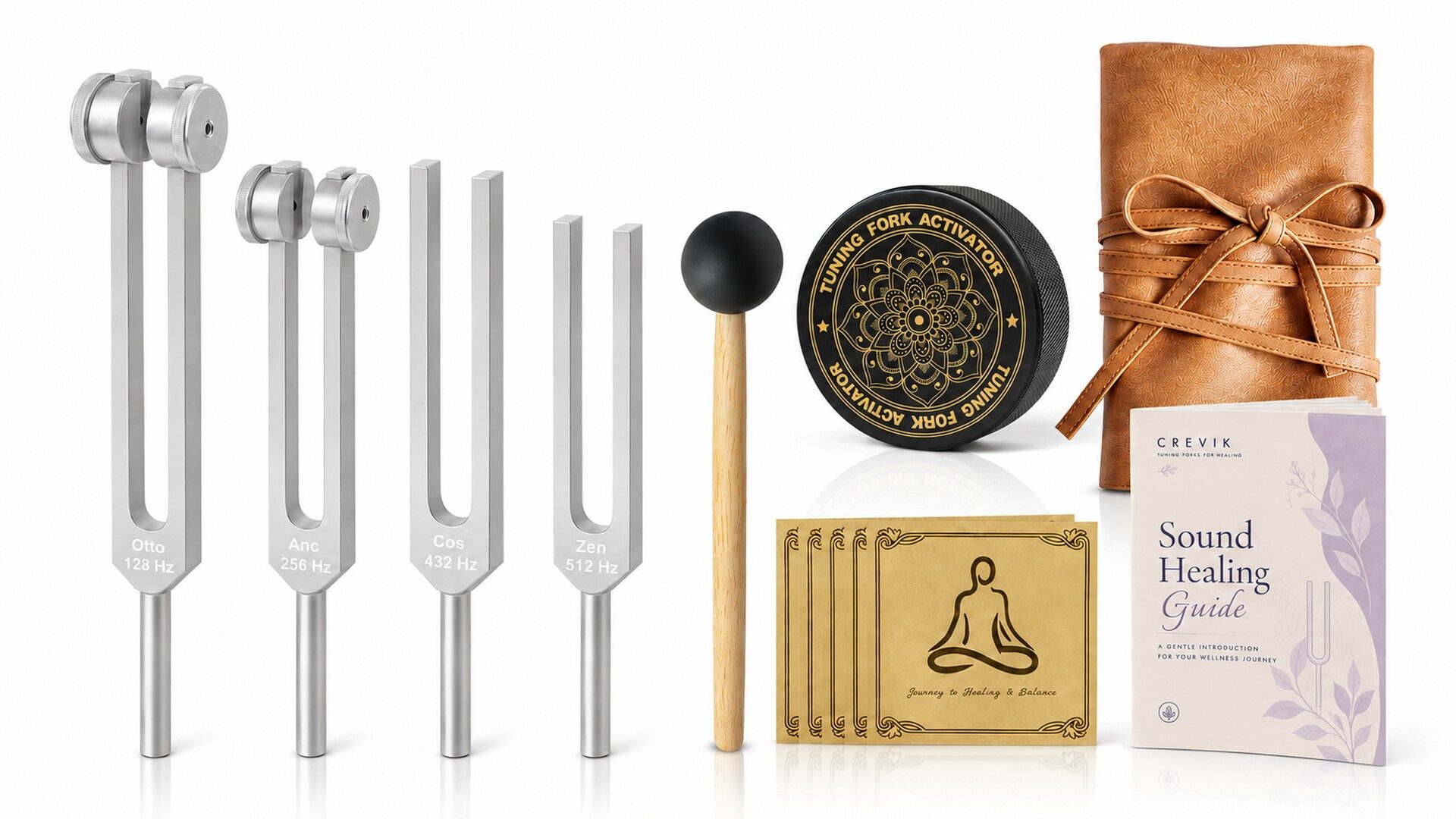
The CREVIK Alignment Set was designed around this movement from felt vibration to open listening. It contains four forks: the weighted 128 Hz Otto and 256 Hz Anc, followed by the unweighted 432 Hz Cos and 512 Hz Zen. It is a selected interval sequence rather than a complete eight-note Pythagorean scale.
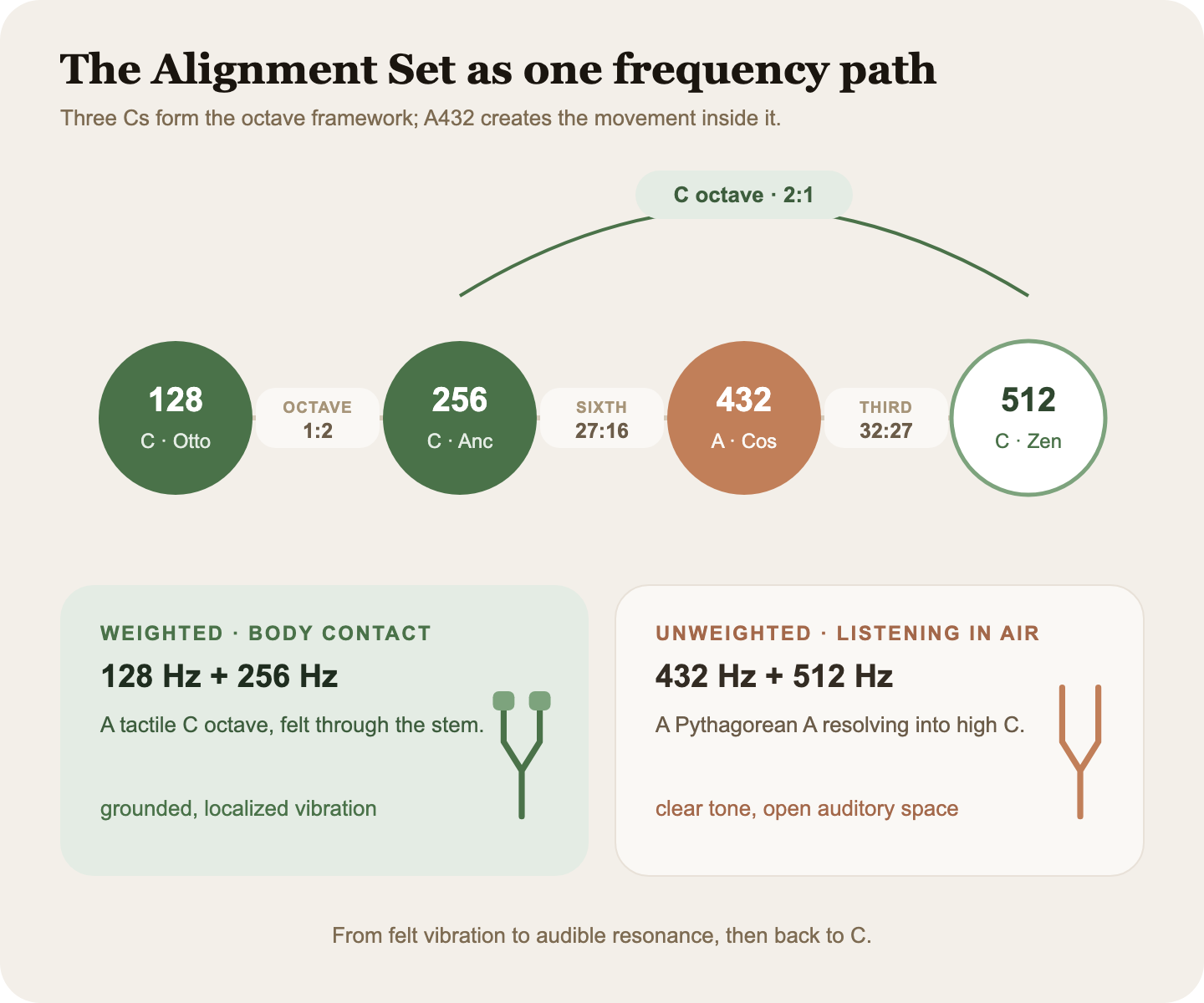
The weighted 128 and 256 forks establish the physical beginning of the practice. They are the same C in adjacent octaves, joined by the exact ratio 1:2. The slower 128 Hz vibration provides a low, readily felt entry point. The 256 Hz fork then brings the same note identity into a higher register while retaining enough tactile presence to be used through contact. Scientific C is therefore encountered as a vibration in the body before it becomes the reference for the tones that follow.
The unweighted 432 and 512 forks change the mode of attention. A432 is the Pythagorean A derived from C256; C512 completes the octave above the central C. Their clearer airborne tones allow the interval to be heard without keeping the fork against the body. The sequence opens away from C at 432, then arrives at the higher C at 512.
The design depends on the four tones working together. Beginning at 128 gives the practice weight and physical location. Moving to 256 establishes the reference tone. The transition to 432 introduces musical distance, and 512 resolves that movement into the C already heard twice below. The result is a continuous passage from contact to listening, and from a low C through expansion to a higher return.
Within this sequence, alignment describes the experience of following a coherent path closely enough that the body, the breath, and the ear are attending to the same few minutes. It does not require a frequency chart that assigns one fixed state to every listener.

A Five-Minute Alignment Practice
The following practice is designed to make the interval structure easy to hear and feel. Allow each fork to fade substantially before moving to the next one; the quiet between tones is part of the sequence.
Sit in a supported position or lie down. Hold each fork by its stem and activate it gently on a rubber activator. Take one natural breath before beginning; no special breathing pattern is required.
Activate the weighted 128 Hz fork. Place the end of the stem on a comfortable, stable area such as the center of the palm, the sole of the foot, or the breastbone. Use light contact and wait until most of the vibration has faded. Repeat once at the same point.
Use the weighted 256 Hz fork at the same contact point. After the second activation, lift it away from the body and listen to the remainder of the tone. Notice whether 128 and 256 register as related versions of the same pitch even though one sits clearly above the other.
Activate the unweighted 432 Hz fork and hold it in the space beside the body or several inches from either ear, never directly against the ear. Let it decay, then activate the unweighted 512 Hz fork in the same position. Listen to how 432 moves away from the C center and how 512 returns to it at a higher octave.
Put the forks down and remain still for three to five unforced breaths. Notice what remains distinct: the last audible tone, the contact point used for the weighted forks, or the surrounding quiet. If you want a longer session, repeat the complete four-fork sequence once rather than striking one fork rapidly many times.
All contact should remain gentle and comfortable. Strike the forks only on a suitable rubber activator, and stop or change position if a vibration feels unpleasant. The purpose of the sequence is attentive listening, not producing the strongest possible sensation.
The two C keys at the beginning of this article introduced the octave as an everyday musical fact: two different pitches can share one note identity. The Alignment Set extends that fact across three Cs. C128 begins in the range of touch, C256 provides the central reference, and C512 returns through the air. Between the last two, A432 gives the ear enough distance to hear the return rather than simply being told that it is there.
A ratio can be written in a single line, but listening to it takes time. In practice, that time is filled by pressure, tone, decay, breath, and silence. The frequencies give the session its structure; attention is what allows the structure to be felt.