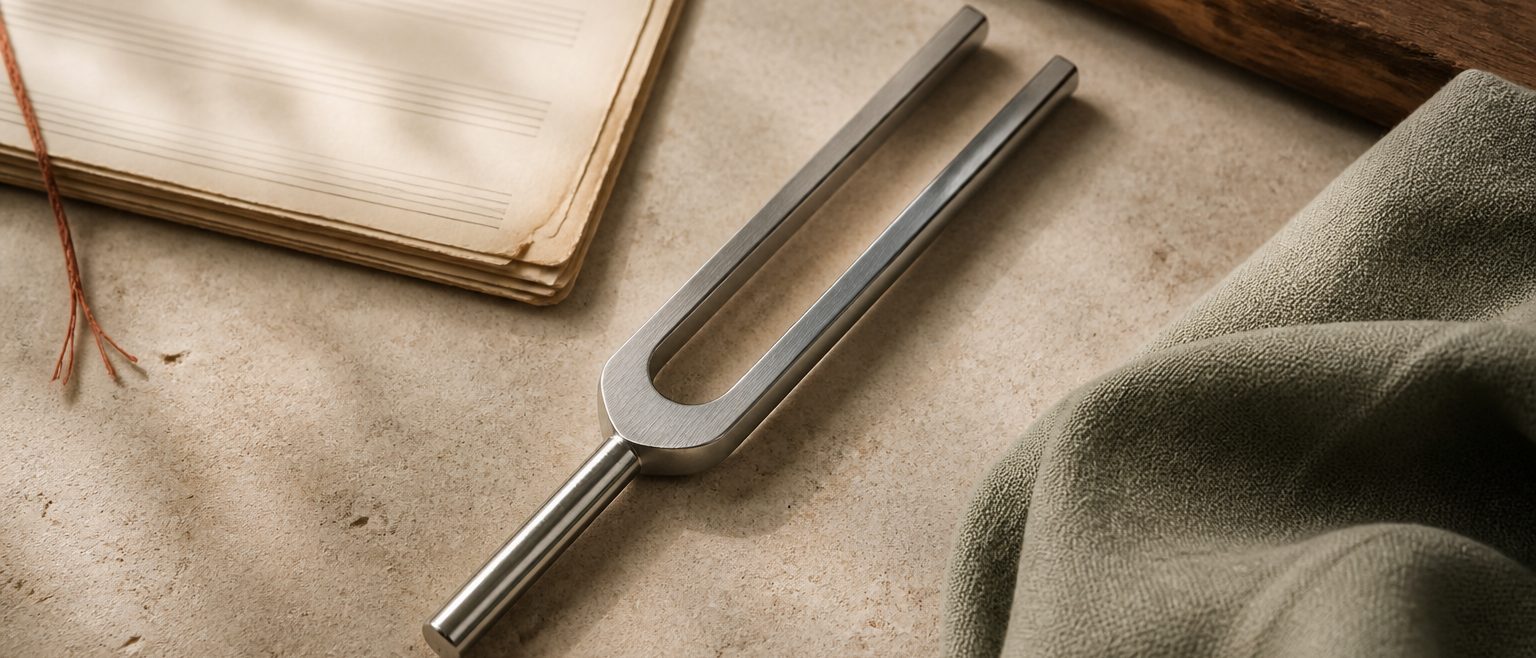
In 1711, the English trumpeter and lutenist John Shore is generally credited with making the first tuning fork, a small steel tool he used to tune his lute. Held by its stem and struck against a firm surface, its two prongs moved rapidly toward and away from one another, producing a reference tone that another instrument could match. The fork was compact enough to travel with the musician and could be sounded again whenever the pitch was needed.
This was a practical answer to an ordinary musical problem. A harpsichord or organ could provide a note, but the instrument stayed where it was, and its pitch might differ from one church, theatre, or town to another. A tuning fork put the reference in the player’s pocket. It did not establish one universal standard—the pitch of early forks varied—but it made a particular standard portable and repeatable.
By 1746, William Tans’ur was describing the device in A New Musical Grammar under the names intonator and retonator. His instructions are recognizably close to the way a fork is handled today: hold it lightly by the stem, strike a tine, and let it sound. He also noted that the tone became more distinct near the ear, teeth, or head—an observation that would acquire new importance when the fork entered hearing research.
The tuning fork began with one job: preserving a usable pitch. As metalworking became more precise, that same reliability allowed it to take on others.
From Tuning Aid to Scientific Instrument
A tuning fork is useful as a reference because its motion is comparatively simple. The two tines bend in opposite directions, while the stem remains relatively still in the hand. The initial strike produces a brief mixture of frequencies, but the fork’s form suppresses many of them quickly, leaving a sustained fundamental tone that is easier to identify than the sound of most musical instruments.
Its pitch depends largely on the dimensions and material of the tines. Removing a small amount of metal raises the frequency; adding mass or increasing length lowers it. Once instrument makers learned to control those variables closely, they could manufacture not just one tuning fork but a graduated series.
In 1834, the German silk manufacturer and acoustic researcher Johann Scheibler proposed a tonometer: a group of carefully tuned forks used to determine the pitch of other sounds. His most developed version contained 56 forks spanning a single octave. When a known fork and an unknown tone sounded together, the listener could hear beats—regular rises and falls in loudness caused by the two frequencies repeatedly moving into and out of alignment. Counting those beats made it possible to calculate the unknown pitch.
The principle was simple enough to hear, yet precise enough to measure with. French-German instrument maker Rudolph Koenig later expanded the idea dramatically. In 1876 he built a tonometer containing 670 forks, covering frequencies from 16 to 4,096 Hz. By the final decades of the nineteenth century, the Smithsonian notes, tuning forks ranked among the period’s most exact scientific instruments. They appeared in acoustics laboratories, lecture demonstrations, frequency comparisons, and experiments that used their regular motion as a timing reference.
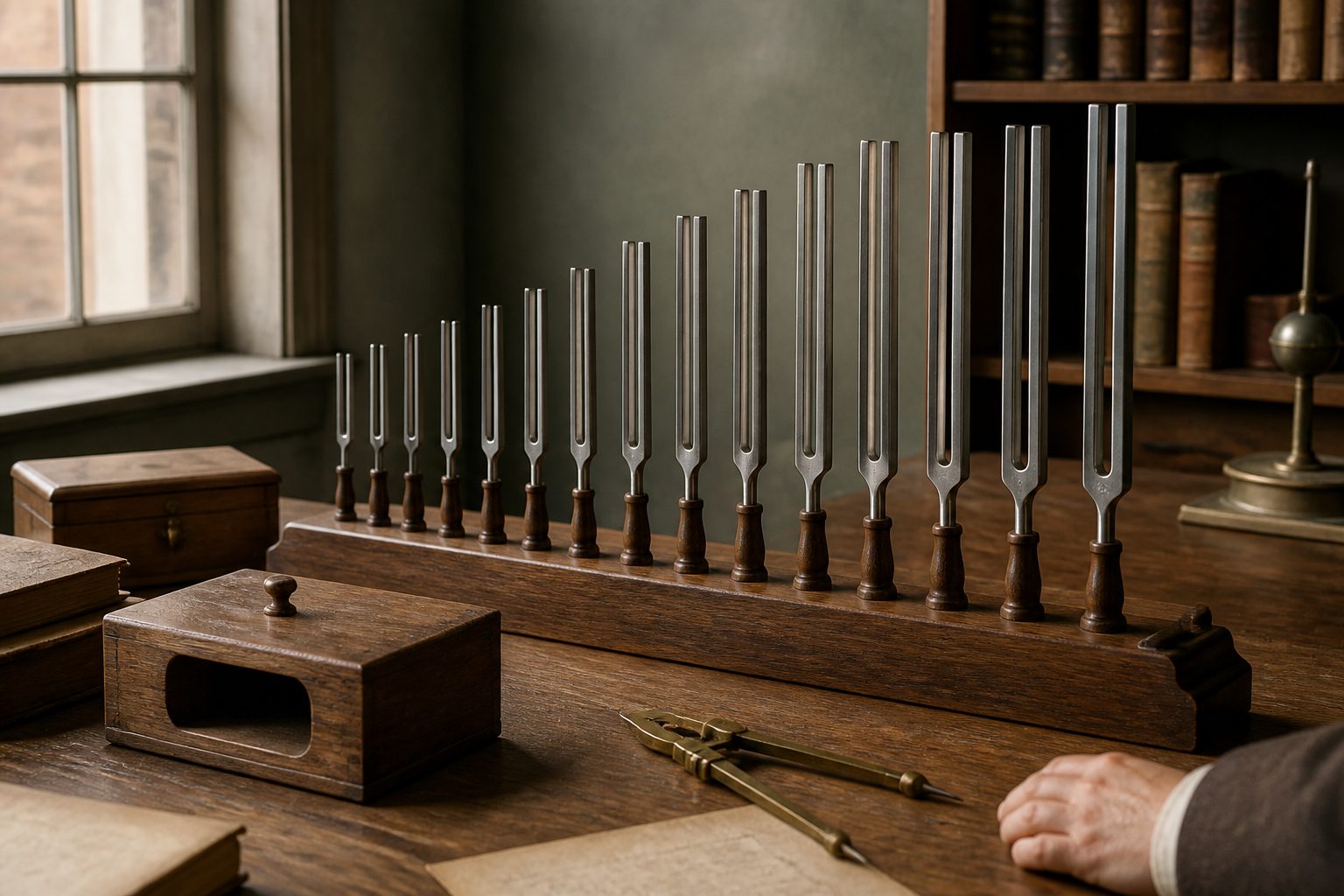
Shore had used one known tone to tune another instrument. Scheibler and Koenig used many known tones to investigate sounds whose frequencies were not yet known. That same combination of consistency and portability soon proved useful in the medical examination room.
When the Tuning Fork Entered Medicine
In the sixteenth century, Girolamo Cardano described how sound could reach the ear through the skull. In 1684, German physician Günther Christoph Schelhammer used an ordinary table fork to investigate what happened when its vibration was conducted through the teeth. These experiments established bone conduction as a subject of hearing research before the purpose-built tuning fork made the observation easier to repeat. A detailed historical account appears in this review of the tuning fork in music and natural science.
The tuning fork offered a recognizable tone without requiring a bell, watch, musical instrument, or elaborate apparatus. During the nineteenth century, physiologists and physicians began using it to compare the routes by which sound reached the inner ear.
Ernst Heinrich Weber described one of the best-known effects in publications of 1825 and 1834. When the stem of a vibrating fork was placed on the midline of the skull, some people with hearing loss perceived the tone more strongly in one ear than the other. Weber was studying hearing physiology rather than performing the standardized bedside test taught today. During the 1840s, physicians including Jean Pierre Bonnafont and E. Schmalz developed the clinical possibilities of the observation, gradually turning it into what became known as the Weber test.
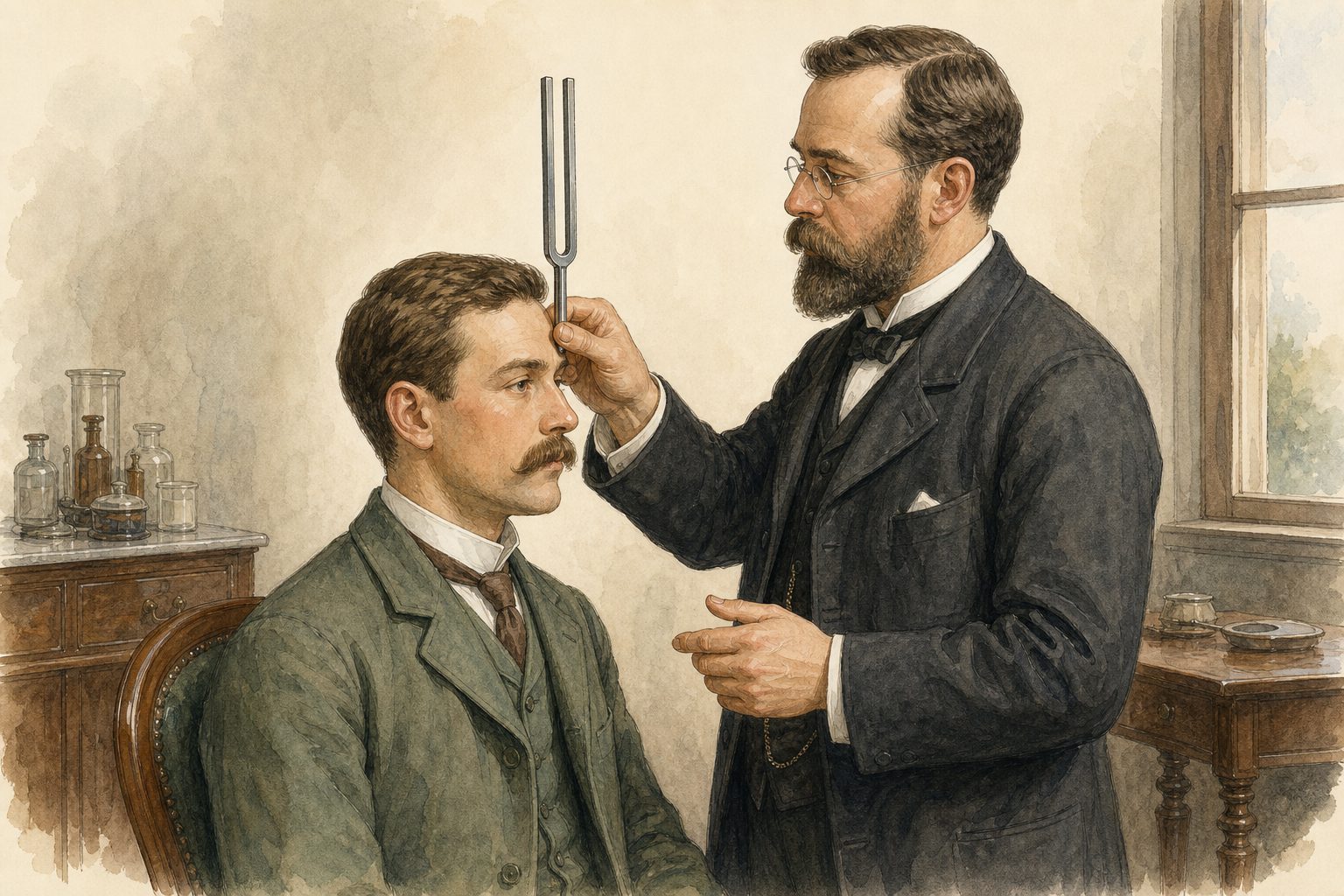
Heinrich Adolf Rinne asked a related but different question. In 1855 he described comparing bone conduction and air conduction in the same ear. In the modern form of the test, the stem of a vibrating fork is placed on the mastoid bone behind the ear. When the patient can no longer hear it, the still-vibrating fork is moved beside the ear canal. With typical hearing, the tone becomes audible again through the air and remains audible for a time after it has faded through bone.
Rinne’s experiment was clear, inexpensive, and easy to repeat, but it was not adopted immediately. Friedrich Bezold and August Lucae helped popularize it in the 1880s, roughly a quarter-century after Rinne published his work. The history is a useful reminder that even a simple medical technique may pass through years of argument, revision, and teaching before it becomes routine.
Modern clinicians generally use a 512 Hz fork for Weber and Rinne testing. The choice is practical. A lower fork such as 128 or 256 Hz produces a stronger tactile sensation, which can make it difficult to distinguish feeling the vibration from hearing the tone. A much higher fork such as 1,024 Hz decays too quickly. At 512 Hz, according to the British Society of Audiology’s recommended procedure, the tone lasts long enough to compare, produces limited overtones, and is not strongly vibrotactile.
Neurology made use of the opposite quality. Here the clinician wants to know whether a person can feel vibration, so a lower-frequency fork is more suitable. A 128 Hz fork may be placed on a joint of the great toe or finger, at the ankle, or on another defined point while the patient’s eyes are closed. The patient reports when the vibration begins and when it disappears. If sensation is reduced at the body’s extremities, the examiner can continue at progressively more proximal locations and compare the pattern with other findings.
In 1903, Adam Rydel and Friedrich Wilhelm Seiffer described a modified fork that made this examination partly quantitative. Weights on its tines prolonged and altered the vibration, while a printed visual scale allowed the examiner to record a value rather than simply “felt” or “not felt.” Versions of the Rydel–Seiffer fork remain in neurological use more than a century later.
These examinations gave the tuning fork two distinct clinical roles. At one frequency it helped a physician compare how a tone was heard through air and bone. At another, it offered a controlled vibration that a patient could feel through contact. In both cases, the crucial reading came from the person being examined: where the tone appeared, and when it was gone. Those responses were interpreted alongside the rest of the examination.
Electronic oscillators, audiometers, and quantitative sensory devices eventually took over many tasks that had once required sets of metal forks. They could generate more frequencies, control intensity, and record results with greater resolution. Yet the tuning fork remained in medical kits and teaching rooms. It required no power, took only seconds to activate, and allowed examiner and patient to attend to the same brief event.
Those practical qualities also attracted practitioners working outside diagnosis. During the later twentieth century, the tuning fork acquired another set of uses—not as a replacement for audiometry or neurological examination, but as a focused source of sound and touch within bodywork, meditation, and complementary healing practice.
The Modern Development of Tuning-Fork Sound Healing
By the time therapeutic tuning-fork systems appeared in the 1970s, voice, rhythm, music, and resonant instruments already had long histories in ritual, care, and contemplative practice. The metal tuning fork entered this territory much later, and its recognizable modern lineages expanded over the following decades.
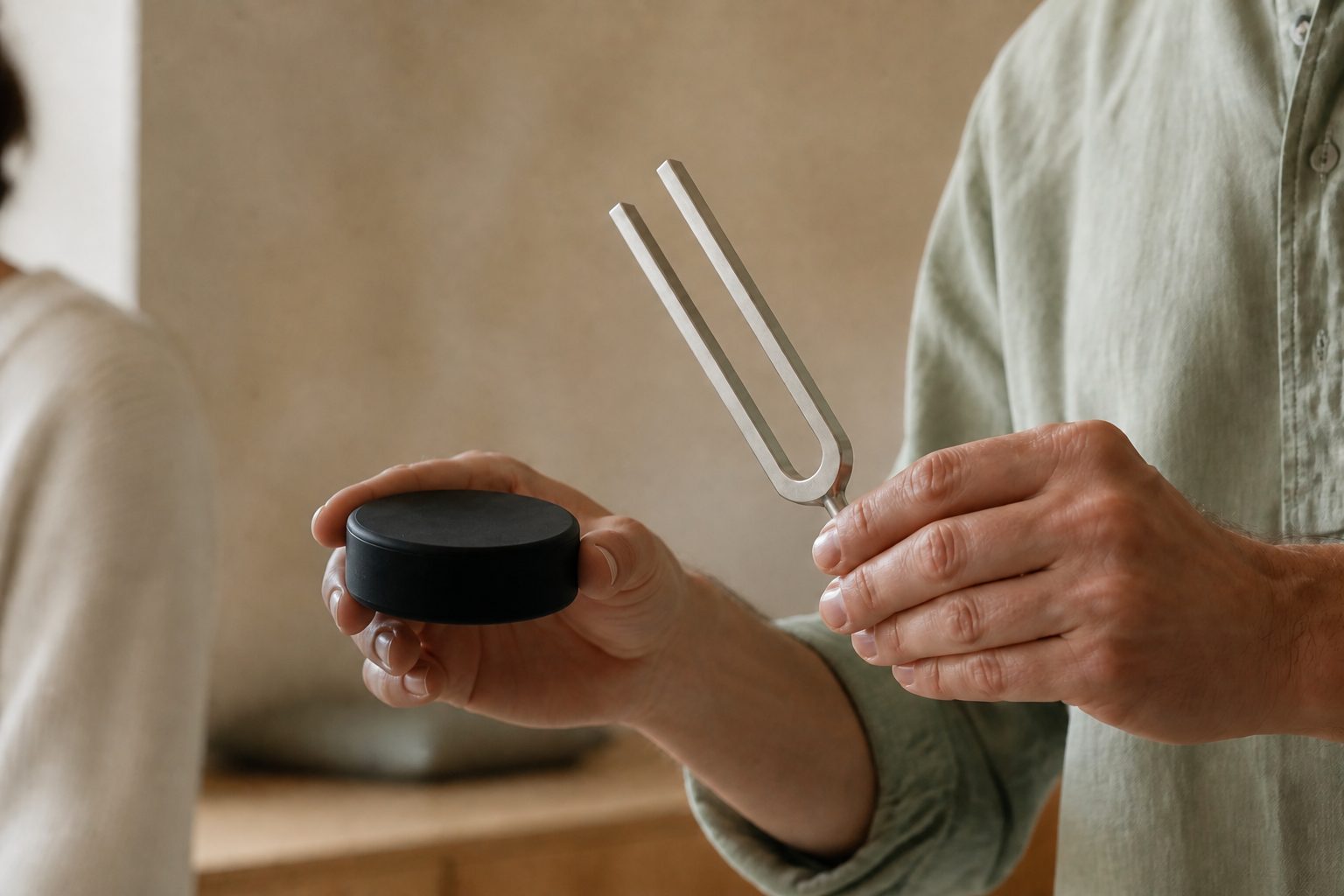
One of the most influential figures was musician, therapist, and naturopathic practitioner John Beaulieu. He dates his experiments with tuning forks to 1973. In his account, extended work with sound—including time spent listening in an anechoic chamber—led him to attend closely to internal bodily sounds and to experiment with how pairs of tuning forks affected his state of listening. His late-1980s book Music and Sound in the Healing Arts placed tuning forks within a broader study of music, consciousness, and therapeutic practice; Human Tuning later concentrated on their practical use.
Beaulieu’s BioSonic system is organized less around isolated “healing frequencies” than around intervals, overtones, and sequences. Its best-known Body Tuners are C256 and G384, which sound the 3:2 perfect fifth discussed in our article on Pythagorean Scientific Pitch. His weighted Otto forks—32, 64, and 128 Hz—were developed for direct contact with the body. In the BioSonic account, the audible interval and the felt vibration are different parts of the same practice.
A second major lineage developed through acupuncture and East Asian medicine. In the early 1990s, acupuncturist Donna Carey was looking for a non-invasive way to work with patients who were uncomfortable with needles or for whom needling was unsuitable. Her collaboration with musician and shiatsu teacher Marjorie de Muynck, together with Ellen Franklin, helped form the system later known as Acutonics. The organization began as the Kairos Institute of Sound Healing in 1997, with its first courses taught the following year.
Acutonics applies tuning forks to acupuncture points and works with meridians, intervals, and frequencies derived from planetary cycles. Its development was not simply a matter of assigning a list of numbers to parts of the body. It joined a pre-existing clinical map—the points and relationships of East Asian medicine—to a new family of non-invasive sound tools. That structured combination of tools, placement, and practitioner training became one of the most widely recognized models of tuning-fork therapy. The Acutonics history records the collaboration and the practical questions from which it grew.
De Muynck subsequently developed Ohm Therapeutics around approximately 136.1 Hz, commonly called the Ohm or OM frequency. The number is obtained by translating the cycle of the Earth’s year into the audible range through repeated octave doubling. Her system uses the fundamental and its octaves in music, on-body application, and work with acupuncture points. Rather than collecting unrelated frequencies, it deliberately builds a practice around one tonal center. Ohm Therapeutics presents that internal coherence as a central part of the method.
Eileen Day McKusick developed another approach beginning in 1996. While working in massage practice, she began moving unweighted forks over and around clients and listening for changes in volume, texture, and overtone activity. Over time, she organized those observations into Biofield Tuning, an off-body method in which the practitioner listens to the fork while moving through the space surrounding the recipient.
Within McKusick’s framework, changes in the fork’s sound are interpreted through a map of emotional history and the human biofield. Those interpretations belong specifically to Biofield Tuning rather than to every form of tuning-fork work. What the method added to the wider field was a sustained emphasis on the fork as a listening instrument: the practitioner attends not only to its stated frequency but also to how its sound seems to change during use. McKusick describes the development of that method in her account of discovering the Biofield Anatomy.
Other systems followed their own routes. SomaEnergetics, founded around 2000, developed practices around the modern Solfeggio frequencies. Some practitioners combined tuning forks with massage, polarity therapy, reflexology, craniosacral work, Reiki, or meditation. Others concentrated on musical intervals or used a single weighted fork as a simple self-care tool.
These lineages share an instrument, but they do not share one explanation of what it does. BioSonic emphasizes intervals, overtones, and nervous-system listening. Acutonics and Ohm Therapeutics connect frequencies with meridians, points, and cosmological cycles. Biofield Tuning listens for changes in the space around the body. Solfeggio systems begin with another set of numbers and associations. Their differences are part of the history of modern sound healing, not a problem that can be resolved by declaring one frequency chart universal.
Weighted, Unweighted, and the Rise of Tuning Systems
Whatever interpretive system surrounds them, weighted and unweighted forks begin with a concrete difference in construction.
A weighted tuning fork has added mass at the ends of its tines. Its dimensions and weights are designed together to produce the intended frequency. When activated, it generally offers a strong, sustained mechanical vibration that travels down the stem. With the stem placed gently against a suitable contact point, that vibration can be felt locally and sometimes across a broader area. The airborne tone remains audible, but bodily contact is usually the principal reason for choosing this construction.
An unweighted fork has bare tines. It generally projects a clearer airborne tone and is easier to use for listening to intervals, sounding near the body, or following the natural decay of a note. It can still transmit vibration through its stem, just as a weighted fork still produces sound; the distinction concerns emphasis, not an absolute boundary.
This is why “weighted for physical healing, unweighted for energy healing” is too crude to describe actual practice. Construction affects how the vibration is delivered. The meaning assigned to that vibration depends on the practitioner’s method, the selected frequency, the point or space in which it is used, and what follows it in the session.
The same applies to frequency. A number engraved on one fork describes how many vibration cycles it completes per second under specified conditions. It does not, by itself, describe a complete practice. A session also has relationships and timing: whether two forks form an octave or fifth, whether they are sounded together or in sequence, whether the first tone is felt and the next is heard, and how long the practitioner waits before activating another. Unlike recorded audio, each activation has its own attack and decay; allowing a tone to finish is one of the practical choices that shapes the session.
Different tuning-fork systems therefore organize sets in different ways. Musical systems may begin with an octave, such as 128 and 256 Hz, or a perfect fifth, such as C256 and G384. Scientific Pitch and Pythagorean tuning provide one network of relationships. The Ohm system begins at approximately 136.1 Hz and works through its octave family. Modern Solfeggio practice usually centers on six frequencies—396, 417, 528, 639, 741, and 852 Hz—while extended sets add 174, 285, and 963 Hz. Planetary, chakra, brainwave, and practitioner-developed sets follow other maps.
These approaches sometimes overlap. A fork may belong to more than one story: 528 Hz appears in the modern Solfeggio set, while C256 can function as Scientific C, the root of a perfect-fifth pair, or simply a clear unweighted tone. The name of the system tells us why a practitioner selected the frequency and how it is meant to relate to the others.
For that reason, a larger set is not automatically more complete for every purpose. A pair can fully express an interval. Four forks can create a progression between contact and listening. Six can present the principal modern Solfeggio series; nine can extend it. What makes a set coherent is not the number of pieces alone, but the logic connecting frequency, construction, and use.
CREVIK’s Approach to Tuning-Fork Sets
CREVIK’s current tuning-fork collection reflects more than one of these modern approaches. The sets are not variations on a single claim that four particular numbers are right for every listener. Each uses weighted and unweighted forks to establish a different route through tactile vibration, musical relationship, and frequencies already meaningful within sound-healing communities.
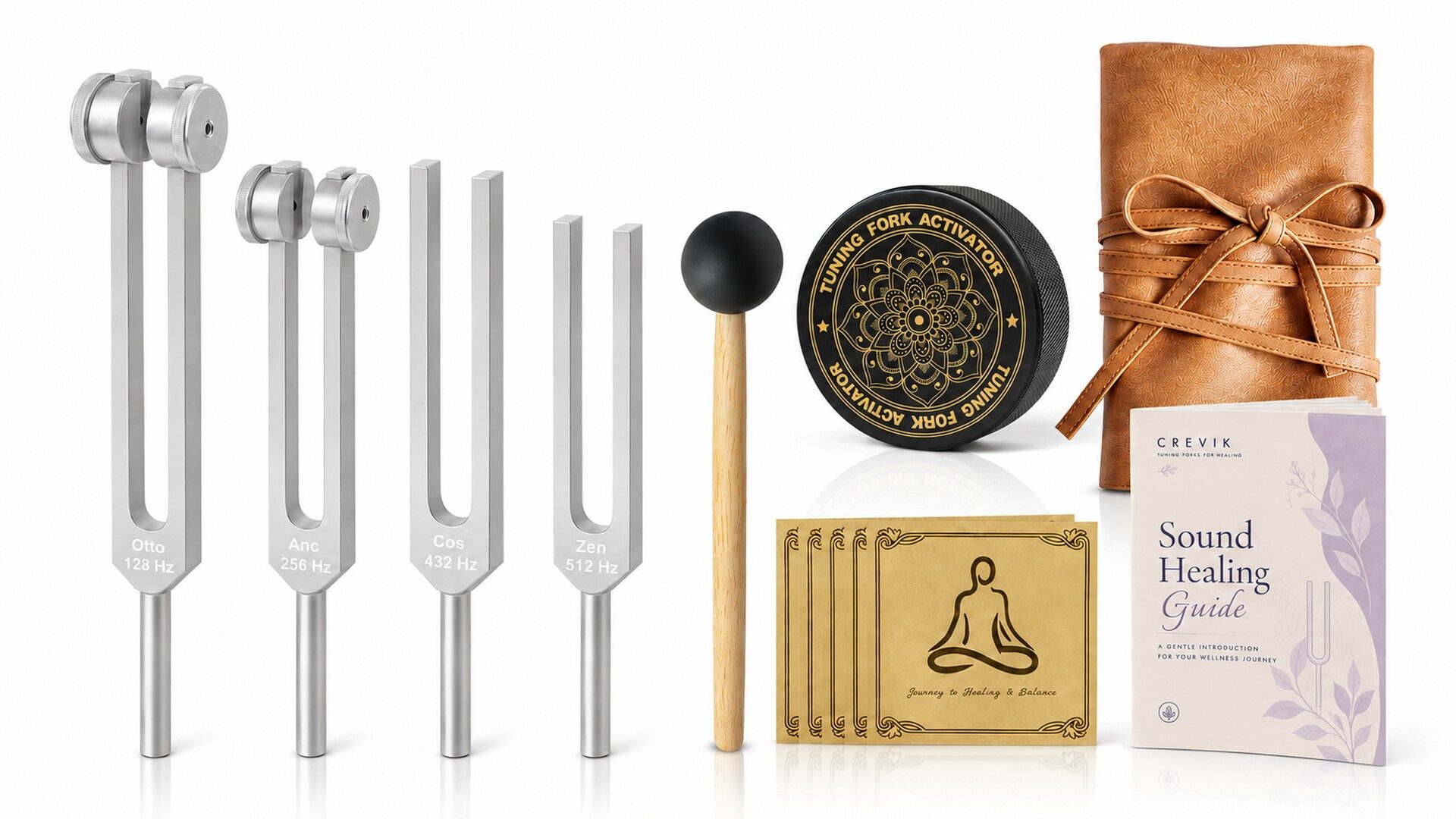
The Alignment Set contains weighted 128 and 256 Hz forks and unweighted 432 and 512 Hz forks. Its internal story begins with the octave relationship between 128 and 256, then moves through the Pythagorean A at 432 toward the upper C at 512. It is the set most directly connected with Scientific Pitch and the interval history explored in our earlier article. The weighted-to-unweighted construction lets that relationship move from contact into open listening.
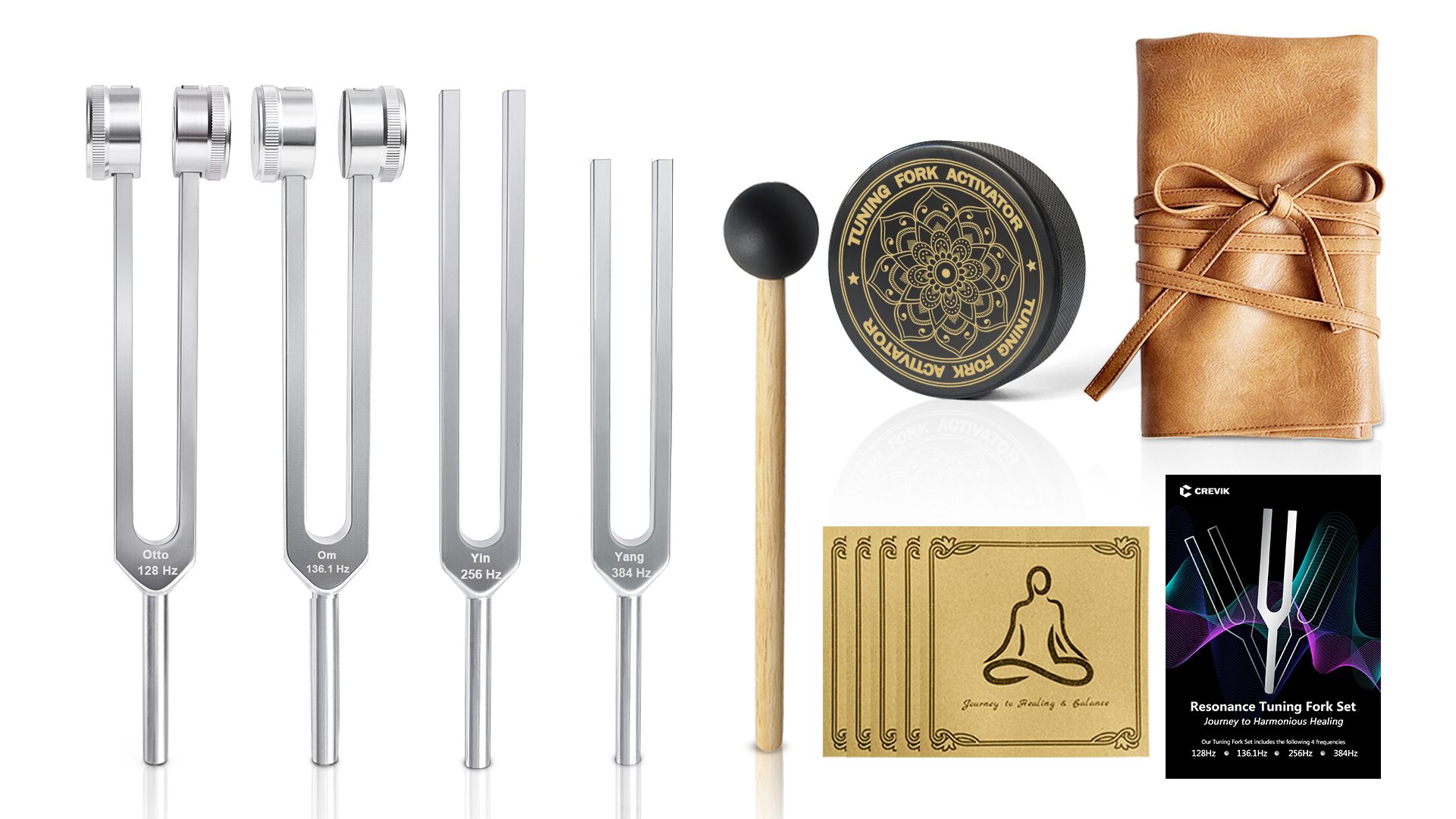
The Resonance Set contains weighted 128 and 136.1 Hz forks, followed by unweighted 256 and 384 Hz forks. Here, several established ideas meet without being collapsed into one. The 128 Hz fork provides a low, tactile beginning. The 136.1 Hz fork introduces the Ohm tradition. The unweighted 256 and 384 Hz forks form the 3:2 perfect fifth used in the BioSonic Body Tuners. The set can therefore be approached through body vibration, a tonal center associated with Ohm, and one of music’s clearest consonant intervals.
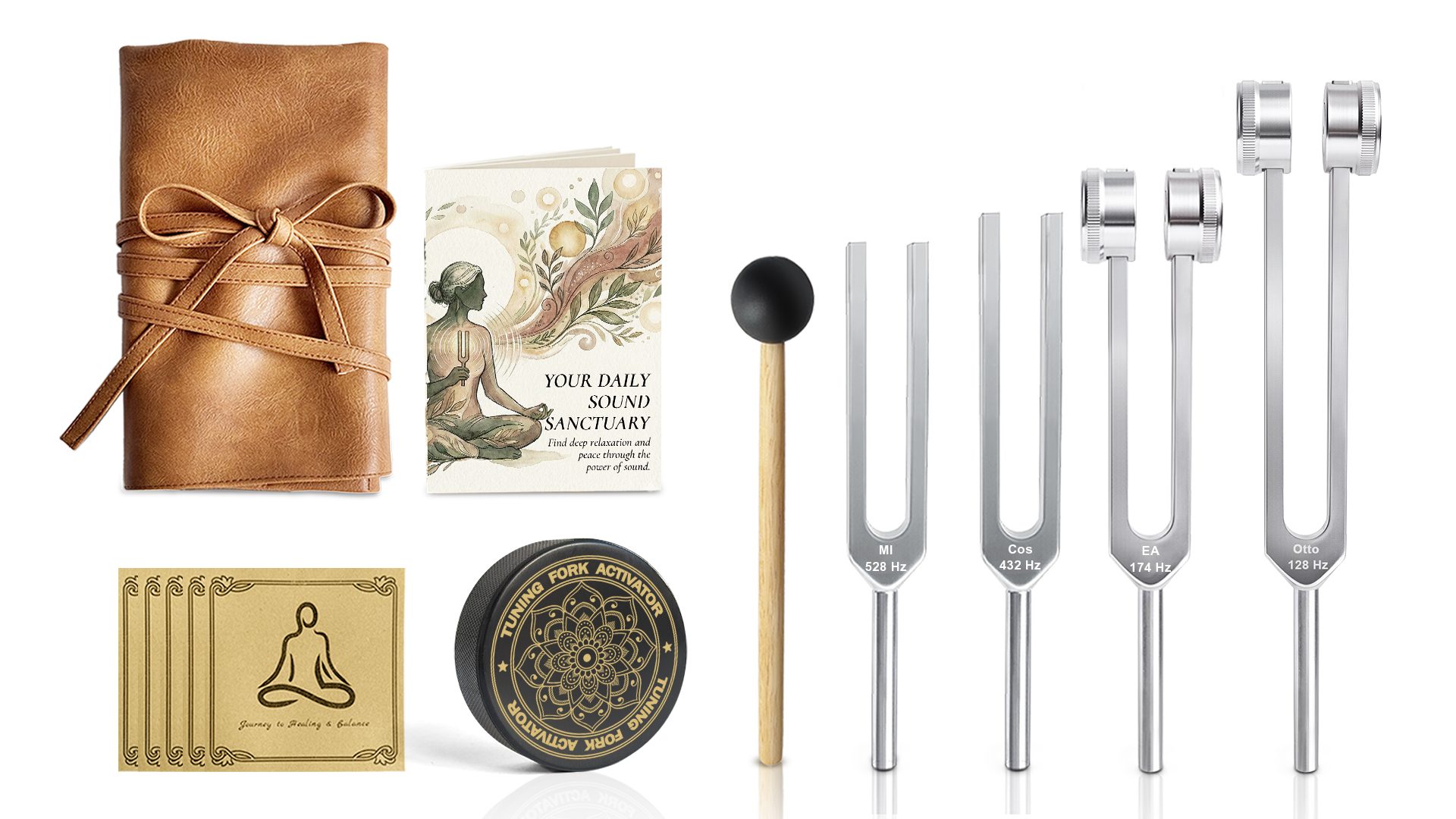
The Harmony Set contains weighted 128 and 174 Hz forks and unweighted 432 and 528 Hz forks. Rather than constructing a single Pythagorean scale, it brings together frequencies that have developed distinct roles in contemporary sound-healing practice. The lower weighted forks emphasize direct vibration; 174 and 528 also connect the set with extended and principal modern Solfeggio traditions, while 432 has its own history as an alternative reference pitch and meditation frequency. Using unweighted forks for the two upper frequencies places greater emphasis on their audible decay.
Future CREVIK sets may follow still other structures: a focused interval pair, a five-fork progression, the six principal Solfeggio frequencies, a nine-fork extended series, or another system whose logic benefits from a larger collection. The same design question applies in each case: what relationships should the user be able to hear or feel, and which construction best supports that experience?
That question is more useful than searching for one universally superior frequency. A person interested in musical ratios may begin with an octave or perfect fifth. Someone already working within an Ohm or Solfeggio practice may want a set that speaks the language of that system. A bodyworker may place greater emphasis on weighted forks, while a practitioner leading meditation may need a wider palette of audible tones. The tool becomes clearer when its intended use is clear.
Shore used the fork to give his lute a reference pitch. A century later, Scheibler placed dozens of forks side by side to measure unknown tones. Otologists compared one tone through air and bone, while neurologists used lower frequencies to examine vibration sense. Modern sound practitioners now arrange the same basic form through contact, intervals, sequences, and periods of quiet listening.
That history provides a useful standard for choosing a tuning fork today. The engraved frequency matters, but so do the fork’s construction, the other tones beside it, and whether it is intended to be felt through contact or heard in the air. Those details determine how a fork or set is actually used. You can see how the current sets answer those questions on the CREVIK tuning-fork collection page.