“When a person is in tune with the cosmos, they are in tune with themselves.” — Hans Cousto, The Cosmic Octave: Origin of Harmony
Look up at the night sky, and you see a silent dance of planets tracing their orbits around the Sun. To our eyes, the solar system is a visual masterwork. To our ears, it is quiet. But what if the movements of the cosmos are not silent at all? What if the planets are actually a symphony of frequencies, humming a song that is simply too deep for the human ear to register?
For centuries, philosophers and scientists have dreamed of hearing this cosmic song. Pythagoras spoke of the Musica Universalis, or the “Music of the Spheres,” suggesting that the proportional movements of celestial bodies create a form of music. In 1619, Johannes Kepler published Harmonices Mundi (The Harmony of the World), using mathematical calculations to map the velocities of planets to musical intervals. Yet, for all their genius, these thinkers treated the music of the planets as a philosophical metaphor or a geometric concept.
It was not until 1978 that a Swiss mathematician and musicologist named Hans Cousto unlocked the mathematical key that translates these celestial orbits into actual, audible sound frequencies and visible colors. He called this principle the Law of the Octave, and his seminal work, The Cosmic Octave: Origin of Harmony, laid the foundation for the entire modern planetary frequency movement in sound healing.
Whether you strike a 136.10 Hz OM tuning fork, lie beneath a Saturn planetary gong, or receive planetary frequencies on acupuncture points during an Acutonics session, you are experiencing the mathematics of the Cosmic Octave. In this comprehensive guide, we will explore the math, the science, the history, and the practical application of this extraordinary system, showing how the movements of the planets are translated into the healing tools of sound and color.
1. The Law of the Octave: The Mathematical Bridge
At the heart of Hans Cousto’s work is a single, elegant mathematical concept: the octave.
In music theory, an octave is the interval between one musical pitch and another with double its frequency. The ratio between the two frequencies is 1:2. For example, if you play a middle A at 440 Hz, the note one octave higher is 880 Hz (440 × 2), and the note one octave lower is 220 Hz (440 ÷ 2). Even though the frequencies are different, our brains perceive them as the same note in different registers. The octave is the interval of lowest energetic resistance; it acts as a universal bridge, linking vibrations across different scales of magnitude.
Cousto’s breakthrough was realizing that this doubling and halving principle is not limited to audible sound. It is a universal law of physics. Any periodic cycle — whether it is the daily rotation of the Earth, its yearly orbit around the Sun, the cycles of the Moon, or the spin of a DNA molecule — has a fundamental period of time (T) that can be converted into a frequency (f). Because these cosmic cycles are incredibly slow, their frequencies are far below the human threshold of hearing. But by repeatedly doubling these frequencies — raising them octave by octave — we can bring them directly into the range of human hearing.
The Calculation Method
The formula Cousto used to calculate planetary frequencies is simple yet profound:
Where:
- T — the period of the celestial cycle, expressed in seconds.
- 1 / T — the fundamental frequency of the cycle in Hertz (cycles per second).
- n — the number of octave doublings required to reach the audible range.
- f — the resulting frequency in the audible range (Hz).
A Worked Example: The Earth Year (OM Frequency)
To see this formula in action, let us calculate the most famous frequency in all of sound healing: the 136.10 Hz OM frequency, which is derived from the Earth’s annual orbit around the Sun.
Step 1 — Find the period T in seconds. The Earth takes approximately 365.24219 days to complete one orbit around the Sun, so we convert that span into seconds:
T = 31,556,925.97 seconds
Step 2 — Calculate the fundamental frequency (1 / T). Taking the reciprocal of the orbital period gives the frequency of the Earth’s year-cycle in Hertz:
This frequency — about 31.7 billionths of a cycle per second — is unimaginably low, far below our hearing range, which begins around 20 Hz.
Step 3 — Raise the frequency by octaves (× 2ⁿ). To bring this frequency into the audible range, we multiply it by 2 repeatedly. Doubling it 32 times (n = 32) gives:
f = 3.16875 × 10⁻⁸ Hz × 4,294,967,296 ≈ 136.10 Hz
By raising the Earth’s orbital rhythm by 32 octaves, we arrive at 136.10 Hz. In music theory, when concert pitch is tuned to the standard A = 440 Hz, this frequency corresponds to a slightly flat C♯ (C-sharp). If we double it one more time, to the 33rd octave, we get 272.20 Hz.
Cousto’s law demonstrates a beautiful, unbroken continuity of vibration:
- At lower octaves (e.g. 8 octaves below hearing), the vibration is perceived as tempo, rhythm, or beat — the Earth’s daily rotation, for instance, translates to a pulse of 45 beats per minute.
- In the middle octaves, it is perceived as audible pitch or sound (136.10 Hz).
- At much higher octaves (around the 40th to 66th), the exact same frequency crosses into the electromagnetic spectrum and is perceived as visible light and color.
2. The Octave of Light: Bridging Sound and Color
One of the most fascinating aspects of Cousto’s work is the mathematical bridge between sound and color. In many spiritual traditions, colors and sounds are linked intuitively. In the Cosmic Octave, they are linked by pure physics.
Visible light is an electromagnetic wave, while sound is a mechanical wave. Despite their physical differences, both are wave phenomena characterized by frequency. Human eyes can perceive a very narrow band of electromagnetic frequencies, spanning roughly one octave: from the lowest visible red light at approximately 375 trillion Hz (terahertz) to the highest visible violet light at approximately 750 trillion Hz.
By raising a planetary frequency about 40 octaves above its audible range, the vibration lands precisely within the visible spectrum. The eye acts as the “octave double” of the ear.
Cousto’s Chromatic Tone-Color Wheel
Hans Cousto mapped the twelve chromatic semitones of the musical scale to twelve corresponding colors in the visible spectrum. By raising musical pitches by 40 octaves, we can see exactly which color corresponds to each note:
| Musical Note | Corresponding Color | Musical Note | Corresponding Color |
|---|---|---|---|
| F | Purple-Red (Magenta) | B♭ | Yellow-Green |
| F♯ | Red | C | Green |
| G | Orange-Red | C♯ | Turquoise |
| G♯ | Orange | D | Dark Blue |
| A | Yellow-Orange | D♯ | Prussian Blue |
| B | Yellow | E | Violet |
Through this mathematical correspondence, we can determine the precise “color” of each celestial cycle:
- The Earth Year (136.10 Hz / C♯): Transposed 40 octaves higher, it vibrates at approximately 500 terahertz, which corresponds to a soothing turquoise / green-blue.
- The Earth Day (194.18 Hz / G): Transposed 40 octaves higher, it vibrates at approximately 540 terahertz, corresponding to an active orange-red.
- The Platonic Year (172.06 Hz / F): In Cousto’s system, the F note lies at the absolute boundary of the visible spectrum — where purple-red meets ultraviolet. Joining these two ends of the color circle (a concept inspired by Goethe’s color theory) yields a rich, spiritual violet.
- The Synodic Moon (210.42 Hz / G♯): Transposed to light, it shines as a vibrant, instinctual bright orange.
- The Sun (126.22 Hz / B): Transposed to light, it vibrates as a radiant light green / yellow-green.
Note — It is important to distinguish between physics-derived colors (calculated via the octave-of-light formula) and the symbolic paint codes used by some tuning fork manufacturers. The Acutonics system, for instance, uses symbolic colors to identify their forks (gold for Ohm, pink for Venus, copper-brown for Saturn) to aid practitioners in clinical settings. Both frameworks have their place: one is rooted in wave mechanics, the other in archetypal therapy and clinical design.
3. The Triad of Earth Tones: Body, Soul, and Spirit
In The Cosmic Octave, Cousto places special emphasis on three frequencies derived from the movements of our home planet. He organizes them into a triad representing the three levels of human existence: Body (Earth Day), Soul (Earth Year / OM), and Spirit (Platonic Year). This triad serves as the practical core of the Cosmic Octave system.
I. The Earth Day Tone — 194.18 Hz (Note: G | Color: Orange-Red | Level: Body)
The Earth Day frequency is calculated from the time it takes the Earth to rotate once on its axis: 24 hours (or 86,400 seconds). When this daily cycle is raised 24 octaves, it yields 194.18 Hz (a G). (Calculated using a sidereal day of 23 hours and 56 minutes, it yields a near-identical 194.71 Hz.)
- The Principle of Dynamic Activity: This tone represents our physical relationship to the Earth’s daily cycle of waking and sleeping. It is a tonic, stimulating, vitalizing frequency.
- Color Correspondence: Its color is orange-red, a shade associated with willpower, drive, physical energy, and the stimulation of life-force.
- Practical Use: This is an excellent frequency to use in the morning or before physical activity. It helps ground consciousness in the physical body, stimulates circulation, and combats lethargy. In chakra work, it is applied to the Root Chakra (Muladhara) to activate Kundalini energy.
II. The Earth Year Tone (OM) — 136.10 Hz (Note: C♯ | Color: Turquoise | Level: Soul)
The Earth Year frequency is derived from the Earth’s orbit around the Sun (365.242 days). Raised 32 octaves, it yields 136.10 Hz (C♯).
- The Primordial OM of Meditation: One of the most beautiful discoveries in Cousto’s work is that 136.10 Hz corresponds exactly to the frequency of the Sadja (the root note “Sa” of the sitar) in ancient Indian classical music. For thousands of years, Indian sages tuned their instruments to this pitch and chanted the sacred syllable “OM” in resonance with it. To discover that this primordial sound is the mathematical signature of the Earth’s journey around the Sun is a profound validation of ancient intuition. Cousto equated this frequency with the Christian “Amen” and the Hindu Nada Brahman (the divine sound of creation).
- The Principle of Relaxation and Relationship: Unlike the active Earth Day tone, the Earth Year tone is deeply calming, centering, and balancing. It corresponds to the level of the soul — the space of emotional relationship, peace, and internal reflection.
- Color Correspondence: Its color is turquoise, a shade that sits between the cooling properties of blue and the healing properties of green. It is soothing and contemplative.
- Practical Use: The OM frequency is the universal starting point for sound healing. It can be used at any time of day to relieve stress, quiet a busy mind, support meditation, and prepare the body for deep sleep. When placed on the body, it resonates beautifully on the Heart Chakra (Anahata).
- Body Placement: In practice, striking a weighted 136.10 Hz fork and placing its stem on the lower sternum — specifically acupuncture points Conception Vessel 16 and 17 (Ren-mai) — induces a deep state of peace and chest resonance.
III. The Platonic Year Tone — 172.06 Hz (Note: F | Color: Violet | Level: Spirit)
The Platonic Year frequency is derived from a much larger astronomical cycle: the precession of the Earth’s axis. As the Earth spins, its axis slowly wobbles like a spinning top, tracing a full circle every 25,920 years. This cycle dictates the transition of the astrological ages (such as the move from the Age of Pisces to the Age of Aquarius). When this massive cycle is raised 47 octaves, it yields 172.06 Hz (an F).
- The Principle of Joyous Spirit: This tone corresponds to the spiritual realm, representing cosmic clarity, liberation, and higher consciousness.
- Color Correspondence: Its color is violet, the traditional color of spiritual mastery, integration, and the crown.
- Cultural Context: In ancient China, the fundamental tone of state music — the “Yellow Bell” (Huang Zhong) — was tuned to an F that aligns closely with this frequency. The Chinese classics held that this tone had to be in perfect harmony with the universe for the empire to flourish.
- Practical Use: The Platonic Year tone is highly uplifting and clarifying. It is typically applied to the Crown Chakra (Sahasrara) or the acupuncture point Governing Vessel 20 (Du-mai) at the top of the head. It supports spiritual integration, encourages lightheartedness, and clears mental stagnation.
The Antidote Rule
Cousto noted that these three Earth frequencies form a natural hierarchy of stabilization. If the stimulating, physical energy of the Earth Day tone (194.18 Hz) feels too intense or creates agitation, you can balance it by applying the relaxing Earth Year tone (136.10 Hz). If that, in turn, feels too heavy or introspective, you can lift the energy into spiritual clarity by applying the Platonic Year tone (172.06 Hz).
4. The Dance of the Moon and the Sun
Beyond the Earth, the two most influential celestial bodies in our lives are the Moon and the Sun. The frequencies calculated from their cycles represent the polarity of Yin (feminine / receptive) and Yang (masculine / expressive).
The Synodic Moon — 210.42 Hz (Note: G♯ | Color: Bright Orange | Principle: Yin / Erotic)
The Moon has several cycles, but the most culturally and biologically significant is the synodic month — the time from one Full Moon to the next, which takes 29.5306 days. Raised 29 octaves, it yields 210.42 Hz (a G♯).
- The Lunar Principle: The synodic Moon frequency represents the archetype of the feminine, emotional depth, communication, and the erotic.
- Color Correspondence: Its color is bright orange. In Cousto’s color theory, orange is a blend of red (will) and yellow (anticipation), representing instinctual, dynamic energy.
- Practical Use: This frequency is widely used to support emotional release, balance the fluid systems of the body, and regulate hormonal and menstrual cycles. It is highly effective during the Full Moon. In acupuncture, it is often applied to the lower abdomen (such as points on the Ren-mai meridian) to support reproductive health and kindle creative energy.
The Sun Tone — 126.22 Hz (Note: B | Color: Light Green | Principle: Transcendental Gateway)
The Sun frequency is unique in Cousto’s system. Unlike the planets, the Sun does not orbit another body in a way that yields a simple, observable period. Instead, Cousto derived the Sun frequency theoretically.
He calculated the orbit of a hypothetical planet circling the Sun at the speed of light (299,792.5 km/s) at a distance equal to the Sun’s gravitational length (its Schwarzschild radius, or black-hole boundary, approximately 1.47 million kilometers). This hypothetical orbit yields an incredibly rapid period of 0.00003095 seconds — a frequency of 32,312.52 Hz. By lowering this frequency 8 octaves, Cousto arrived at the audible Sun tone of 126.22 Hz (a B):
- The Gateway Between Worlds: Because it is calculated at the boundary of light-speed and gravitation, Cousto described the Sun tone as a “door from one world into another.” It represents the threshold between expansion and contraction, Great Yang and Great Yin. It is the frequency of pure center, warmth, and boundary dissolution.
- Color Correspondence: Its color is a radiant light green.
- Practical Use: Because of its transcendental, boundary-dissolving nature, the Sun tone can feel disorienting or intense for beginners. Cousto advised becoming comfortable and grounded with the Earth and planetary frequencies before working with the Sun tone. Once integrated, it is used to stimulate vitality, clear deep-seated blocks, and align the solar plexus chakra.
5. The Planetary Orchestra: Sidereal Orbits & Archetypes
When we expand our focus to the rest of the solar system, each planet’s orbital period around the Sun yields a specific frequency. These frequencies are calculated using the planets’ sidereal years (the time it takes a planet to complete one full orbit relative to the stars).
Below is the definitive reference table of the planetary frequencies calculated by Hans Cousto, complete with their musical notes, physics-derived colors, and traditional archetypal meanings:
| Celestial Body | Orbital Period (Earth Years) | Frequency (Hz) | Note | Octave | Color (Octave of Light) | Archetypal Principle & Chakra |
|---|---|---|---|---|---|---|
| Sun | Theoretical | 126.22 | B | 8th lower | Light Green | Center, gateway, boundary dissolution |
| Mercury | 0.24082 | 141.27 | C♯ | 30th | Turquoise | Communication, intellect, synthesis (Throat) |
| Venus | 0.61521 | 221.23 | A | 32nd | Yellow-Orange | Harmony, relationship, love, beauty (Third Eye / Heart) |
| Earth (OM) | 1.000 | 136.10 | C♯ | 32nd | Turquoise | Relaxation, grounding, integration (Heart) |
| Mars | 1.88081 | 144.72 | D | 32nd | Dark Blue | Strength, courage, action, drive (Root / Sacral) |
| Jupiter | 11.86223 | 183.58 | F♯ | 36th | Red | Expansion, vision, growth, abundance (Third Eye) |
| Saturn | 29.45774 | 147.85 | D | 37th | Dark Blue | Structure, discipline, boundaries (Crown) |
| Uranus | 84.01529 | 207.36 | G♯ | 39th | Orange | Liberation, awakening, sudden change |
| Neptune | 167.78830 | 211.44 | G♯ | 40th | Orange | Spirituality, dreams, artistic inspiration |
| Pluto | 248.4301 | 140.25 | C♯ | 41st | Turquoise | Rebirth, transformation, deep shadow work |
Exploring the Planetary Frequencies
Let us examine how each planetary frequency is understood and applied in sound therapy.
1. Mercury (141.27 Hz | Note: C♯ | Color: Turquoise)
Mercury is the planet of the mind. Its frequency represents communication, intellectual agility, mental synthesis, and the flow of information.
- Applications: Use Mercury to clear mental fog, enhance logical thinking, and facilitate communication. It is highly beneficial for writers, speakers, and students. In therapy, it is applied to the Throat Chakra (Vishuddha) to support self-expression.
2. Venus (221.23 Hz | Note: A | Color: Yellow-Orange)
Venus embodies the energy of love, beauty, harmony, and relationship. It is the frequency of balance and aesthetic appreciation.
- Applications: Venus is used to open the heart, encourage emotional harmony, and promote self-love and compassion. It is a wonderful frequency for relationship healing and creative artistic work. In chakra therapy, it is commonly applied to the Third Eye or the Heart Chakra.
3. Mars (144.72 Hz | Note: D | Color: Dark Blue)
Mars represents the warrior archetype. Its frequency is tied to physical energy, courage, decisiveness, and the drive to take action.
- Applications: Mars is used to stimulate vitality, overcome hesitation, and cultivate inner strength. It provides the energy needed to manifest ideas into physical reality. Because it is highly energizing, it is typically applied to the lower chakras (Root and Sacral).
4. Jupiter (183.58 Hz | Note: F♯ | Color: Red)
Jupiter is the planet of expansion, luck, abundance, and higher wisdom. Its frequency encourages optimism and the ability to see the “big picture.”
- Applications: Jupiter is used to support personal growth, welcome abundance, and expand consciousness. It helps open the mind to new possibilities. It is often applied to the Third Eye (Ajna) to stimulate inner vision and intuition.
5. Saturn (147.85 Hz | Note: D | Color: Dark Blue)
Saturn is the planet of structure, discipline, boundaries, and time (Chronos). While Mars is about action, Saturn is about form and grounding.
- Applications: Saturn is used to establish healthy boundaries, encourage focus, and ground scattered energy. It is an excellent tool for bone and joint health, reflecting its archetypal connection to structure. In sound therapy, it helps us face reality with discipline and resilience.
6. Uranus (207.36 Hz | Note: G♯ | Color: Orange)
Uranus is the planet of revolution, awakening, and sudden, unexpected change. It represents the breakthrough of new ideas and the dismantling of old, limiting structures.
- Applications: Uranus is used to break through stagnation, encourage innovation, and support major life transitions. It helps liberate the mind from dogmatic thinking.
7. Neptune (211.44 Hz | Note: G♯ | Color: Orange)
Neptune governs the realms of the subconscious, dreams, mysticism, and spiritual union. It is the planet of dissolution — dissolving the boundaries of the ego to connect with the divine.
- Applications: Neptune is used to support deep meditation, dreamwork, and artistic inspiration. It helps us access the transpersonal realms. Because it is highly floating and ethereal, it must be used with grounding frequencies (like Earth / OM) to avoid feeling spaced out.
8. Pluto (140.25 Hz | Note: C♯ | Color: Turquoise)
Pluto represents the underworld, deep transformation, shadow work, death, and rebirth. It is the frequency of radical purging and renewal.
- Applications: Pluto is used to support deep emotional healing, clear generational trauma, and assist individuals going through profound personal transformations. It helps us access the deep resources stored in our subconscious.
6. How to Work with Planetary Tuning Forks: A Practical Guide
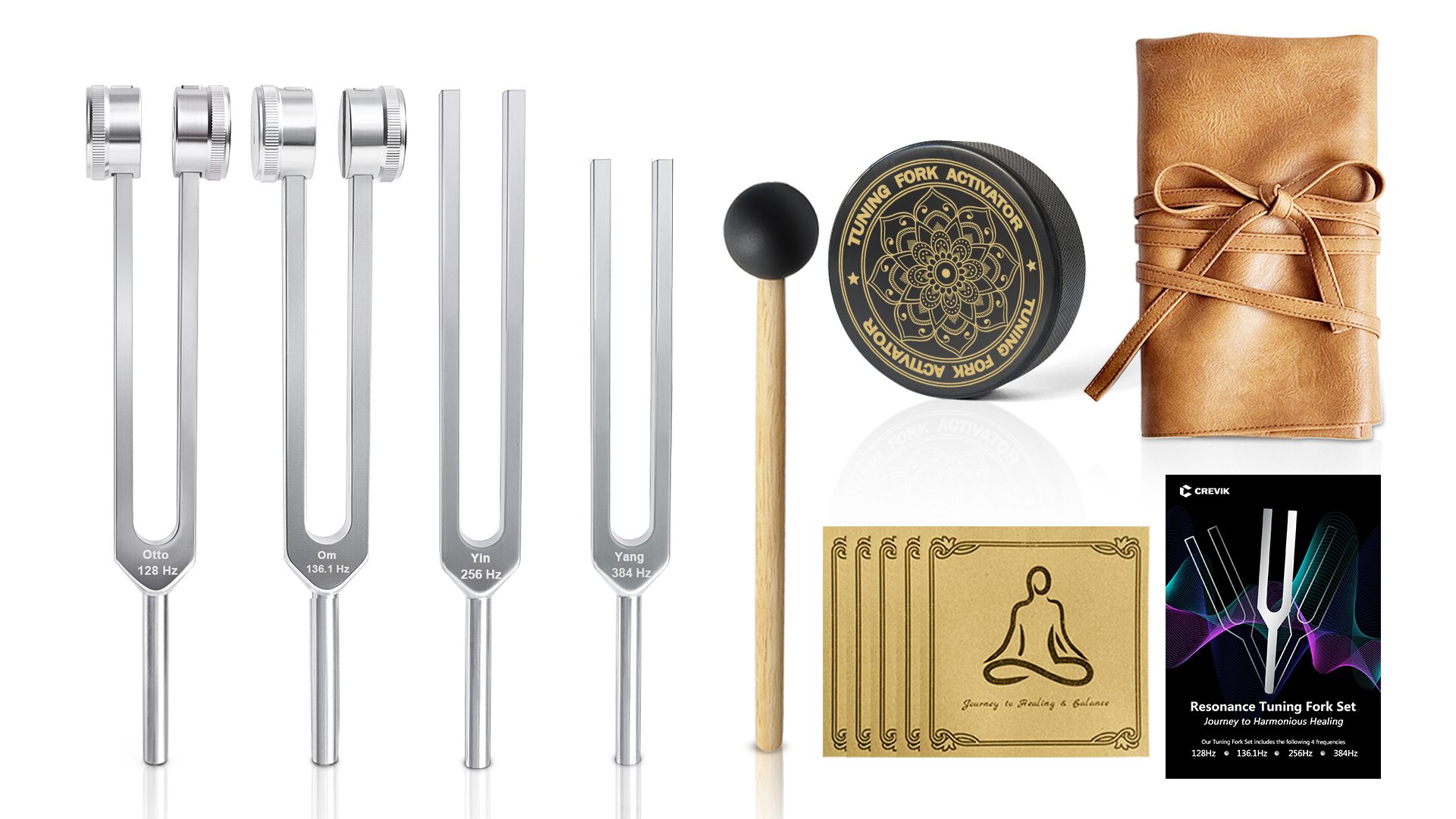
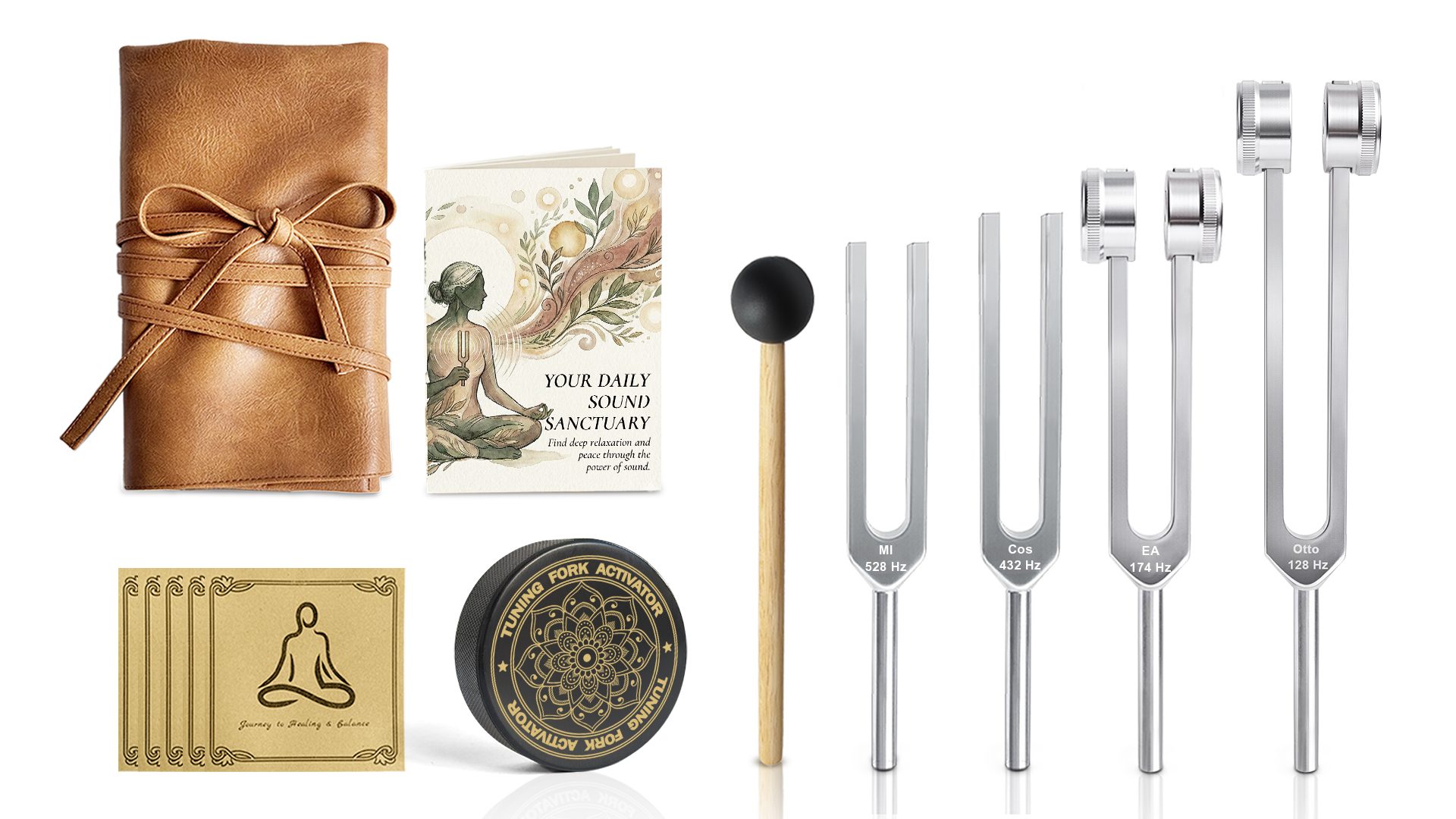
Now that we understand the mathematics and meaning behind the Cosmic Octave, how do we apply this knowledge practically? Tuning forks are the most precise and accessible tools for working with these frequencies. When selecting planetary forks, you will encounter two types — weighted and unweighted — and knowing the difference is crucial for effective therapy.
Weighted vs. Unweighted Tuning Forks
Weighted Tuning Forks:
- Appearance: Round brass or aluminum weights are attached to the ends of the prongs.
- Function: The weights lower the frequency of the fork and concentrate the vibration at the stem. When struck, they produce a very quiet audible sound but an incredibly strong, physical vibration that can be felt through the handle.
- Application: Weighted forks are designed to be placed directly on the body. You hold the fork by the stem and press its base against bones, joints, muscle trigger points, or acupuncture points (a practice known as phonophoresis). The physical vibration travels deep into the tissues, relaxing muscles, increasing local circulation, and stimulating the flow of energy (Qi) along meridians.
- Key Example: The weighted OM 136.10 Hz fork is the de-facto standard for physical relaxation and acupoint stimulation.
Unweighted Tuning Forks:
- Appearance: Straight, uniform prongs with no weights attached.
- Function: Unweighted forks vibrate at higher frequencies and ring for much longer. They produce a loud, clear, pure musical tone, but very little physical vibration is felt through the stem.
- Application: Unweighted forks are designed to be used in the air around the body (the biofield or aura) or near the ears for auditory therapy. They are excellent for clearing energy fields, balancing the chakras, shifting brainwave states, and creating acoustic intervals.
- Key Example: An unweighted Venus 221.23 Hz fork used near the ears helps calm the nervous system and induce a state of creative relaxation.
The Art of Phonophoresis (Acupoint Placement)
Developed in part by French physician Jean Lamy and popularized globally by systems like Acutonics and Ohm Therapeutics, phonophoresis is the application of sound vibration to acupuncture points and meridians.
By placing a weighted planetary tuning fork on specific acupoints, you combine the healing properties of the planetary frequency with the energetic pathways of Traditional Chinese Medicine (TCM). Here are three foundational placements to begin with.
1. The Grounding Portal: Kidney 1 (Yongquan)
- Location: On the sole of the foot, in the depression that forms when the toes are curled.
- Fork to Use: Weighted OM (136.10 Hz) or Earth Day (194.18 Hz).
- Benefit: Kidney 1 is the lowest acupuncture point on the body, representing our connection to the Earth. Applying the grounding OM frequency here pulls energy down from an overactive head, calms anxiety, and establishes a firm sense of stability and presence.
2. The Center of Peace: Conception Vessel 17 (Shanzhong)
- Location: In the center of the chest, on the sternum, level with the nipples.
- Fork to Use: Weighted OM (136.10 Hz).
- Benefit: Known as the “Sea of Qi” and the physical location of the Heart Chakra, CV 17 is the center of emotional balance. Applying the OM frequency here opens the chest, deepens respiration, relieves emotional grief, and settles the nervous system.
3. The Gate of Spiritual Clarity: Governing Vessel 20 (Baihui)
- Location: At the vertex of the head, on the midline, in line with the apex of the ears.
- Fork to Use: Weighted Platonic Year (172.06 Hz).
- Benefit: Known as the “Hundred Meetings,” GV 20 connects us to celestial energy and the Crown Chakra. Applying the Platonic Year frequency here clears the mind, uplifts the spirit, and promotes a sense of spiritual connection and joy.
7. Resolving the Frequency Confusion: Where the Cosmic Octave Fits
If you have researched sound healing online, you have likely run into a confusing conflict. Some websites claim the Heart Chakra vibrates at 639 Hz (according to the Solfeggio frequencies). Others claim 341.3 Hz (according to Pythagorean tuning). Meanwhile, Hans Cousto’s Cosmic Octave states that the Heart frequency is 136.10 Hz (the Earth Year OM).
How can they all be correct? The short answer is that these systems are built on different structural philosophies. Understanding how they differ helps us appreciate the unique power of the Cosmic Octave.
The Three Major Frequency Systems in Sound Healing
1. The Solfeggio Frequencies (e.g. 396 Hz, 528 Hz, 639 Hz)
The Solfeggio system is a modern reconstruction of a historical medieval singing scale. Its frequencies are calculated using a specific numerological grid based on the reduction of digits (often summing to 3, 6, or 9). These tones are primarily vocal and melodic, designed to balance emotional and spiritual blockages. The Solfeggio system is highly intuitive and widely popular, but its frequencies are not derived from physical astronomical cycles.
2. Pythagorean / Natural Tuning (A = 432 Hz or C = 256 Hz)
Pythagorean tuning is based on the geometry of pure musical intervals (specifically the perfect fifth, with a frequency ratio of 2:3). Advocates of A = 432 Hz argue that this standard creates intervals in harmony with the geometry of nature and human physiology. It is a highly cohesive musical system, but its baseline is a chosen geometric anchor rather than a direct translation of a planetary orbit.
3. The Cosmic Octave (Cousto)
Unlike the Solfeggio and Pythagorean systems, the Cosmic Octave is astronomical. It does not try to build a traditional diatonic musical scale. Instead, it asks: what is the actual, physical rhythm of the Earth, Moon, Sun, and planets, and how can we hear them?
Because of this, the Cosmic Octave tones do not form a traditional, pretty musical scale when played in sequence. They are a cosmological palette. Striking Mars (144.72 Hz) and Venus (221.23 Hz) together creates a complex, dissonant interval — but energetically, it represents the exact relational tension between the masculine and feminine principles of our solar system.
Frequency + Intention = Healing
In sound healing, we follow the formula popularized by sound pioneer Jonathan Goldman: Frequency + Intention = Healing.
There is no single “scientifically correct” frequency for any part of the body. The human body is a multi-dimensional instrument. The Solfeggio frequencies resonate with our emotional and spiritual intentions. Pythagorean tuning aligns us with the geometric architecture of sound itself. The Cosmic Octave connects us directly to the physical movements of the universe.
By choosing the Cosmic Octave, you are choosing the path of cosmological alignment — tuning the microcosm of your physical body to the macrocosm of the solar system.
8. Conclusion: Tuning the Microcosm to the Macrocosm
When we strike a planetary tuning fork, we are doing something far deeper than just listening to a pleasant sound. We are engaging in a process of resonance-matching.
Our bodies are rhythmic systems. Our hearts beat, our lungs breathe, our brainwaves cycle, and our cells divide in accordance with natural biological clocks. When we live in stressful, industrialized environments, these natural rhythms become disrupted, leading to fatigue, anxiety, and physical disharmony.
By introducing the precise, astronomical frequencies of the Cosmic Octave to our ears and bodies, we offer our nervous system a reference point of perfect order. We invite our biological clocks to entrain with the astronomical clocks of the cosmos.
When you strike the 136.10 Hz OM fork, you are resonating with the Earth’s year. When you strike the 194.18 Hz Day fork, you are aligning with the Earth’s daily spin. You are reminding your body that it is not separate from nature, but a vital part of a vast, harmoniously humming universe.
At CREVIK, we design our sound healing instruments to meet the exact mathematical calibrations of the Cosmic Octave, ensuring that every vibration you introduce to your practice is an authentic, non-arbitrary gateway to cosmological harmony. Let the planets sing through you, and discover the deep peace of being in tune with the cosmos.
9. Frequently Asked Questions
Q1: What musical note is 136.10 Hz?
When tuned to the standard concert pitch of A = 440 Hz, 136.10 Hz corresponds to the note C♯ (C-sharp). Because it is calculated directly from the Earth’s year-cycle, it is slightly flatter than a standard tempered C♯, carrying a natural, microtonal quality.
Q2: Is the 136.10 Hz OM frequency the same as the Schumann Resonance?
No. They are derived from completely different physical phenomena:
- The Schumann Resonance (7.83 Hz): an electromagnetic frequency generated by lightning strikes in the cavity between the Earth’s surface and the ionosphere. It is a measurement of the Earth’s atmospheric electromagnetic field.
- The OM Frequency (136.10 Hz): the acoustic transposition of the Earth’s physical orbit around the Sun, calculated by raising the year-long orbit by 32 octaves.
Q3: Why do some websites assign different colors to the planets?
You may notice that some sound healing schools use different colors for planetary tuning forks than those listed in Cousto’s system. This is because there are two primary color frameworks:
- Physics-Derived Colors (Cousto’s Octave of Light): calculated by raising the planet’s orbital frequency by ~40 octaves into the visible light spectrum. For example, the Earth Year (C♯) mathematically yields turquoise.
- Symbolic Color Codes: some lineages (such as Acutonics) assign symbolic, archetype-based colors to their tools for ease of clinical identification (e.g. Venus is colored pink to represent love, even though its physics-derived frequency yields yellow-orange). Both systems are valid, depending on whether you are working with wave mechanics or symbolic psychology.
Q4: Can I use multiple planetary tuning forks together?
Yes. Playing two planetary tuning forks together creates a musical interval that combines the archetypal energies of both celestial bodies. For example, striking the Earth / OM fork (136.10 Hz) and the Venus fork (221.23 Hz) creates a highly soothing, heart-opening interval. In sound therapy, combining forks is a powerful way to address complex emotional or physical blockages.
Q5: How often should I use planetary tuning forks?
Planetary tuning forks are entirely safe for daily use. A typical self-treatment session lasts between 10 and 20 minutes. You can strike and place a weighted fork on a specific acupoint three times consecutively, allowing the vibration to completely fade before striking it again. Listen to your body and adjust your practice based on how you feel.
References and Further Reading
- Cousto, Hans. The Cosmic Octave: Origin of Harmony. LifeRhythm, Revised Edition, 2000. ISBN 0-940795-20-5.
- Kepler, Johannes. Harmonices Mundi (The Harmony of the World), 1619.
- Goethe, Johann Wolfgang von. Theory of Colours (Zur Farbenlehre), 1810.
- Acutonics Institute of Integrative Medicine. From Galaxies to Cells: Planetary Science, Harmony, and Medicine.