“The OM tone is the sound of the year… it is the frequency of the Earth’s orbit around the Sun, brought into the audible range. Chanting OM or listening to this tone is our way of aligning with the natural rhythm of our cosmic home.” — Hans Cousto, The Cosmic Octave
In an era defined by constant notifications, sensory overload, and hyper-accelerated schedules, our nervous systems are under siege. We spend our days caught in a state of high-alert, our minds racing ahead of our bodies. In this storm of modern life, we instinctively search for a reset button — a way to step off the treadmill of active thoughts and drop back into our physical bodies.
In the practice of sound healing, that reset button is a single, clear, grounding frequency: 136.10 Hz, commonly known as the OM (Ohm) frequency.
If you have ever experienced a sound bath, visited an acupuncture clinic that uses sound tools, or held a tuning fork to your chest, you have likely encountered this tone. But 136.10 Hz is not an arbitrary number chosen for its pleasant sound. It is a fundamental key of our universe. It is the mathematical signature of the Earth’s annual journey around the Sun, brought into the audible range by the Law of the Octave.
Even more remarkably, it is the exact same pitch that ancient Indian sages, working without modern scientific tools, arrived at by pure meditative intuition as the sacred primordial hum of creation.
In this deep-dive guide, we will explore the cosmic origins of 136.10 Hz, its ancient spiritual heritage, its neurological benefits, and how you can work with it practically to ground your body and calm your soul.
1. The Cosmic Origin: Translating the Earth Year into Sound
To understand why the OM frequency feels so deeply grounding, we must first look at where it comes from. It is not synthesized in a lab; it is calculated directly from the physical movements of our planet.
As explored in our introductory guide to the Cosmic Octave, Swiss mathematician Hans Cousto calculated planetary frequencies by transposing the orbital periods of celestial bodies into audible tones. The frequency of 136.10 Hz represents the Earth Year — the time it takes the Earth to complete one full orbit around the Sun.
The Mathematics of the Earth Year
The calculation follows Cousto’s standard transposition formula:
Let us break down the mathematics step-by-step:
Step 1 — Determine the orbital period (T) in seconds. A tropical year (the time between two successive spring equinoxes) is approximately 365.242198 days.
T = 31,556,925.97 seconds
Step 2 — Calculate the fundamental orbital frequency (1 / T). Taking the reciprocal of this year-long period gives us the frequency in Hertz:
This fundamental frequency is a microscopic 31.7 billionths of a cycle per second — a rhythm far too slow to be detected by the human ear.
Step 3 — Transpose by 32 octaves (× 2³²). To bring this cycle into the range of human hearing, we must double the frequency 32 times consecutively.
f = 3.16875 × 10⁻⁸ Hz × 4,294,967,296 ≈ 136.10 Hz
By raising the Earth’s annual rhythm by exactly 32 octaves, we arrive at 136.10 Hz. When concert pitch is calibrated to standard A = 440 Hz, this frequency translates to a slightly flat C♯ (C-sharp).
When you strike a 136.10 Hz tuning fork, you are literally listening to the sound of the Earth’s year. You are hearing the rhythm of our planet’s seasonal journey translated into a physical sound wave.
Clearing the Confusion: 136.10 Hz vs. the Schumann Resonance
A common point of confusion in the sound healing community is the difference between the OM frequency (136.10 Hz) and the Schumann Resonance (7.83 Hz). While both are referred to as “Earth frequencies,” they are derived from entirely different physical systems:
- The Schumann Resonance (7.83 Hz): This is an electromagnetic frequency. It is generated by lightning strikes discharging in the space between the Earth’s surface and the ionosphere, creating a standing electromagnetic wave. It represents the electrical pulse of the Earth’s atmosphere.
- The OM Frequency (136.10 Hz): This is an acoustic transposition of the Earth’s orbital motion. It is calculated from the mechanical orbit of the Earth around the Sun, brought into the audible range by octave doubling.
Both frequencies carry healing, calming signatures, but they represent different dimensions of our planet: the Schumann Resonance is atmospheric and electromagnetic, while the OM tone is astronomical and orbital.
2. The Sacred Convergence: India’s Sadja and the Chanting of OM
The mathematics of the Earth’s orbit are elegant, but the spiritual history of this frequency is where science meets mysticism.
In the ancient musical and philosophical traditions of India, sound is considered the primary creative force of the universe — a concept known in Sanskrit as Nada Brahma (“the universe is sound”). In the practice of Nada Yoga (the yoga of sound), practitioners use vocal chanting, mantra, and focused listening to align their individual consciousness with the cosmic vibration.
At the center of Indian classical music is the tambura (or tanpura), a stringed drone instrument that provides the acoustic foundation for all classical performances. The tambura is always tuned to a central, unvarying root note known as the Sadja (often abbreviated as “Sa”).
The word Sadja translates to “the father of the others” or “that which gives birth to the six other notes.” It is the primordial ground from which all melody arises and to which all notes must eventually return.
In The Cosmic Octave, Hans Cousto documented a remarkable convergence: when analyzing the tuning of traditional Indian classical instruments, the pitch of the Sadja was found to vibrate at exactly 136.10 Hz.
For thousands of years, without the aid of calculators, telescopes, or frequency counters, Indian masters tuned their instruments and sang the sacred syllable “OM” to this exact frequency. They did so by pure, meditative intuition — attuning their bodies and voices to the natural rhythm of the Earth.
When you chant “OM” or hum along with a 136.10 Hz tuning fork, you are not merely singing a vowel; you are resonance-matching your voice to the ancient, astronomical chord of the planet that sustains us.
3. The Therapeutic Benefits: Sound as a Somatic Anchor
In clinical sound therapy, the 136.10 Hz OM frequency is the workhorse of grounding. Because it is derived from our planet’s primary orbital cycle, its energetic signature is stabilizing, organizing, and deeply settling.
When introduced to the human body, 136.10 Hz acts as a somatic anchor, yielding several physiological and emotional benefits:
I. Somatic Grounding and Stress Down-Regulation
When we experience stress or anxiety, our energy tends to gather in the upper regions of the body — specifically the chest, throat, and head. This is accompanied by shallow breathing, muscle tension in the jaw and shoulders, and a racing mind.
Striking a 136.10 Hz fork and applying its vibration to the body acts like an anchor, drawing overactive energy downwards. The vibration physically entrains the nervous system, shifting it from the sympathetic state (fight-or-flight) into the parasympathetic state (rest-and-digest).
II. Vagus Nerve and Autonomic Regulation
The vagus nerve is the main highway of the parasympathetic nervous system, running from the brainstem down through the neck, chest, and abdomen. It regulates heart rate, digestion, and the relaxation response.
Applying the 136.10 Hz frequency to the sternum (near the pathway of the vagus nerve) helps stimulate vagal tone. This physical vibration tells the brain that the body is safe, triggering a cascade of physiological relaxation: slowing the heart rate, deepening the breath, and reducing muscle tension.
III. Brainwave Entrainment and Alpha-Theta States
Listening to the pure tone of 136.10 Hz can help shift brainwave activity. Under normal waking conditions, our brains operate in high-frequency Beta waves (12–30 Hz).
Listening to the steady drone of the OM tone helps transition the brain into Alpha waves (8–12 Hz), associated with relaxed awareness, and Theta waves (4–8 Hz), associated with deep meditation, creative flow, and REM sleep. It quiets the “monkey mind,” making it an exceptional tool for beginning or ending meditation.
IV. Pain Relief and Tissue Relaxation
When applied directly to the body via weighted tuning forks, the physical vibration of 136.10 Hz penetrates deep into soft tissues, muscles, and bones.
Vibrational therapy (or phonophoresis) stimulates local circulation, relaxes chronic muscle spasms, and helps clear lymphatic congestion. It is widely used by massage therapists, acupuncturists, and physical therapists to relieve localized pain, ease joint stiffness, and release tension held in the fascia.
4. Clinical Application: Working with the 136.10 Hz Tuning Fork
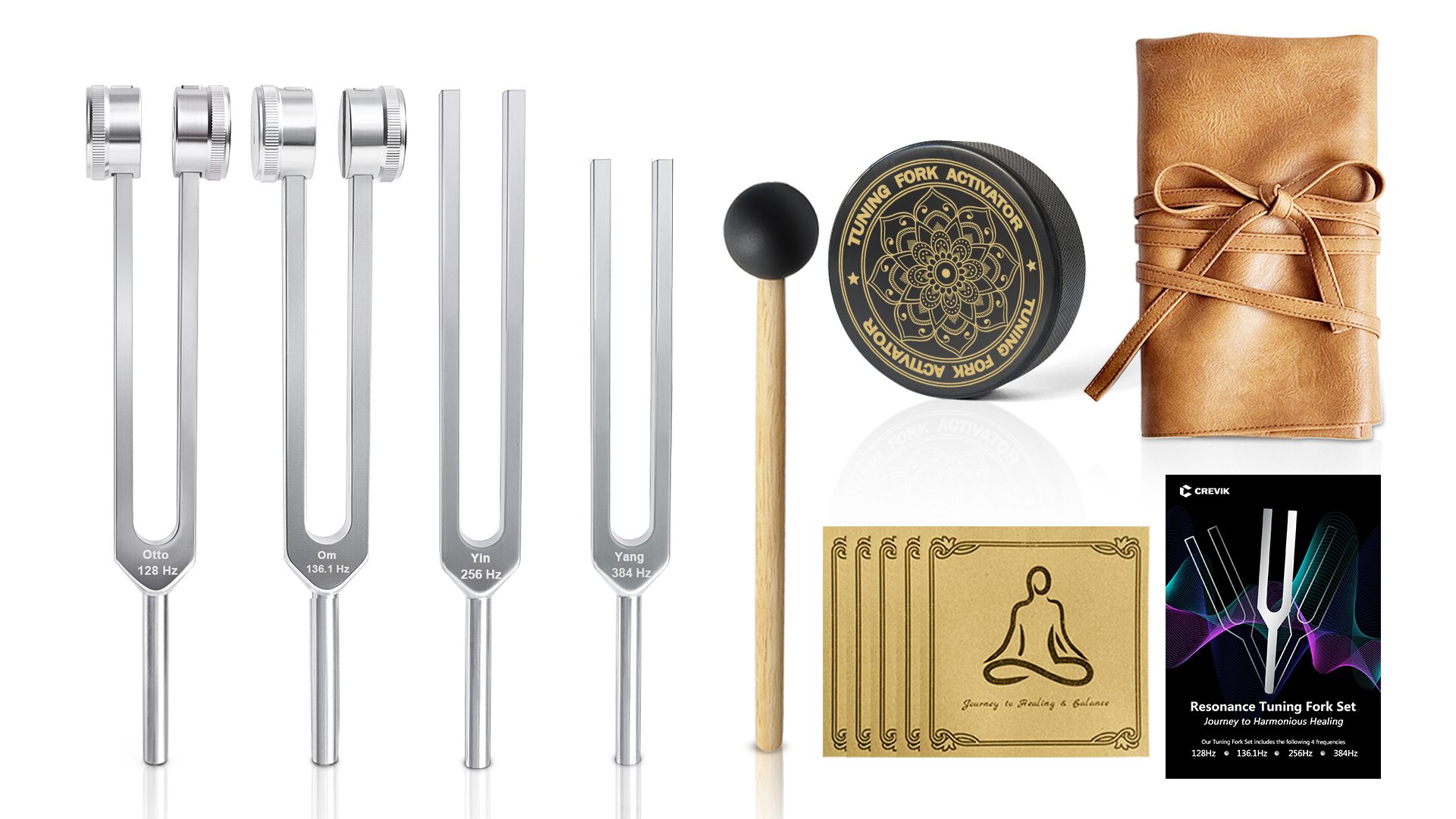
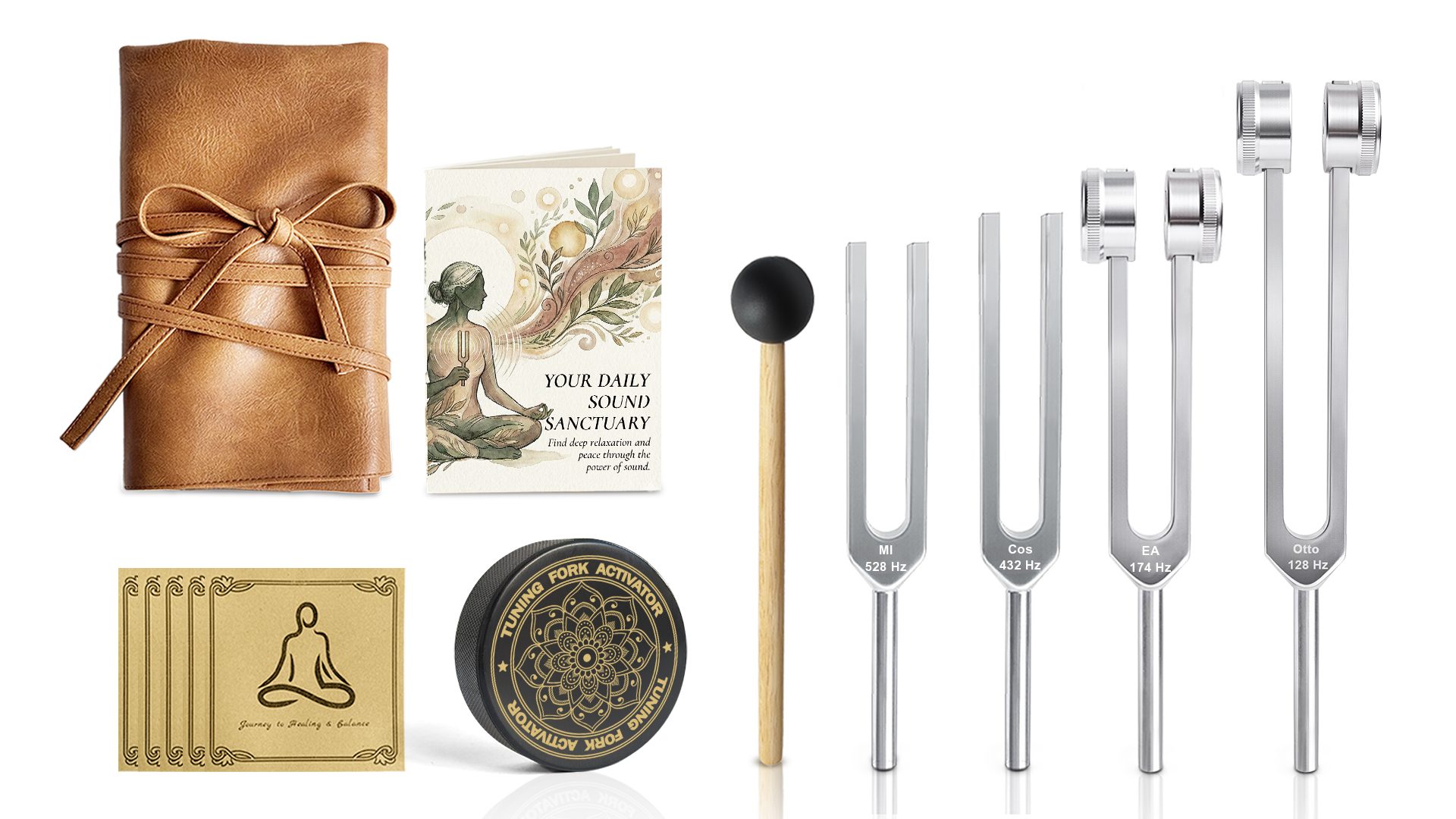
To experience the benefits of the OM frequency, the most direct and effective method is working with a weighted 136.10 Hz tuning fork (often called the Mid-Ohm fork).
The Art of Activation and Placement
- How to Hold: Always hold the tuning fork by its smooth stem (handle). Do not touch the prongs, as this will instantly stop the vibration.
- How to Activate: Strike the flat side of one of the weights against a firm, semi-flexible surface, such as a rubber tuning fork activator, a hockey puck, or the soft side of your knee. Avoid striking it against hard surfaces like metal or wood, which can scratch the fork.
- How to Apply: Once activated, place the round, flat base of the stem firmly against the chosen point on the body. Maintain a gentle, consistent pressure. You will feel a warm, vibrating sensation travel from the stem deep into your tissues. Hold it there until the vibration completely fades.
Foundational Acupoint Protocols (Phonophoresis)
By applying the weighted OM tuning fork to specific acupuncture points, you merge the science of sound healing with the ancient map of energy meridians. Here are four essential protocols for home or professional practice:
Protocol 1: The Grounding Portal — Kidney 1 (Yongquan)
- Location: On the sole of the foot, in the depression formed when the toes are curled slightly. It lies roughly one-third of the way down from the base of the toes.
- Method: Strike the 136.10 Hz fork and place the base of the stem firmly on Kidney 1 of the left foot. Let the vibration fade, reactivate the fork, and apply it to Kidney 1 of the right foot. Repeat three times per foot.
- Therapeutic Benefit: Kidney 1 is the lowest point on the body’s meridian system. It is the literal gateway through which we draw grounding energy from the Earth. Placing the OM fork here pulls overactive mental energy down from a busy head, instantly grounding your awareness and calming acute anxiety.
Protocol 2: The Sea of Qi — Conception Vessel 17 (Shanzhong)
- Location: In the center of the chest, on the sternum, directly level with the nipples.
- Method: Activate the fork and place the stem directly on the center of the bone. Hum along with the tone as you feel the chest cavity resonate. Repeat three times.
- Therapeutic Benefit: In Chinese medicine, CV 17 is the “Sea of Qi” and the master point of the chest. It is also the location of the Heart Chakra. This area often holds physical tension related to emotional grief, anxiety, and heartbreak. Applying the OM frequency here opens the chest, deepens breathing, and releases emotional armor.
Protocol 3: The Gathering of Yin — Spleen 6 (Sanyinjiao)
- Location: On the inside of the lower leg, approximately four finger-widths above the tip of the inner ankle bone, right behind the tibia.
- Method: Activate the fork and place the stem on the point. Apply to the left leg first, then the right. Repeat three times.
- Therapeutic Benefit: Spleen 6 is the junction point where three major Yin meridians (Spleen, Kidney, and Liver) meet. It is one of the most powerful points for nourishing the Yin essence of the body, cooling heat, regulating hormone cycles, and promoting deep, restorative sleep.
Protocol 4: The Spinal Stabilizer — Sacrum and Coccyx
- Location: The flat, triangular bone at the base of your spine (the sacrum) and the tailbone (coccyx).
- Method: Place the base of the stem on the sacrum, right between the dimples of the lower back. Repeat three times.
- Therapeutic Benefit: This placement directly stimulates the parasympathetic nervous system centers in the sacral region. It is highly effective for relieving lower back pain, sciatica, and deep pelvic tension, while inducing a state of systemic calm.
5. The Ohm Octave: Healing through Harmonic Relationships
In advanced sound healing systems like Acutonics and Ohm Therapeutics, the primary therapeutic agent is not a single tone, but the interval created between two tones.
The most fundamental interval used in these practices is the Ohm Octave.
To create this interval, a practitioner strikes two forks simultaneously:
- The Mid-Ohm Fork (136.10 Hz)
- The Low-Ohm Fork (68.05 Hz) — which is exactly one octave lower (136.10 ÷ 2)
When applied to the body together, the 1:2 ratio of the octave creates a powerful energetic polarity.
Why the Octave Works
The octave is the interval of lowest energetic resistance. Because the two frequencies are in a perfect 1:2 mathematical relationship, they do not fight each other; instead, they create a highly organized, resonant wave pattern.
- The Downward-Drawing Effect: The relationship between the Mid and Low Ohm forks creates a downward-drawing energetic sink. It behaves like a vacuum, pulling excess, scattered, or hyperactive energy down towards the lower register.
- Clinical Application: The Ohm Octave is the ultimate pairing for severe insomnia, physical muscle spasms, chronic lower back pain, and deep emotional agitation. By placing the Low-Ohm fork on Kidney 1 (foot) and the Mid-Ohm fork on Kidney 3 (ankle), you create a therapeutic bridge that anchors and integrates the entire body’s energy system.
6. Conclusion: Tuning into the Earth’s Heartbeat
When you strike the 136.10 Hz OM tuning fork, you are doing more than just generating a sound wave. You are introducing a reference point of perfect, natural order to your body.
In a world that demands we move faster, think louder, and react constantly, the OM frequency invites us to do the opposite. It is an invitation to slow down, breathe, and remember that our biological systems are deeply interconnected with the planet we walk upon.
By taking a few moments each day to align with this cosmic rhythm, we step out of the artificial, accelerated tempos of modern life and tune ourselves back into the slow, steady heartbeat of the Earth.
At CREVIK, we calibrate our weighted OM tuning forks to the exact mathematical precision of 136.10 Hz, providing you with a reliable, therapeutic anchor to support your journey back to center. Let the rhythm of the Earth year resonate through your bones, and experience the profound peace of coming home.
References and Further Reading
- Cousto, Hans. The Cosmic Octave: Origin of Harmony. LifeRhythm, 2000. ISBN 0-940795-20-5.
- Carey, Donna, and de Muynck, Marjorie. Acutonics: There’s No Place Like Ohm: Sound Healing, Oriental Medicine, and the Cosmic Octave. Devachan Press, 2002.
- Goldman, Jonathan. Healing Sounds: The Power of Harmonics. Inner Traditions, 2002.
- Lamy, Jean. Phonophorèse: Sound and Meridian Therapy.