
You tap a tuning fork just as a car turns into your street. For a moment, the note is clear. Then the sound of tires on the road fills the room. By the time the car has passed, you’re unsure whether you can still hear the fork.
You can use a tuning fork in an ordinary room, with the sounds of home going on around you. A quieter spot helps if you want to hear the faint end of the note. On a day when the house stays busy, there may still be a minute to sit down, hear the beginning of a tone, and notice how it fits among the sounds already there.
When the Room Covers the Tail of a Note
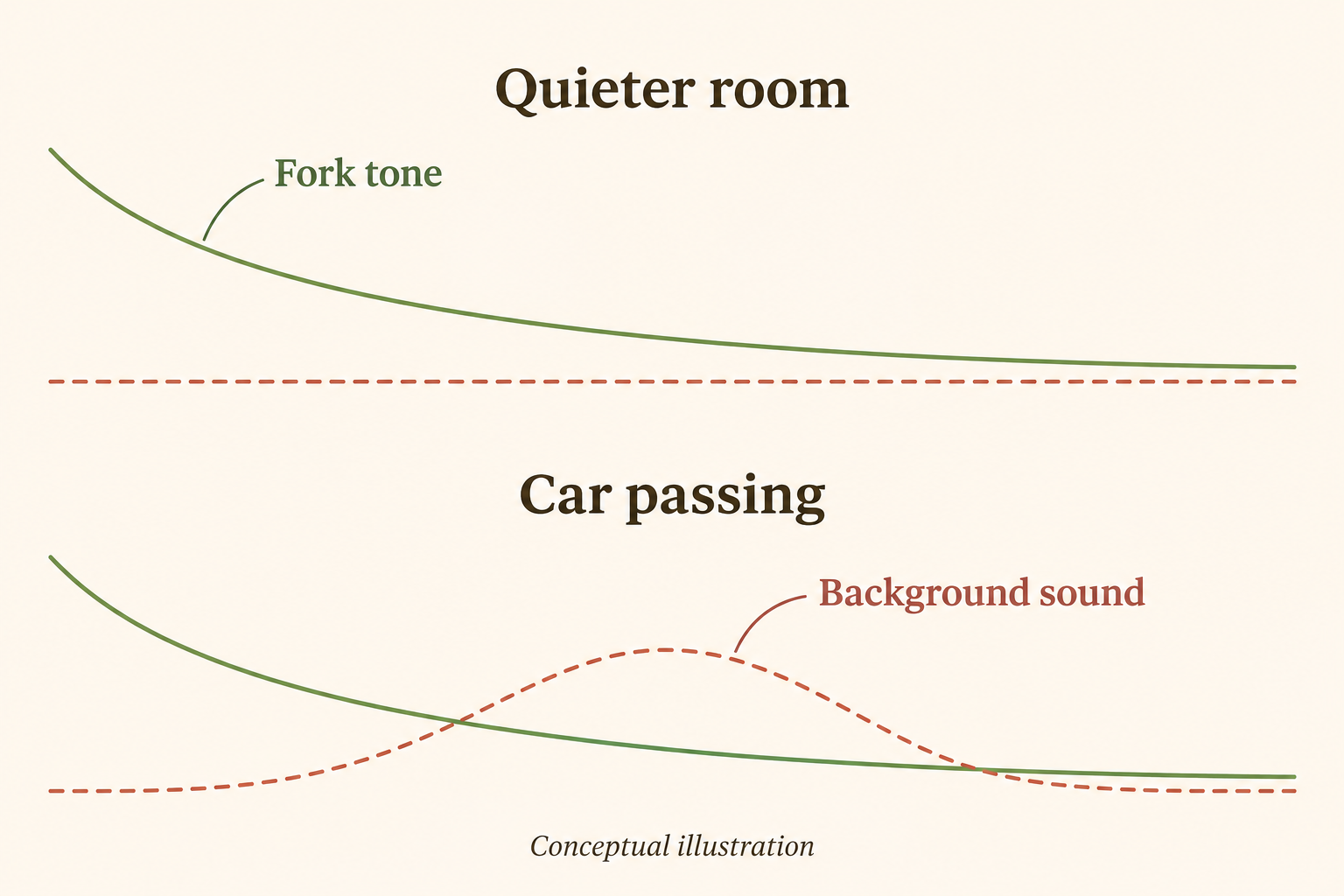
A tuning fork’s note grows softer as the fork vibrates. In a quiet room, you may be able to follow it until it becomes very faint. With a fan running or traffic passing, you may lose track of it sooner. The fork can still be vibrating after the sound has become too hard for you to pick out.
Hearing researchers call this auditory masking. One sound makes another harder to hear. In experiments with pure tones, researchers have found that the parts of a background noise close to the tone’s frequency can be especially effective at covering it. In a living room, the useful thing to notice is that a background sound can make the last part of the note harder to hear, even when the first part came through clearly. The Measurement of Critical Masking Bands
Sometimes what changes is where your attention goes. Someone in the next room says your name, and you find yourself listening for the rest of the sentence. A moment later, you may be able to pick out the fork again. The sound was available to you for at least part of that time, while something else had your attention. A passing car can cover a faint note. A voice can give you something else to listen to. In a busy home, both can happen within a few seconds. Distractor Probability Influences Suppression in Auditory Selective Attention
Change One Thing Before You Tap Again
If there’s a steady sound, try a different seat. The chair beside a fan may be where you usually sit. Try the other side of the room, keeping the fork at the same comfortable distance from you. Use the same light tap and see whether the tail of the note is easier to follow. A small move is often the simplest thing to try.
If the sound comes and goes, listen for a gap. Let the bus pass or the elevator doors close, then sound the fork in the quieter moment that follows. Experiments with tones and fluctuating noise show that changes in the background can affect how easily a tone is detected. At home, you can use a natural lull to see how much of the note you hear. Masked Detection and Discrimination of Tone Sequences
If the room is shared, choose what you want to notice. Someone might be watching a show or catching up with a friend. If you’re curious about the faintest part of the note, you could take your fork to the next room. If you’d rather stay where you are and have a weighted fork, you can gently activate it on its rubber pad and notice the vibration through the handle. That gives your attention somewhere to rest while life in the room carries on.
Try one change at a time. Two gentle taps, from two different seats, can tell you something about where you like to listen.
Try One Tone in the Room You Have
Take about a minute. A familiar unweighted fork and its rubber mallet are enough.
- Hear the room. Sit where you are and notice one sound already present. It might be air moving through a vent, water in the pipes, or footsteps above you.
- Add one tone. Hold the fork by its stem with the tines free. Give one tine a light tap with the rubber mallet and listen at a comfortable distance from your ear.
- Follow it for as long as you can hear it clearly. Notice the moment it becomes difficult to tell the fork apart from the room. If another sound draws your attention, you can listen for the note again.
- Return to the room. Lower your hand and listen for the sound you noticed at the start. It may still be there, or something else may have taken its place.
This exercise borrows from a guided listening practice developed by Guy’s and St Thomas’ NHS Foundation Trust, which invites you to notice sounds inside and outside the room, as well as how your attention responds to them. NHS Mindfulness Exercises
The next car may go by just as the note starts to soften. You might hear only the beginning this time. If you’re curious about the rest of it, wait for the tires to recede and give the fork one more light tap.