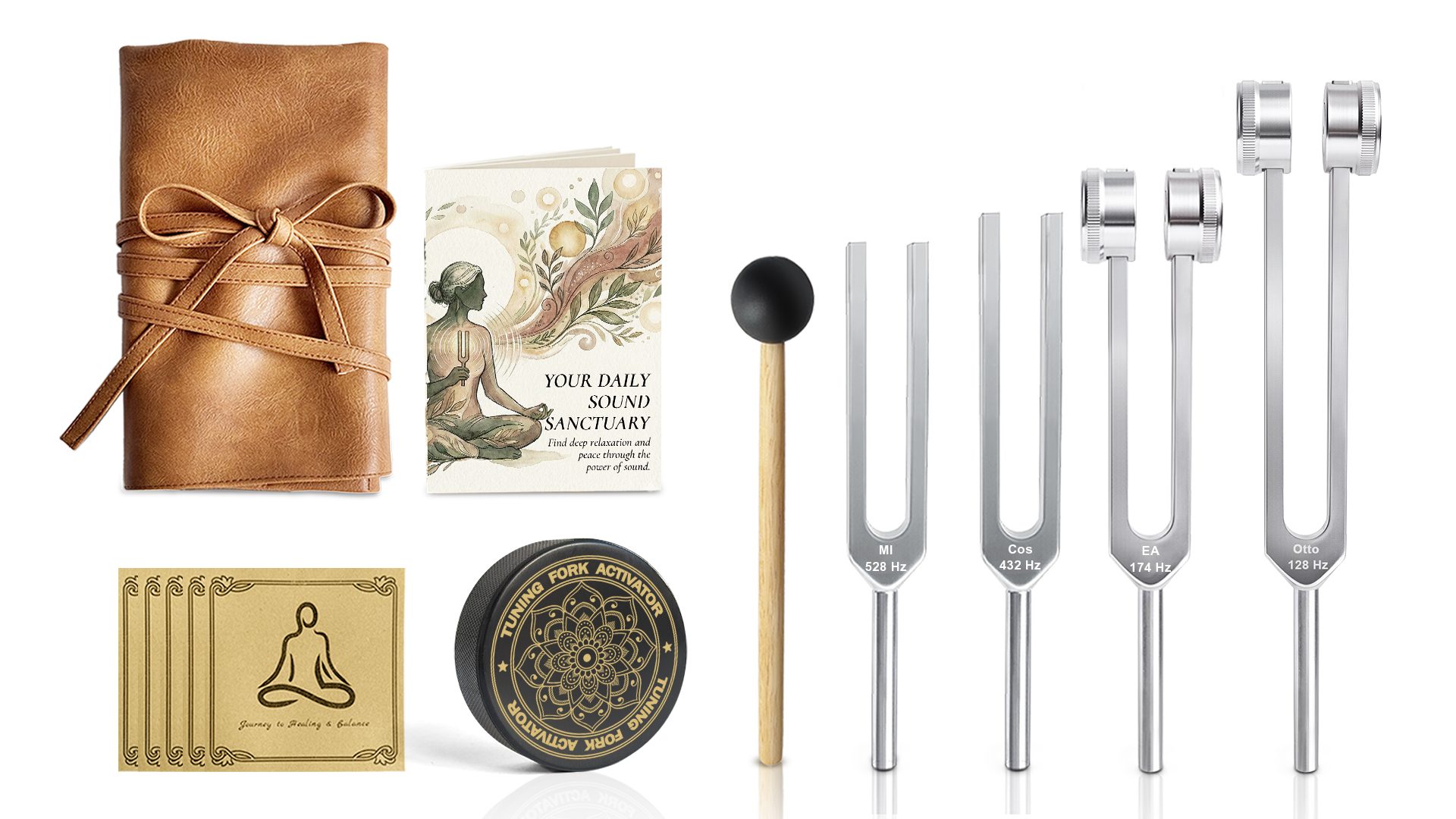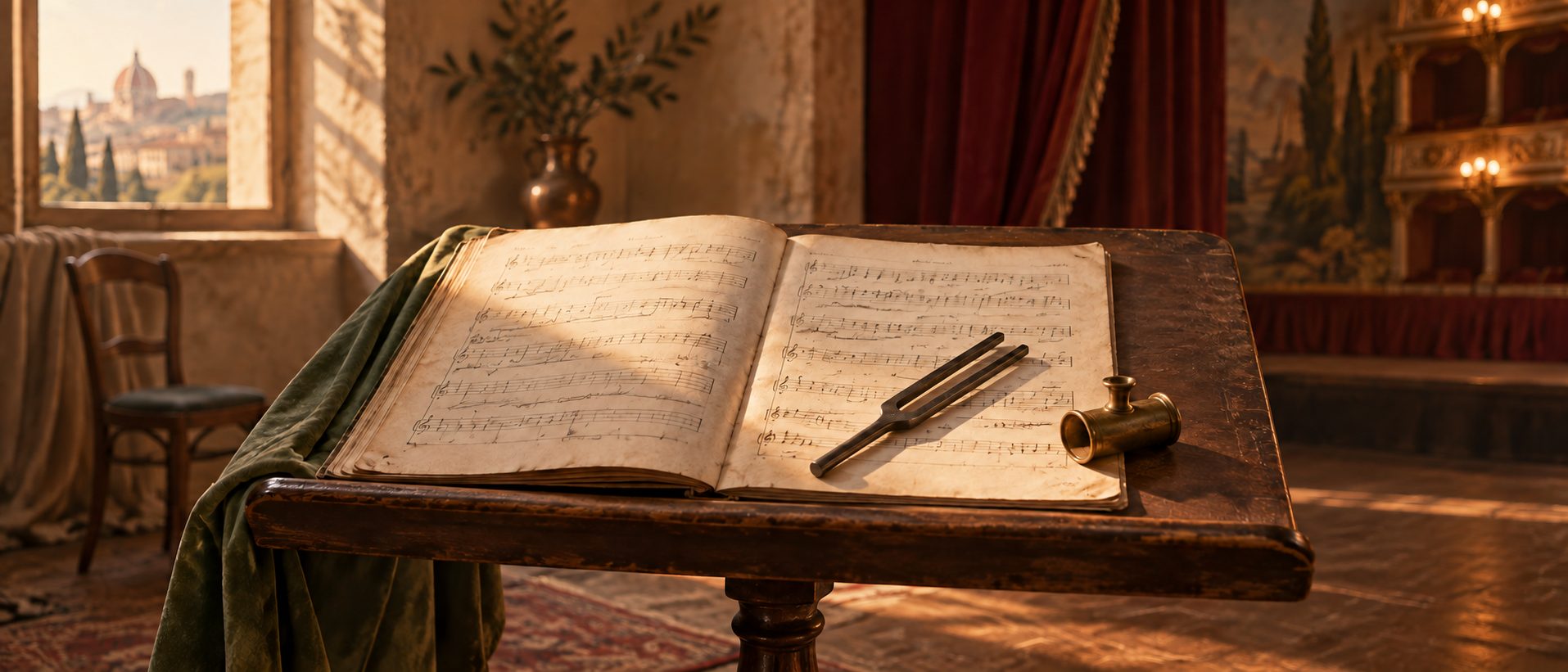
Type “432 Hz” into a search bar and a number begins to carry an extraordinary weight. It is called the frequency of nature, a lost musical standard, a gentler way to tune an instrument, a pattern hidden in the sky. These descriptions belong to several ways of listening at once: musical history, personal experience, symbolic correspondence, and sound-healing practice.
The story of 432 Hz unfolds in several threads. It begins in opera houses where the same written note could sound startlingly different from one city to the next, then follows Giuseppe Verdi’s campaign for a lower shared pitch into the musical ratios that give A432 its enduring appeal. It also leaves room for a quieter, personal question: what do you notice when music is tuned a little lower?
Before 440, “A” Did Not Have One Fixed Height
For much of European music history, a note name described a role in a melody or scale, not one universal number of vibrations per second. An organ, a theatre, a court, or a town could have its own reference pitch. Musicians who stayed in one place could work within that local convention. Musicians and instruments travelling between cities could not rely on it.
By the nineteenth century, the problem was becoming more acute. Historical measurements show both enormous regional variation and a long upward drift in pitch. In parts of Italy, orchestral A often sat above 450 Hz. The reason was never one simple decision—instrument design, local custom, temperature, theatre practice, and musical competition all played a part—but singers felt the consequence in the upper register. A pitch that crept upwards could make established repertoire harder to sing.
France responded with the diapason normal: an 1859 decree fixed A at 435 Hz for state-supported musical institutions. It was a practical effort to make performances, instruments, and teaching agree across a country. It did not end the variation elsewhere, but it gave the debate a number that could travel.
Verdi and the Search for a Gentler Pitch
Giuseppe Verdi became one of the names most closely associated with A432 because he cared deeply about the question of concert pitch.
Verdi was deeply involved in the Italian argument over concert pitch from the late 1860s onward. In a 1871 letter, he supported the French A435 standard. He was concerned that a high tuning fork placed too much strain on singers and that an opera should not change character simply because it moved from Milan to Rome. At the 1881 Congress of Italian Musicians, he sent Arrigo Boito to argue for A432. In 1884, Italy’s War Ministry prescribed A432 for cavalry and infantry military bands.
Today, this part of the story is often gathered under the name “Verdi pitch.” Verdi advocated more than once for a shared pitch below 440, supporting A435 and, later, a slightly lower A432 in different contexts. His central concern was musical and practical: a standard that could serve voices, ensembles, and performances together.
Seen this way, Verdi’s story gives the later 432 tradition a human foundation: breath, tone, and the wish for a voice and an orchestra to meet in a more gracious place.

How C256 Leads to A432
Another part of the story begins more than a century before Verdi. In 1713, French acoustician Joseph Sauveur proposed a fixed C at 256 Hz. The choice later became known as Scientific Pitch or Philosophical Pitch. Its appeal is mathematical: the C octave family is exceptionally easy to calculate.
32 → 64 → 128 → 256 → 512 → 1024
Each step doubles the frequency, which is exactly what an octave does. This numerical clarity has made C256 a lasting reference point in acoustical, musical, and sound-healing conversations.
Where does A432 enter? That depends on the tuning system.
| If C is 256 Hz… | A is… | Why |
|---|---|---|
| In Pythagorean tuning | 432 Hz | Three pure fifths from C produce the ratio 27:16; 256 × 27/16 = 432. |
| In twelve-tone equal temperament | about 430.54 Hz | Equal temperament divides the octave into twelve equal logarithmic steps. |
| In five-limit just intonation | about 426.67 Hz | A pure major sixth can use the ratio 5:3. |
This Pythagorean path is one way C256 and A432 meet. In a modern twelve-tone equal-tempered piece retuned to A4=432 Hz, middle C sits at about 256.87 Hz; five-limit just intonation gives another graceful relationship. The figures change with the tuning map, while the invitation remains the same: listen for the relationships between tones.
These figures show different ways of organizing the distances between notes. Today, A440 is the widely used reference point, which makes it a useful comparison while the story stays with A432.
What Changes When You Retune From 440 to 432?
The difference is modest but real. Setting A4 to 432 Hz rather than 440 Hz shifts the entire tuning down by about 31.8 cents—roughly one third of a semitone, or 1.8 percent in frequency. The 8 Hz shift at A becomes a shared movement across every note in the piece.
Imagine the same piano melody played twice. In the A432 version, every note sits a little lower; some listeners hear less brightness at the top of the sound and more room around sustained chords. On a violin or guitar, tuning down also eases the pull on the strings, which can change the instrument’s response and resonance. A digital track may feel different again, depending on how it was retuned and how loudly it is played. These small differences give the ear something real to notice when moving between 440 and 432.
The comparison offers one distinct version of a piece, and many listeners find that version meaningful in its own way. The listening relationship—between tone, music, place, and person—is where its character becomes clear.
The Symbolic Life of 432
Part of 432 Hz’s appeal comes from patterns that are easy to remember. A rounded precession figure of 25,920 divided by 60 gives 432. The Sun is often described as about 864,000 miles wide, which is 432 × 2,000, and the Moon is about 2,160 miles wide, close to 432 × 5. In frequency culture, these echoes give the number a way to travel from musical pitch toward a sense of cosmic proportion.
Astronomical figures vary with definition and rounding: NASA gives Earth’s axial-precession cycle as about 25,771.5 years, the Sun’s diameter as about 865,000 miles, and the Moon’s mean diameter as 2,159.1 miles. That variation gives these correspondences their most useful place in practice: as contemplative associations rather than a formula one needs to defend. They can widen the imaginative space around a tone.
The same spaciousness belongs to cymatics. Sound and vibration can create striking patterns in sand, on plates, and on liquid surfaces. Each image arises through the particular vessel, material, boundary, thickness, amplitude, and way the sound is introduced. That is part of the fascination: a tone meets a form, and the meeting becomes visible. Cymatics invites us to witness resonance as a relationship, not merely as a number.
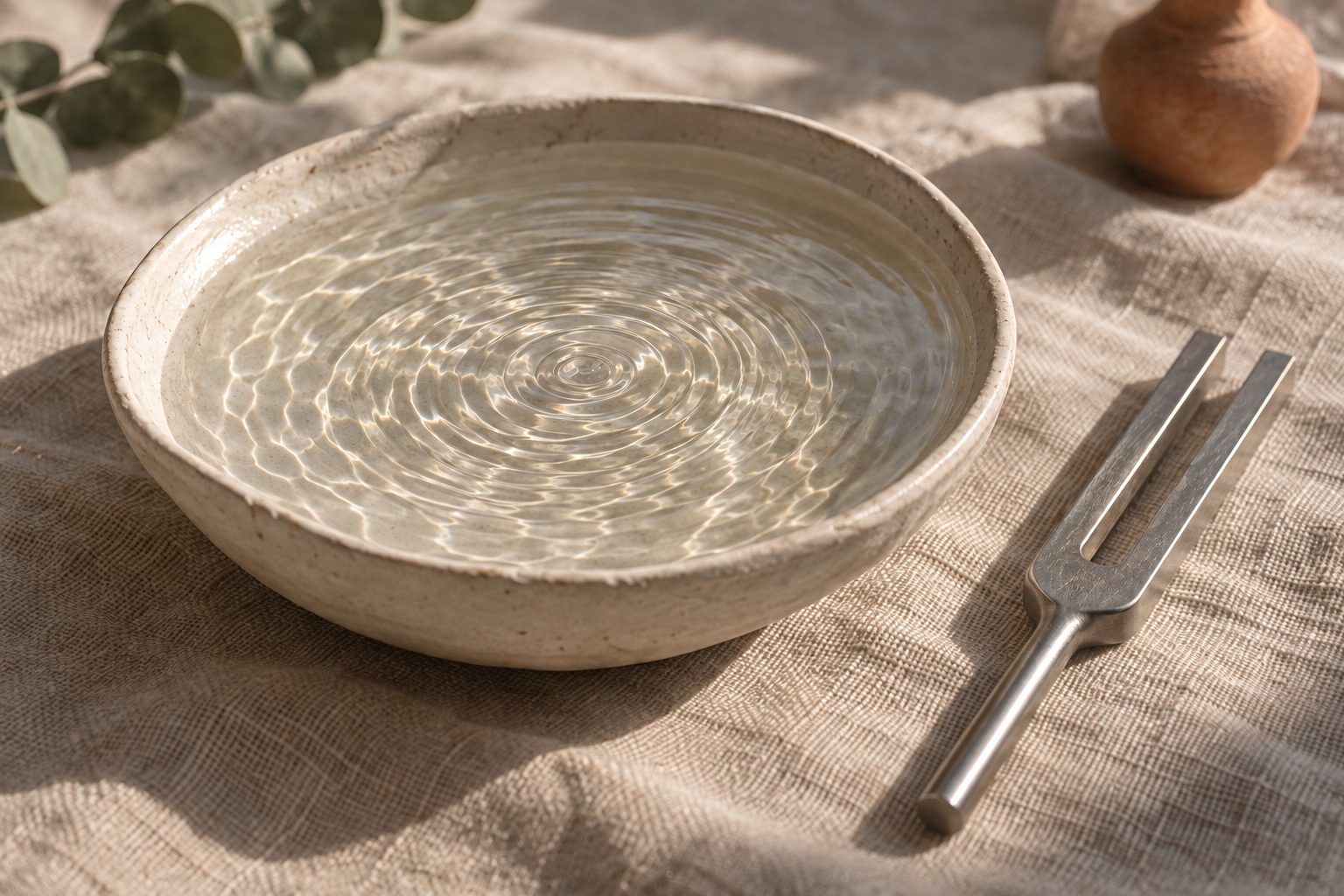
In contemporary frequency culture, 432 often appears beside 174 Hz, 528 Hz, and the symbolic language of 3–6–9. These threads arise from distinct modern traditions, yet they can share a practice space through intention, imagery, and attentive listening. Holding their musical history and symbolic resonance together lets each layer contribute its own kind of meaning.
What Current Research Is Beginning to Explore
There are now a few clinical and laboratory studies exploring how different tunings may be experienced in the body. They bring scientific attention to questions that listeners and practitioners have been holding for much longer.
A 2019 double-blind cross-over pilot study asked 33 volunteers to hear 20-minute versions of the same film-music programme tuned to 432 and 440 Hz. The 432 condition was associated with a 4.79 bpm lower mean heart rate than the 440 condition, and the authors suggested larger randomized studies as a next step.
Other small studies take different routes. A 2019 daytime-nap study found increased Alpha-band energy after 432 Hz music in 15 healthy male participants, using silence as its comparison. In a 2020 randomized dental study of 42 people, both 432 and 440 Hz music reduced reported anxiety compared with no music; the 432 group had lower post-listening cortisol than the other groups. A 2025 randomized cross-over study in 43 cancer patients found that both 432 and 443 Hz body-monochord sessions were associated with improvements in several relaxation-related measures, with a somewhat larger heart-rate reduction after 432.
These studies keep the conversation open. They sit beside the practical knowledge of sound healing, where frequency is approached through duration, sequence, intention, the construction of the instrument, and the listener’s response. A particular tuning can become part of a calming experience in its own way, on its own day.
Listening for Your Own Response
If you are curious about 432 Hz, make time for a simple listening experiment. Choose a familiar instrumental piece available in both 440 and 432 versions. Keep the volume consistent. Listen on different days without checking which version is playing, then write down only what you notice: ease, brightness, tension, attention, memory, or nothing at all.
The point is to become more precise about your own response. A 432 Hz tuning fork can support the same kind of inquiry: let its clear tone decay fully, notice the room become quiet again, and see what remains in your attention.
432 Hz has survived because it gives people more than a number: a history of singers and standards, an elegant web of musical ratios, a symbolic language of correspondence, and a reason to listen with care. Its invitation is simple: hear more closely.
Sources and Further Reading
- Ellen Lockhart, “Tuning Sounds in Italy, 1750–1885,” Nineteenth-Century Music Review (2025).
- John Beaulieu, “Answers to Solfeggio Tuning Fork Questions.”
- Jonathan Goldman, “The Lemurian Tuning Forks, Magic Frequencies, and Sacred Ratios.”
- Calamassi and Pomponi, “Music Tuned to 440 Hz Versus 432 Hz and the Health Effects” (2019).
- Rajagopal et al., “Effect of music of specific frequency upon sleep architecture and electroencephalographic pattern” (2019).
- Aravena et al., “Effect of music at 432 Hz and 440 Hz on dental anxiety and salivary cortisol” (2020).
- Hohneck et al., “Differential effects of sound interventions tuned to 432 Hz or 443 Hz” (2025).
- NASA: Milankovitch cycles and axial precession, Sun facts, and Moon facts.
- Nature: Cymatics and the role of boundary conditions.